


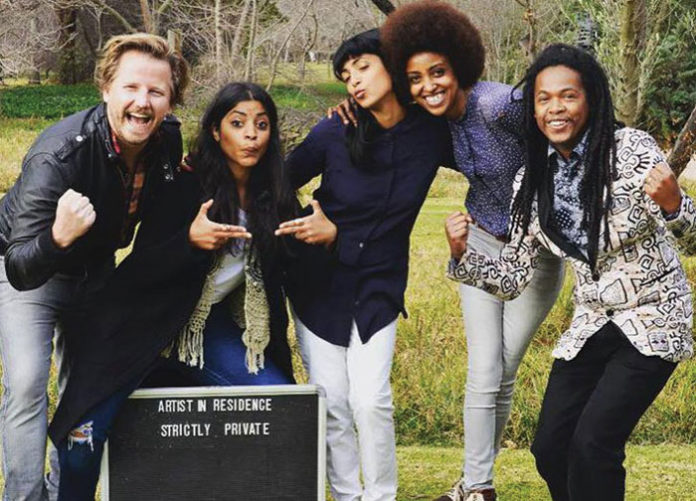
Last December Urucu Media – under the mentorship of Berlinale Talents, in partnership with Nirox Foundation, Durban FilmMart, Restless Talent Management, The French Institute of South Africa and and its Cinemas du Monde initiative, Torino Film Lab, EAVE and World Cinema Fund – announced a call for submissions for REALNESS, a pan-African screenwriter’s residency with an objective to provide Africa’s most promising emerging screenwriters with the time, space and support, both instructive and financial, to cultivate their unique cinematic vision.
Conceptualised by Urucu Media co-founders Elias Ribeiro and John Trengove, the initiative was an answer to the frustration they were feeling regarding the lack of funding avenues for story development in the African film industry.
“Our goal was not only to identify and select the best emerging talent in Africa, but also to grant these filmmakers the access they need in order to take the next steps to getting their film made,’ says Ribeiro.
The residents
After careful evaluation of 175 submitted projects from 29 African countries, the five selected residents (and their projects) were announced in Cannes earlier this year. They are:
Amirah Tajdin from Kenya
Tajdin is an artist and filmmaker whose short films have screened at international festivals including Sundance and Cannes Director’s Fortnight. Her project Hawa Hawaii, a dramatic feature film set in the Swahili community of Mombasa, Kenya, follows a Muslim drag queen wedding singer who uses the dying art of Swahili orchestral music and lyrics to mend a deeply fractured relationship with his mother. “I’ve brought the story closer to home and my heart, setting it in my home country of Kenya and more importantly, Mombasa – an island I have a complicated relationship with owing to its ancestral hold over my heritage and identity that continues to unravel itself to me,’ comments Tajdin. “Hailing from this Swahili background myself, I felt compelled to pen a story set within its sometimes restricting confines yet incredibly rich history.’
Sheetal Magan from South Africa
Magan is an emerging South African filmmaker who was recently named one of five Creatives To Watch by the City Press. Her short film Paraya was one of four short films to open the Directors’ Fortnight in Cannes this year. During the residency, Magan spent her time developing her first feature film The Day and Night of Brahma – a layered portrait of domestic life that follows a modern Indian couple in pursuit of ordinary desires that develop into intricate conflicts. “I have a genuine desire to see on screen questions that are close to my heart envisioned in the language that I think. For me that means seeing the metaphysical as an inseparable part of what is lived, real and experienced through any aspect of our lives. And so while the struggles of Gita and Sanj are personal, I want to look at them in a very specific way, through the language of the soul,’ Magan says.
Hiwot Admasu from Ethiopia
Admasu is a filmmaker who, after graduating in Computer Engineering, took up her passion for filmmaking full-time. Her first professional project was the short film New Eyes which went on to screen at numerous international festivals including Venice and Toronto. Admasu’s project, A Fool God, follows 11-year-old Mesi, who in a moment of tragedy, confronts the limitations of her gender within traditional life, compelling her to leave school and explore new ways of being. “My character Mesi says no to her community, she says no to God. She tells them that they all are fools… Society preaches us its rules as if they are a natural governing law and we are forced to believe them and judge ourselves and others accordingly. For me, gender, race, sexuality, class and religion are the most complex parts of this craziness. Which results the mess our world is in right now,’ comments Admasu.
Wim Steytler from South Africa
Steytler is a writer and director with a degree in Fine Art. His narrative music video about xenophobic attacks in Johannesburg won him the CFP-E/SHOTS Young Director Award at Festival de Cannes. His film Uitlander is a thriller inspired by true events. The film follows the events of a misfit South African farmer who falls into a Doomsday cult after he meets a mysterious new-age French couple following the death of his best friend. “I went to school with the farmer’s son that befriended this eccentric couple, so I had exclusive access to researching the actual events and interviewing everyone impacted by it. The story itself is stranger than fiction, with all the elements for great psychological thriller,’ Steytler says.
Luck Razanajaona from Madagascar
Razanajaona is a filmmaker who has participated in a number of prestigious programmes, including Berlinale and La Fabrique des Cinemas du Monde. His film Disco Africa is about a young Malagasy miner who comes to know his father through a stack of West African Afro Beat 45 records from the 70s. The film is about a country corrupted by money and politics where the youth decided to take control of its future. “I come from a very rich but unfortunately badly governed country. This is pretty near what is happening in some African countries. In the 70s, my country was one of the great countries to build a strong Africa,’ Razanajaona comments. “For me this film is necessary to give some hope to the African people but also an invitation to return to the atmosphere of post-independence Africa of the 70s where the music was very present in people’s lives and where it was good to live.’
The residency
The seven week programme commenced on 16 June with an introductory week at the 2016 Durban FilmMart (DFM). While at DFM, the participants were under the mentorship of Nigerian-British script consultant, Selina Ukwuoma. Along with spending one-on-one time with each participant, Ukwuoma presented master classes and workshops conceived as a meditation on voice, craft, and audience.” The aspects of storytelling that one has to consider during the development process,’ she explains.
Additionally Ukwuoma helmed a workshop titled “How to sell yourself and your story’ and to end off the week at DFM, she moderated the public presentation of the residents’ projects at Talents Durban Story Junction. “I’m always amazed at the growth of workshop participants in environments like these — the incredible leaps they are able to make in such a short time… The residents were engaged and responsive and, as a result, got the most out of the process,’ says Ukwuoma.
After the Durban leg, participants moved into their residency space at the Nirox Foundation where they were mentored by Nadja Dumouchel – a freelance script consultant based in Paris. In addition to her master class on dramaturgy, Dumouchel provided both individual and group sessions guiding the participants based on what each one needed. Resident Sheetal Magan says that Dumouchel’s insight into dramaturgy “is like a propeller that both drives and navigates you through the terrain of your story to uncover hidden gems.’
“All the residents made great progress…’ comments Dumouchel. “For me they represent the future of African cinema, with their different backgrounds, story worlds, rich cultural references and strong minds.’
The next step
The most promising projects to materialise from REALNESS will receive funding to participate in the La Fabrique des Cinemas du Monde in Cannes, EAVE Producers’ Workshop and Torino Film Lab Meetings all in 2017.
Now that the residency has come to an end, the stages of each participant’s project varies, with some still in the early phase of writing, others perfecting their treatment and one already looking for financing to move into the production stage. One thing they all agree on though: the residency provided them with the invaluable time and guidance necessary to give life to their individual projects. Amirah Tajdin says that the reason for this is because the incubator programme is so well thought out – formed from the direct experiences, setbacks and challenges of fellow African filmmakers who are writing the new narratives of Africa. “That in itself is a huge step forward in finally forming solid building blocks for our industry that are homegrown and free of outside agendas of what Africa is supposed to look like,’ she concludes.
By Chanelle Ellaya


