


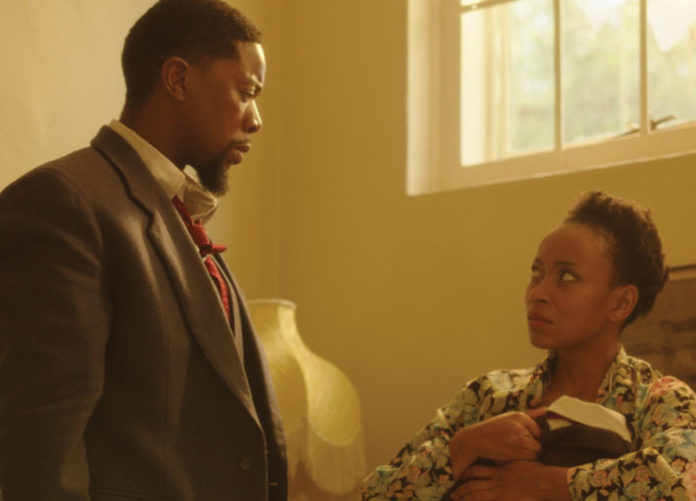
Renowned short story, The Suit, by Drum magazine writer and anti-Apartheid rebel Daniel Canodoce ‘Can’ Themba is finally being adapted for the screen.
Set against the backdrop of the 1950s forced removals in Johannesburg’s Sophiatown under the Group Areas Act, the short story – previously banned by the Apartheid government – went on to become a high school set work in South Africa and was adapted several times into a theatre production, most notably by Barney Simon at the Market Theatre in the 1980s, and more recently by British playwright Peter Brook, whose adaptation has had successful runs around the world including in the West End and on Broadway.
Mandela Films’ Jarryd Coetsee, writer and director of the screen adaptation of The Suit, first read Themba’s short story as a prescribed reading when he was a student at Pretoria Boys’ High School. Despite growing up under the diminishing influence of the Apartheid regime, Coetsee says that he did not fully grasp the immensity of its psychological and emotional impact on an extensive part of the South African population. This all changed the day he read The Suit, which enabled him to “understand this dysfunction on a more profound level,” he says.
Coetsee, who resided in London and Los Angeles over the past few years, experienced certain ‘travesties of justice’ in his time there, such as the eviction of the Travellers at Dale Farm and the shooting of Trayvon Martin, which deeply perturbed him. “The heart-wrenching images of their suffering families and friends left an indelible print in my mind. It occurred to me how little consideration is given to the tremendous personal consequences of such insidiously oppressive and clinical decisions taken at a political level,” he explains. It was these injustices that led Coetsee to turn his attention back to his adaptation of The Suit, which he had been working on for several years already: “I’d been developing a screenplay adaptation of The Suit for several years and realised that now would be a good time to produce the film given its relevance to the current crises.”
The film tells the story of Philemon (Atandwa Kani) who, after hearing of his wife Matilda’s (Phuthi Nakene) infidelity, rushes home to discover her in bed with her lover. Fearful, the lover flees, leaving behind his suit. Philemon uses the forgotten suit to torment Matilda by making her treat it as a guest who must eat with them, go on walks with them and accompany them to church. Philemon’s harsh punishment has tragic consequences as Matilda, unable to live with the humiliation, takes her own life. The story is a powerful metaphor for how oppression has inescapably devastating effects on one’s personal relationships, while also highlighting how not being able to forgive, intolerance and revenge are paradoxically self-destructive.
“Here is a story ostensibly dramatising the disintegration of a marriage in the context of the Apartheid regime’s forced removals in 1950s Sophiatown. However, the author cleverly uses the universal theme of infidelity as a pretext for exploring another universal and perhaps more pressing theme, that oppression has catastrophic consequences for personal relationships,” explains Coetsee.
Produced by Mandela Films’ Luke Sharland, the film was financed by a grant from the National Film and Video Foundation and was shot over just one week in February this year, with almost the entirety of it filmed in original buildings in Sophiatown. Following the forced removals, most of the existing buildings in Sophiatown were demolished, but a few survived, including the Anglican Church of Christ the King in Ray Street, and two buildings on the property of the St Joseph’s Diocesan Centre. “The Anglican Archbishop of Southern Africa and the Bishop of Johannesburg granted the producers permission to shoot at the St Joseph’s Diocesan Centre and the Church of Christ the King,” Coetsee comments. “In period films, one strives for a surface verisimilitude, and the opportunity to shoot in the original buildings offered an unparalleled sense of authenticity, and to some extent, an homage to the original residents.”
Shot by cinematographer Briony Sam Macloed on the Arri Alexa to ensure high visual quality, the film features a stark, controlled look “…with low-key lighting to affect a high contrast,” says Coetsee. To produce a convincing depiction of the 1950s Sophiatown, several filmic techniques were used including the use of a 4:3 aspect ratio, which, according to Coetsee: “Was common in the period, with deliberate symmetry/asymmetry of framing and meticulous mise-en-scène for aesthetic and narrative purposes.”
“We used tobacco and soft FX filters to date the visuals. The costumes, which were supplied by Pierre Vienings are either originals or handmade which greatly heightened the sense of verisimilitude,” he adds.
Coetsee says that he and his team intend to take The Suit to the local and international film festival circuit in March this year. “Though it would be a welcome testament to the talent and skills of the cast and crew if we were to win an award, the primary objective is to share the film with as many people as possible across the world,” he concludes.


