


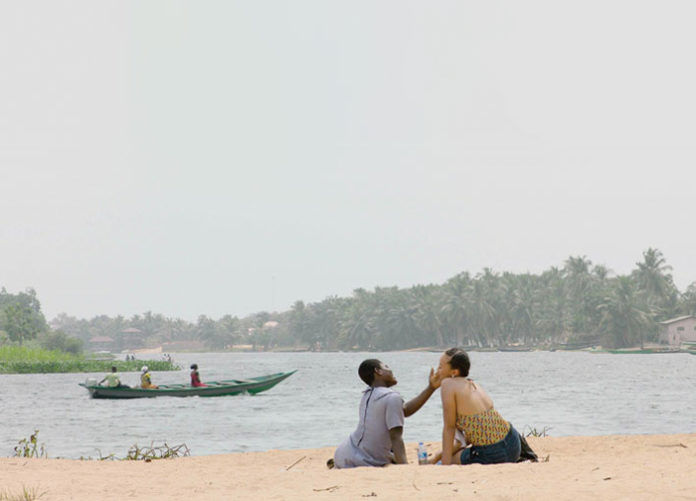
London Film School student Koby Adom travelled back to his motherland Ghana after 18 years to shoot his graduation short film House Girl. The film explores the ill-treatment of domestic workers in West Africa.
Based on a true account, House Girl is a coming-of-age story which follows Jennifer (Emma Naomi), a young British girl of Ghanaian descent, who goes on holiday to Ghana for the first time. While staying with her wealthy aunt Barbara (Edinam Atatsi) in Accra, Jennifer meets Efua (Gloria Amanu), her aunt’s very young domestic worker who is being physically and emotionally abused by Aunty Barbara.
A witness to the violent abuse of Efua, Jennifer struggles to suppress her feelings of anger and frustration toward her aunt and the young domestic’s treatment. Eventually, feeling compelled to put an end to Efua’s maltreatment, Jennifer makes a valiant attempt to rescue her from her abusive situation but in an unlikely twist, she is quickly brought crashing back down to reality.
Written and directed by Adom, the inspiration for the film came from his mother’s personal experiences which she shared with him. “She told me about a time when she witnessed the maltreatment of housemaids in Ghana and the story stuck with me so I wrote a story similar to it exploring the issue while trying not to pass any judgment,” Adom explains.
“I did a lot of research on the matter and found many publications on the matter which caught my eye, all of which indicated that the maltreatment of domestic workers is still an issue in Africa. That gave me the green light to proceed with making this film.”
Shot over four days in mid-February this year, House Girl showcases the exquisite, almost unrealistically picturesque landscape of Accra, Ghana. Told from Jennifer’s point of view, which Adom says was done to allow the audience to learn about Ghanaian and West African culture as Jennifer does, the film acts as a powerful vehicle for social commentary on cultural restrictions in the African diaspora, modern day slavery and child abuse. “The style of this film is very point of view driven,” Adom comments, “The story is told through the eyes of Jennifer, a girl who has never been to Ghana before, and the camera follows her journey. She is learning new things about Ghana and her aunt’s house at the same time as the audience which is an extremely powerful thing.”
DOP Mark Kuczewski along with Adom opted for very high contrast but soft lighting, utilising the luxury of the constant natural lighting from the sun in Ghana. “The high contrast is to dramatise the film more because of the nature of the story,” explains Adom. “Also Marco Turcich, the production designer, joined the conversation when we discussed colour schemes. During day scenes we have a very warm feel with colours like orange, brown, cream featuring but at night time it is very cool with blues and blacks starting to appear.”
Kuczewski used the new Arri Alexa Mini to shoot the film, which Adom says was selected because the output it provides is the closest to 35mm film: “The texture of 35mm would suit the kind of film we are making. Furthermore, we chose the Alexa Mini because it is more practical… we are shooting in a country that the majority of the crew had never visited before so we needed a camera compact enough to give us plenty of options while shooting.”
Adom and Kuczewski matched the Arri Alexa Mini with Cooke lenses because they complimented the soft lighting approach chosen for the film. “The other lenses we considered were the Karl Zeiss super speeds however those lenses would have been too defined for the look and feel of the film we were going for,” Adom comments.
House Girl is a London Film School (LFS) graduation project, produced by Joy Gharoro Akpojotor. Adom explains that LFS kick-started the funding of the project with just over £4 000. To raise enough funds to achieve the production value for the film that Adom and Akpojotor had envisioned, they ran a Kickstarter campaign. “We had a successful crowd funding campaign on Kickstarter which gave us just over £9 000 after all the Kickstarter charges and private investment from the executive producers as well as myself to top up the funding,” says Adom.
House Girl aims to shed light on the many cultural and social issues inherent in west Africa, but Adom says the message that he hopes audiences will take away from the film is to never ignorantly attempt to impose one’s way of life elsewhere. “Secondly,” he says, “abuse is wrong full stop, let alone when young domestic workers are the victims. I want this film to shine some light on the matter so the people of Africa can sit up and take action on such occurrences.”


