


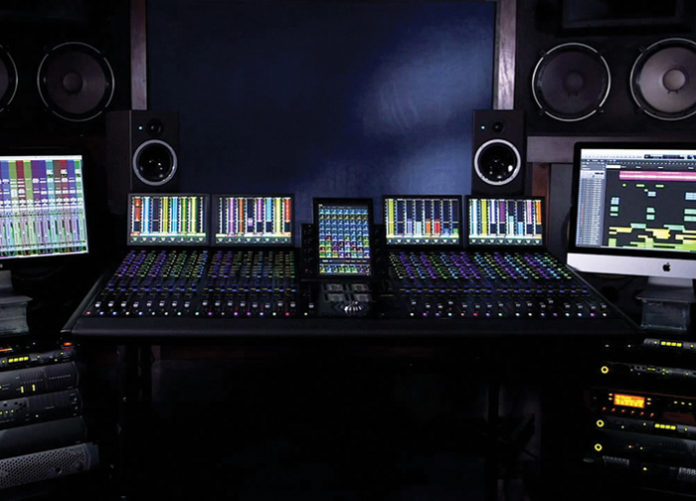
Whether editing audio, recording bands, composing soundtracks, or mixing 50 tracks of an episodic television series, the audio professional has a wide range of digital tools at her/his disposal.
Yet, with the vast number of Digital Audio Workstations (DAW) available, one needs to choose the proper fit to be the most efficient and creative as possible. While each DAW consists of fairly similar features and functions, there are many varying opinions on which DAW is the ’best‘ and it tends to be a fairly subjective choice.
Commercial digital recording was pioneered in Japan by NHK and Nippon Columbia, under the brand name Denon, way back in the 1960s. In 1971 the BBC developed a two-track digital recorder and a few years later 3M released their digital multitrack recorder which was based on the BBC’s technology.
The 1980s saw rapid technology advances with the development of the Compact Disc (CD) and the first hard drive recorder and the release of Digidesign’s Sound Tools and Sound Designer. It wasn’t until the ‘90s that the first workstations saw the light of day. At this time, all DAWs were Apple Mac based (eg. Pro Tools, Studer Dyaxis, Sonic Solutions).
Around 1992, the first Windows based DAWs started to emerge from companies such as IQS Innovative Quality Software (SAWStudio), Soundscape Digital Technology, SADiE, Echo Digital Audio and Spectral Synthesis. All the systems at this point used dedicated hardware for their audio processing.
The 2000s saw technology leap forward and computing power allowed the development of ‘software only’ DAWs and sessions that could only previously be mixed in a studio environment, could now be knocked out in garages and homes.
Globally, there are two ‘standard’ DAWs in the film and television post-production industries that keep topping the list of ‘the top 10 best’. Avid Pro Tools and Steinberg Nuendo have enjoyed the market share for many a year, but that’s not to say that there are not any others to compete with. Some DAWs have a leaning to the post environment and some toward music creation and publishing and some a good blend of the two.
Whichever way, most DAWs can all do similar things and it is most often found that ‘final mix’ environments encompass audio editing as well as music production because the two fit so closely together. The DAWs mentioned here are more diverse samplings of what is available as opposed to a review-based ‘Top 10’. While a post-production environment may require certain hardware devices to operate, we are only looking at the software behind DAW’s features.
Avid Pro Tools is virtually a household name, it is often referred to as the ‘biro’ of the professional recording world and over the years has become something of an industry standard.
With v12 recently released perhaps the most exciting feature is the new set of Cloud Collaboration tools. These tools enable artists to compose, record, edit and mix sessions working with other Pro Tools users in the cloud, as if they are all together in the same studio. They simply invite other artists to collaborate on a session using built-in text/video chat, or find new collaborators through the new Avid Marketplace Artist Community. If the person they want to work with doesn’t already have Pro Tools, then they can simply download the new free Pro Tools | First to start working together immediately.
Avid has also realised that the subscription model for software does work and offers several options as well as a perpetual licence.
Steinberg Nuendo has a familiar design and basic workflow to anyone who uses Cubase and is designed primarily as a tool for post-production audio for picture: sound design, dialogue and mixing for movies and TV. Pro Tools had this market completely sown up a few years ago (some would argue it still does), but Nuendo is one of the only alternatives to have made much of an impact – many top post-production studios and technicians now base their core systems around Nuendo instead. Why? Simply that it’s at least as good as the ‘industry standard’. Nuendo 7 covers every aspect of audio-to-picture work, be it in game audio, TV or film post-production. Functions include direct connection to the Audiokinetic Wise middleware, in-built reconforming solution for audio-to-picture alignment, VCA fader support, advanced project collaboration tools, as well as rendering options for handling large amounts of audio files.
The software also comes with an updated user interface offering improved window handling and a customisable workspace for an intuitive workflow. Additional effect plug-ins and an enhanced overall programme performance round out the feature set.
Adobe Audition – With Audition CS6, Adobe busied itself adding back features that were available to Windows users in Audition 3. The result was a very fine audio editor aimed at sound designers, radio producers, audio and video editors and podcasters. Now with Audition CC 2015, Adobe has largely finished feature restoration and instead focuses on adding new audio restoration and manipulation tools, and tweaking the interface to make the application easier to use. It’s now a better audio editor; however, its target audience may look at alternatives solely because of Adobe’s subscription-only model.
Ableton Live – First appearing in 2001 but really becoming a contender as a serious production solution in the competitive audio software market in the past seven or eight years, Live revolutionised our conception of what we could consider a DAW to be. Blurring the line between studio production tool and live/DJ performance tool, it has caught the more-established DAW manufacturers on the hop – in recent years they’ve mostly caught up again, introducing their own versions of many of Live’s best-loved features, including fast, auto-time-stretching and arrangement workflows that mean we can finally make whole tracks on the fly by jamming with elements in real time. First time users may get frustrated with the layout but once you get the hang of it Ableton Live competes quite nicely with Pro Tools and Nuendo.
Bitwig Studio – The new(ish) kid on the block, Bitwig Studio’s arrival has been causing quite a stir – it’s not often that a completely new DAW enters the fray. Bitwig seems to be a logical progression from the leaps made by Live over the past few years – indeed; it was created by former Ableton developers. While not sharing any actual code DNA with Live, the layout features integrated Clip and Arrange windows that hint at an effort to bridge between Live’s innovative functionality and more traditional sequencing. Try it – you might be surprised!
Image-Line FL Studio – A firm favourite among aspiring electronic producers, FL Studio has developed hugely from fairly humble origins (the step sequencing Fruity Loops) into a fantastic, fully-featured DAW. Version 11 saw huge interface improvements and a host of new plug-in effects and instruments (Image-Line’s stand-alone plug-ins are always worth checking out). More geared towards the music producer FL Studio has great potential for the novice wanting to enhance their production work for a reasonable price.
Apple Logic Pro X – Another of the longest-serving DAWs available, Logic has been developed beyond recognition from its pure MIDI roots. With X, Logic finally underwent some overdue cosmetic and functionality overhaul, consolidating what it has always been good at and adding a ton of new plug-ins, MIDI effects and feature enhancements. A natural step-up from Garageband for developing producers, but also so much more than that – a truly professional solution with great features for in-house final mix production work.
Steinberg Cubase – Another of the original DAWs, Cubase has been many a muso’s tool as an introduction to music production. Like Logic Pro, it’s done a good job of keeping up with the younger competitors, and has more than a few genuine innovations lurking among its huge feature set. Cubase Pro 8 provides many features to get excited about. Steinberg didn’t give this recording studio software a total facelift – instead it improved upon an already upstanding programme. Steinberg added the necessary pieces to create a better workflow and to help you save time processing your audio so you can stay in the mind-set of producing, recording and mixing.
Sonar Platinum – is a totally revamped version of the previously popular Cakewalk DAW. Its new layout and clean and organised design is an impressive feature and that whether you are working on a single-monitor laptop or a dual-monitor setup, all of the work windows – mixer, file browser and pro-channel – can float or be docked. Sonar is also compatible with a number of different plug-in formats including VST3, VSTI and DXi formats, which means you can expand your plug-in library without running into compatibility issues. The Sonar redesign and interface make this programme ultra-usable and desirable. It is a shame that this programme is only available on PC platforms; otherwise this programme would be ever more sought after. Sonar Platinum is also available on a monthly or an annual basis, much like Adobe Audition Creative Cloud. If you pay for a year of Sonar, you will receive updates and downloads for the year. Don’t mistake this for a subscription – subscriptions run out. If you pay in full and don’t want to renew your yearly payment, you will still have access to Sonar, it just won’t update.
Propellerhead – Reason users are fairly evangelical about their chosen DAW: after all, it does everything, and in a fun and stylish way. Reason 8 has made some great improvements from previous versions of the software – lack of third-party plug-in support and inability to record audio – have now been resolved, making it basically impossible to find significant fault with Reason at all. An entire virtual studio (it even includes the virtual patch cables for hooking everything together) in a single software package: very enticing. It has great virtual instruments and a large loop library, but the plug-ins are only expandable through the Propellerhead rack extension format. Reason is unique among DAWs in look and feel, but this software makes it well worth stepping outside the box.
Conclusion
The sound purists will argue with me and say there are only two proper final mix DAWs available – in fact most will say only one is a true final mix tool. Software and hardware development have created fierce competition in this environment and it all comes down, not to what can be done but how it can be done. A US$99 piece of software has all the potential to compete with a US$20 000 audio suite; it just depends on how it is used and by whom.


