Home Authors Posts by Canon Press

Canon Press

30 POSTS 0 JOBS
Canon Inc. is a Japanese multinational corporation specializing in the manufacture of imaging and optical products, including cameras, camcorders, photocopiers, steppers, computer printers and medical equipment.

Meet the Editor: Haiko Boldt

Haiko Boldt is a freelance video editor and graphic designer currently living in Namibia, who worked as editor and cinematographer on #LANDoftheBRAVEfilm. He has received a Namibian Film Award for his editing work and is the owner of Thunderboldt Design & Post Production.

#LANDoftheBRAVEfilm, produced in Nambia, traces the journey of policewoman Meisie Willemse: a tough cop with an illustrious career, who hides a dodgy past. As she solves one the biggest cases of her career, she is forced to face herself; the closer she gets to catching the killer, the more the dark secrets of her past are revealed, ultimately derailing her life.

Screen Africa chatted to Haiko about the interesting story, the equipment used to capture the epic Namibian landscapes and the need to “kill your darlings” in the editing room…

How did you first become involved in working on the film?

My involvement came about through the director, Tim Huebschle, and producer David Benade. We had worked together on short films and various other projects over the years. I was given the opportunity to read one of the early drafts of the script and I enjoyed the story immensely. It is a local story, which I hoped would turn into a local production and would give me the chance to stretch my creative muscles as an editor. Initially, my involvement was only meant to be editor of the film, but during the pre-production phase Tim and David approached me and asked if I would also like do the cinematography for the film, as well. This was an amazing opportunity and daunting, as well, but of course I accepted.

The teasers all look amazing – especially the wide-angle shots. What cameras and lens set-ups were used on the film?

The early teasers were filmed on a Canon 60D with the 18-135mm kit lens. Some of the aerials were done with the Phantom 2 and later with the DJI Inspire One. For principal photography, we used the Sony A7s II with a Metabones adaptor and Canon lenses (EF 16-35mm, EF 24-105mm and the EF 100-400mm), as well as a Sigma Macro lens. We recorded onto the Blackmagic Design 4K Video Assist from the Sony A7s II HDMI out to be able to capture in 4K (UHD) and Apple ProRes HQ 422.

The director’s monitor on set was an identical 4K Video Assist. In the beginning of the production, the director’s monitor would get its feed via SDI cable. We did have a wireless video transmission option but could not use it because it only worked with HD and we were shooting in UHD. A bit into the production, however, I found a new solution after the launch of a few products from Blackmagic Design. Among these was the Mini Converter SDI to HDMI 4K. This was used to down-convert the UHD to HD and to connect the wireless video transmitter. Luckily, the device is small and compact and did not add too much weight to the camera rig. The whole setup was powered from a V-Mount battery plate system via 12V and D-Tap cables to the devices. Aerials were filmed with the DJI Inspire One and the DJI Ronin MX gimbal was used for the motion shots.

Can you talk us through your choice to complete full picture post in Resolve? What advantages did this bring?

Working on other projects, we had gotten into a bit of a workflow issue between FCP X and the export and import of the audio through third-party software for audio post.

I always assumed that the colour grade was going to happen in DaVinci Resolve, which led us to decide to choose Resolve for editing as well. Because of the free version, we could install DaVinci Resolve, give it a try and see if it would be the right fit. The advantages were clearly the fact that the entire workflow happens within one ecosystem. It is so easy to switch from edit to audio to colour workflow with a click of the mouse. This became evident when, during the rough cut of the film, the sound designer would come in over the weekends and clean up the audio for the past week’s rough cut. This meant that by the time we had a first full rough cut, we had clean audio, too.

Recording on the 4K video assist in ProRes HQ, which is optimised for DaVinci Resolve, also meant no transcoding. It was liberating, as we edited in full resolution – and so what we saw on screen was what we would get out, and it didn’t slow down the computer.

What was your Resolve setup, including panels, hardware, monitoring and more?

The studio setup consisted of an entry-level iMac Pro running DaVinci Resolve and a 16TB G-Tech Raid Drive for the media. Connected to this was a 4K Ultra Studio. We opted for a BenQ SW271 monitor and the Blackmagic Design Micro Panel for the colour grading. During editing, the audio was taken out of the 4K studio and sent into a small mixer and out to two Yamaha speakers. We also had a big screen TV for viewing in studio.

Can you describe the brief for the edit? What were you trying to achieve with it?

The brief was to forget what I had seen on location, and craft the edit from the footage that was there. The director and I started to make editing decisions as early on as the storyboarding stage. The edit was quite predetermined in a way, as we had created an extensive storyboard with more than 700 boards. We spent about five weeks on it and had already made decisions on shot sizes and angles, and had specified the shots we would use for specific parts of the dialogue. This helped us immensely on set, but also set the tone for the edit.

The story is really interesting – and the female lead, too. Did you face challenges in telling her story through your work?

‘To kill your darlings’, like the director said, was and is probably always a challenge. We all loved some shots for whatever reason, but for the greater good of the story, some of them didn’t fit or just felt a bit ‘out.’ Letting go of shots like these can only make the film better.

Do you have a favourite scene or sequence? Can you tell us why, and give us an insight into the workflow behind creating it?

In #LANDoftheBRAVEfilm, my favourites are the shots that involved small edit decisions. Omitting certain parts of the story, or even just seconds of footage – small decisions that ultimately strengthened the film. Always remember that sometimes the things you don’t say also have an impact. For a specific example, I really like one of the city skyline shots. We kept the bottom of the shot at normal speed and sped up the top part to get some movement into the clouds, to create the effect that time was passing.

 

Canon launches an iconic new lens – the RF 85mm F1.2L USM

Canon Europe, a world leader in lens manufacturing, builds on its ongoing commitment to photographers, with the launch of the latest generation of Canon’s iconic 85mm f/1.2L lens, the RF 85mm F1.2L USM. Offering the highest resolution of a Canon lens launched to date, it features a super-fast aperture and outstanding AF speeds, making it ideal for capturing candid portraiture and wedding photography.

Following Canon’s lens development announcement in February, the RF 85mm F1.2L USM is the first of six RF mount lenses being introduced by Canon in 2019. This lens, endorsed by award-winning Canon Europe Ambassador Félicia Sisco, will take users of the legendary EF 85mm f/1.2L II USM to the next level of performance. All six RF lenses will offer incredible quality and versatility for those looking to get the perfect shot.

Impressive resolution for every detail

Designed for the EOS R System, the RF mount redefines the possibilities of photography and videography, providing the tools for users to enhance their skills and shoot creatively without limitations. Developed in line with technological advancements and end user feedback, the RF 85mm F1.2L USM uses the RF mount’s advanced possibilities to enhance image quality and communication between the lens and the full-frame mirrorless camera body.

The 85mm short telephoto lens provides the ideal focal length for portraits and a flattering perspective for faces. The RF 85mm F1.2L USM is only the second lens in Canon’s line-up, after the EF 35mm f/1.4L II USM, to use Canon’s unique BR optic technology, which effectively corrects axial chromatic aberration that is not completely correctable with a combination of traditional glass lenses – improving resolution and sharpness. Ensuring incredibly high image quality for every shot, the aspherical and UD lens elements reduce lens aberrations enabling stunning optical performance.

High-speed, high-quality

The RF 85MM F1.2L USM is one of Canon’s fastest aperture autofocus lenses for its full-frame mirrorless range of cameras.

When coupled with the short telephoto length and Dual Pixel CMOS AF, the fast f/1.2 aperture creates stunning shallow depth of field, bokeh and background separation. The lens aperture makes the subject leap from the image, whilst the nine-aperture blade system enhances the subject against the smoothly blurred background, ideal for portraiture photography. The ultra-wide aperture transmits 50 per cent more light than a f/1.4 lens for shooting in challenging, lighting conditions – down to -6EV (EOS R) and -5EV (EOS RP) – capturing the atmosphere in every moment.

Using the same ring type USM motor as the RF 50mm F1.2L USM, the RF 85mm F1.2L USM ensures sharp focus is found swiftly and accurately, allowing objects to be tracked as they move around the frame. Coupled with a new microprocessor, which uses a new high-performance CPU and firmware, the lens utilises the EOS R system increasing data transfer, resulting in faster operation and AF, allowing the photographer to capture split-second moments.

Exceptional handling and durability

Incorporated in Canon’s RF lenses is a control ring – where settings are programmable to TV, AV, ISO and exposure setting – adds a layer of customisation, making it ideal for wedding photographers who need ranging settings for both perfect candid moments and beautifully modelled shots. The lens is also equipped with a full-time manual focus ring, which allows manual focusing by turning the focusing ring, without the need to switch to MF mode. Ideal for shooting outdoors, or on location, the RF 85mm F1.2L USM features the iconic L-series weatherproofing, sealing the lens to protect against adverse weather conditions when shooting outdoors or on location.

Award-winning wedding photographer and Canon Ambassador, Félicia Sisco commented, “As a wedding – and portrait – photographer, I need to be able to trust my tools so that I can focus on the subject and tell their story. I have been using Canon’s iconic 85mm 1.2 lens for over 20 years because of its speed and wide-aperture which guarantees beautiful images, even in low light.

“The new RF 85mm F1.2L USM is better than I could have imagined. This lens produces a depth of field and bokeh that is impossible to achieve with other lenses and I already know it will become a staple in my kitbag. It separates the subject from the background and delivers a sharp focus on the subject’s eyes which is simply breath-taking, capturing every special moment.”

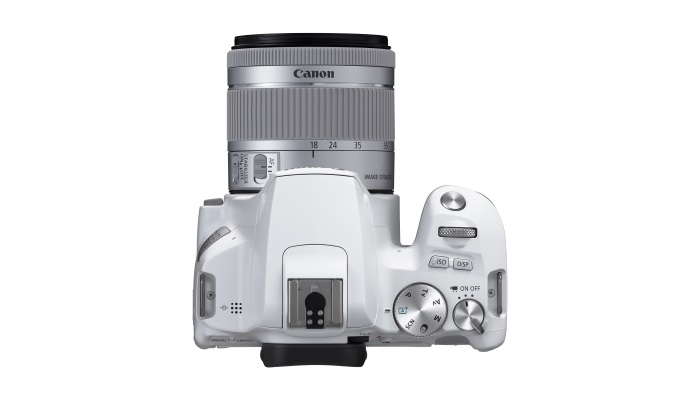
The Canon EOS 250D is the world’s lightest DSLR with a moveable screen

Canon Europe recently announced the launch of the Canon EOS 250D, the world’s lightest DSLR camera with a moveable screen[1].

Successor to Canon’s multi-award winning EOS 200D, the EOS 250D has a guided user interface for easy operation, a large 24.1 Megapixel Dual Pixel CMOS APS-C sensor, 4K movie capability, super-fast and responsive autofocus, and excellent connectivity to smart devices. In addition, the camera features DIGIC 8, Canon’s latest image processor which powers many of its functions, including 4K movie recording, 4K time-lapse and 4K frame grabs from 4K movies.

Straightforward handling in a lightweight and compact body, the EOS 250D enables the whole family to enjoy capturing life’s experiences, whenever, wherever. The guided user interface makes this effortless from the moment the camera is switched on, with on-screen hints and tips to ensure everyone is getting the most out of the camera. It is also easy for users to capture their experiences in imaginative ways with Canon’s Creative Assist feature, a suite of effects, filters and colour adjustment tools to apply to photographs when composing an image or after it has been taken.

Canon’s DIGIC 8 image processor supports a variety of improvements in Live View autofocus precision and Eye AF, Auto Lighting Optimizer, Digital Lens Optimizer and Highlight Tone Priority for sharp high-resolution images ready to share straight from the camera. The 24.1 Megapixel sensor performs well in low-light and facilitates a shallow depth of field, adding beautiful background bokeh to treasured family portraits. The camera’s cutting-edge technology combined with its ease of use, makes the EOS 250D the perfect DSLR for those wanting to capture precious family moments so they can be enjoyed for generations to come.

The EOS 250D is a camera for every occasion. Its intuitive Vari-Angle touchscreen enables comfortable shooting from a variety of angles, making family selfies a joy or recording a vlog effortless. Canon’s Dual Pixel CMOS AF technology will also keep family and friends in sharp focus when shooting stills and video via the touchscreen. Delivering a classic shooting experience, the EOS 250D features an optical viewfinder with a  responsive 9-point AF, so moments can be framed clearly and as they were seen with the naked eye.

When images and videos are ready to be shared, the EOS 250D integrates effortlessly with smart devices[2] via Bluetooth®[3] and Wi-Fi using the free Canon Camera Connect app for iOS and Android. From here, images and videos can be downloaded to a smart device, reviewed and posted on social media or shared with friends and family.

The Canon Camera Connect app also facilitates shooting remotely from a smart device, perfect for capturing family group shots or a hands-free selfie. Images can then be sent to a paired smart device as soon as they are taken via the Automatic Image Transfer function, delivering peace of mind that cherished memories are safely backed-up.

The EOS 250D is available in three sleek finishes: black, white and silver and is part of the Canon EOS ecosystem, comprising of over 80 world-class lenses, flashes and accessories, offering an optimum level of choice as users look to expand the camera’s capabilities.

The EOS 250D’s guided and creative features, combined with Canon’s cutting edge technology, will set families up for storytelling greatness and equip them with the tools and knowledge to make beautiful memories in a click.

The EOS 250D is available across South Africa from May 2019.

[1] Canon EOS 250D (Black/Silver) is the world’s lightest DSLR among all the digital single-lens reflex APS-C size sensor cameras with a moveable screen. Including battery and memory card as per CIPA guidelines. As of April 9th, 2019 (researched by Canon).

[2] Requires smart device to be equipped with Bluetooth version 4.0 (or later). Also requires smart device to be using operating system iOS 8.4 (or later) or Android 5.0 (or later).

[3] The Bluetooth® word mark and logos are registered trademarks owned by the Bluetooth SIG, Inc. and any use of such marks by Canon Inc. is under license. Other trademarks and trade names are those of their respective owners.

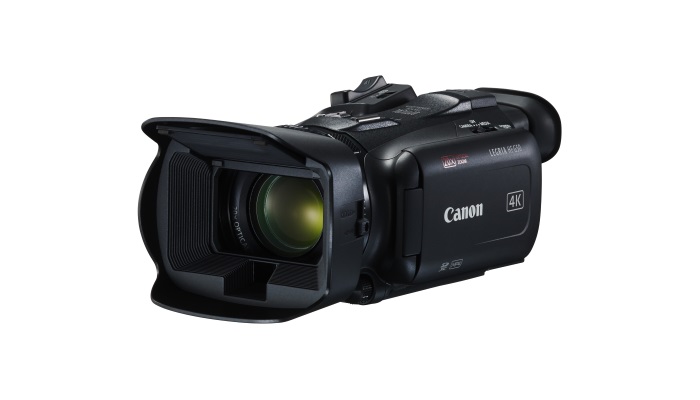
Canon announces two 4K camcorders, the LEGRIA HF G50 and LEGRIA HF G60

Canon Europe recently announced the expansion of its 4K camcorder LEGRIA range with two new models – the LEGRIA HF G50 and LEGRIA HF G60. As an entry-point to the world of 4K, the LEGRIA HF G50 is designed to capture and future-proof special moments in higher resolution – boasting a 1/2.3-type sensor with manual control, coupled with premium optics and processing for superior image quality. The LEGRIA HF G60, with its 1.0-type sensor, provides advanced users with the ability to shoot vivid and stunning movies in 4K UHD. The latter – supporting Canon-developed Dual Pixel CMOS AF – is perfect for those looking to capture extra detail and dynamism. Both camcorders are integral to Canon’s growing range of 4K products, paramount for the market as consumption and demand becomes increasingly mainstream.

The LEGRIA HF G50: Capture every detail with ease like a pro

With a new 4K sensor, the LEGRIA HF G50 captures outstanding levels of detail in 4K or Full HD with 4K oversampling – making this camcorder ideal for those looking to take their first steps into the world of 4K video, reliving their captured action in fantastic resolution. Allowing the user to push their creative ability, the LEGRIA HF G50 with its 20x wide-angle zoom lens and f/1.8 – f/2.8 maximum aperture, offers greater control over depth of field and excellent low-light capability, resulting in clearer and more vibrant content.

The LEGRIA HF G60: Tell your story in sharp and stunning 4K

Supporting Dual Pixel CMOS AF – Canon’s renowned sensor-based, phase detection Auto Focus (AF) technology – the LEGRIA HF G60 is aimed at enthusiast users looking to tell stories by capturing their passions, important family milestones and once-in-a-lifetime holidays in incredibly vivid 4K. Dual Pixel CMOS AF allows for smooth, high-performance focus tracking and fast autofocus acquisition, enabling users to create professional-looking pull-focus effects with ultimate simplicity – keeping a subject moving towards the user in sharp focus while maintaining a blurred background.  With its large 1.0-type sensor and maximum f/2.8-4.5 lens aperture, the LEGRIA HF G60 also gives smooth control over depth of field and truly stunning image quality.

Pushing creative boundaries with state-of-the-art features

Equipping users with a range of features that enhance their artistic shooting abilities, both camcorders feature circular apertures for smooth bokeh. In addition to this, the LEGRIA HF G50 and LEGRIA HF G60 both have powerful, wide angle optical zoom lenses, 20x and 15x respectively – enabling users to get close to the action with superior image quality. With customisable focus speeds, both camcorders can achieve almost instant smooth focusing enabling them to prioritise the look of a movie or the urgency of capturing ‘the shot’ for a documentary. Having the option to speed up or slow playback speed down, both camcorders allow the enthusiast users to get creative with motion and increase the dramatic effect of their video content. What’s more, both the LEGRIA HF G50 and LEGRIA HF G60 support Canon’s advanced Image Stabiliser (IS) technology. Shake-free, professional-looking content is maintained optically with high quality mechanical compensation for up-down/left-right camera movement, plus electronically with intelligent correction of roll and tilt.

Make life easy and shoot it your way

The customisable settings empower video enthusiasts to mould the LEGRIA HF G50 and LEGRIA HF G60 to their own shooting preferences; perfect for those committed to shooting in a specific style, whether it’s family moments or a personal passion project. With highly responsive and state-of-the-art controls, both handheld camcorders are compact and simple-to-use, ideal for capturing on the go. Both fitted with a professional grade zoom rocker, a dial to reduce menu diving, lens ring with fingertip light sensitivity and the ability to assign functions and commands to five buttons, the LEGRIA HF G50 and LEGRIA HF G60 make for an easy shooting experience. In addition to this, they both support adjustable exposure with built-in ND filters for wider apertures or slower shutter speeds.

With both models featuring a highly responsive 3.0-inch (460,000 dots) capacitive touch screen and a 0.24-inch tilting high resolution electronic viewfinder, users can be confident the images are framed perfectly.

The LEGRIA HF G50 and LEGRIA HF G60’s responsive touchscreen provides the ability to adjust tracking, focus and exposure, and their electronic viewfinder – excellent for shooting in tight and bright conditions to achieve a high-quality outcome. As well as this, both camcorders accommodate for dual recording with two SD card slots.

Plug more in, get more out

Ideal for households already upgraded to a 4K television, both camcorders provide users with the ability to play their creations in stunning detail. With mini-HDMI connector, the LEGRIA HF G50 and LEGRIA HF G60 connect directly to 4K TVs making viewing footage fast and easy.

Abri Kriegler, product manager, Canon South Africa commented: “As with all Canon products, these camcorders have been created with customer requirements and needs top of mind. The 4K market is rising, and video enthusiasts – of all abilities – want to future-proof their content and watch their creations in stunning high resolution – especially consumer content on 4K televisions is increasingly becoming the ‘norm’. Both the LEGRIA HF G50 and LEGRIA HF G60 join a growing portfolio of 4K-ready Canon products and are the ideal choice for those looking for a compact and easy-to-use camcorder that doesn’t compromise on superior image quality.”

Alongside the launch, Canon has also announced it is further bolstering its 4K product line-up with the launch of three new compact 4K UHD professional camcorders, the XA55, XA50 and XA40.

For the first time globally, the LEGRIA HF G50 and LEGRIA HF G60 will be on display at NAB 2019 on the Canon stand.

LEGRIA HF G50 Key features:

  • 20x optical zoom
  • 4K sensor
  • f/1.8 – f/2.8 lens aperture
  • Image stabiliser with dynamic mode
  • Custom function dial and buttons

LEGRIA HF G60 Key features:

  • 15x optical zoom
  • 1.0-Type 4K sensor with Dual Pixel CMOS AF
  • f/2.8 – f/4.5 lens aperture
  • Image stabiliser with dynamic mode
  • Custom function dial and buttons

Why campaigns need consumer insight to succeed

By Michelle Janse van Vuuren, marketing director at Canon South Africa

The rise of digital media has reduced consumers’ attention span to that of a goldfish, which is less than 9 seconds.[1] With consumers seeing over 5 000 ads a day[2], it’s no surprise that around 615 million devices globally are now blocking ads.[3] With so many brands competing for a few seconds of our time, how can they cut through the digital clutter with their marketing efforts? From apps being created to be deliberately addictive to users[4], to consumers feeling as though they are being stalked by bad digital ads[5], marketers are responding by going to the extremes. But the answer is more simple: effective marketing is about understanding people and their behaviour.

Nick Morris, Founding Partner and managing director at independent behavioural insights practice Canvas8, whose clients include Google, Nike, Samsung and MTV, explains, “Despite so much digital data being collected about consumers, brands are still failing to fully understand their customers. It’s more than just the collection of data. Through gathering behavioural insights, considered analysis and consistent application to a brand’s marketing activities, businesses can better understand their customers’ behaviours and predict how they are likely to engage with certain marketing messages.”

Consumers are already telling us that advertising has become pervasive, intrusive and relentless. Research by Trinity Mirror Solutions has shown that 40% of people associate brands with being ‘pushy’ and 57% of adults agree that brands should be more careful where they place their advertising.[6]

The data trade-off

However, with annual volumes of direct mail equating to 5.7 billion items in 2017 in the UK alone[7], what is the difference between direct mail that remains at the front of a consumer’s mind compared to ‘junk mail’ that is thrown in the bin?

Brands can maximise the effectiveness of direct mail by going beyond simply addressing customers by name: the key to doing this successfully is the relevance of the marketing message and delivering it in a timely fashion. As a recipient of brand communication, we tend not to resent marketing when it’s personal and relevant. However, it becomes irritating and wasteful when it’s generic information that is not tailored to our individual buying behaviours and product preferences – or has been delivered at an unsuitable time.

By gathering behavioural insights on customers, it is now more possible than ever to communicate timely and relevant messages. Brands can now track customers and prospects through every stage of the customer journey, from looking at a product online to buying it in store. At each touchpoint, they can collect and analyse data to gain a 360-degree view of the customer’s behaviours and preferences. This gives the brand multiple opportunities to act on what the data tells them, creating tailored offers and delivering them to consumers in real-time. Through digital media, consumers are sharing more and more of this data about themselves with brands. In return, they expect a positive trade-off in the form of relevant marketing materials, personalised special offers that apply to previous purchases, or loyalty rewards – and rightly so.

Act human

People sell to people and the decision to buy from one brand over another is not always necessarily about the product itself. This brings us back to Morris’s focus on behavioural insights: there is an important lesson for any brand to learn and that is to be human.

When devising any omni-channel marketing campaign, brands should analyse the data they have on consumers to understand how they behave and how they want to be interacted with. This means brands must become more personal and aim to surprise consumers, by reaching them with relevant personalised messages at a moment when they are receptive, what Morris calls ‘sparking serendipity’.

Through using individualised printed direct mail as a high quality communication tool to complement digital marketing, brands can leverage the emotional pull of physical media and intelligent personalisation to stimulate a deeper connection to the promotional message and stimulate response with ultra-targeted offers.

Inkpact is just one example of a forward-thinking brand that is transforming the way businesses communicate with their customers by offering the opportunity to send personalised handwritten letters to customers. Speaking at Canon’s Future Promotion Forum in autumn 2018, Morris highlights why companies like Inkpact are successful: “In order for direct mail to truly succeed, it needs to be two things: smart and personal. ‘Smart’ derives from the insight gained from studying the customer’s behaviour – it’s about being timely and relevant. ‘Personal’ direct mail, when done well, addresses me and my needs without being intrusive or inappropriate. Without these two things, it is vacuous.”

The future is programmatic

We believe that the future success of direct mail will come from the power of ‘programmatic print’. By this we mean the combination of digital marketing’s unique ability to personally address consumers with relevant messages at each touchpoint in the customer journey with print’s equally unique ability to engage consumers with those messages on a deeper emotional level.

Programmatic direct mail is only one example of how today’s digital print solutions can help to increase direct marketing effectiveness. There are now a variety of promotional print applications brands can use beyond direct mail to engage with customers including brochures, catalogues, ‘magalogues’, customer magazines, brand books, customer newsletters and so on.

Helping companies tailor their brand marketing material for their respective customers has never been easier, thanks to the new potential enabled by digital print. Everything that can be personalised online can now be personalised in print.

Digital production technologies give print the same immediacy as online, offering the brand owner the capability to adapt and personalise their print marketing collateral and produce selective amounts for short-term and highly targeted campaigns.

The key benefit of today’s on-demand promotional communications is the agility to respond dynamically to live campaign data.

Using the latest digital print technology, brands can use consumer data to tailor communications, fine-tuning campaign messages on the fly to achieve maximum effectiveness. Small adjustments in targeting can be made relatively quickly and simply as the campaign evolves, with delivery to the consumer within less than 24 hours.

Marketers that make intelligent use of data about their consumers and take a smart and personalised approach to print marketing will deliver more effective marketing campaigns, achieve better engagement with customers, and see the direct impact on short-term sales and long-term brand engagement.

[1] https://www.telegraph.co.uk/science/2016/03/12/humans-have-shorter-attention-span-than-goldfish-thanks-to-smart/

[2] https://www.cbsnews.com/news/cutting-through-advertising-clutter/

[3] The state of the blocked web, PageFair 2017 Adblock Report, PageFair

[4] https://www.bbc.co.uk/news/technology-44640959

[5] https://research.hubspot.com/why-people-block-ads-and-what-it-means-for-marketers-and-advertisers

[6] https://research.hubspot.com/why-people-block-ads-and-what-it-means-for-marketers-and-advertisers

[7] https://www.printweek.com/print-week/news/1165004/door-drop-spend-remains-stable-despite-uncertainty

Canon introduces a full fame mirrorless EOS R System in East Africa

Canon Central & North Africa (CCNA), a world leader in imaging solutions, has for the first time in East Africa unveiled its pioneering EOS R System, redefining the frontiers of photography and filmmaking. Over thirty years on from the original, era-defining EOS launch, the bold, new EOS R Full Frame Mirrorless Camera that expands photographic possibilities in countless ways. The new RF lens mount has been engineered with the perfect blend of optical, mechanical and electronic design to capture unique moments in previously impossible ways.

A pioneering lens mount, built from the best of EOS legacy

Since its inception in 1987, the EOS System – including Cinema EOS – has grown into the most recognised imaging system in the world. Today’s introduction takes the EOS platform to new heights, incorporating the best from the existing system, with even greater levels of performance, lens design possibilities and creative flexibility. The new RF mount has been built on the strengths of the existing EF mount and is the result of detailed research by Canon engineers, who have designed an impressive optical system with a flange back distance of 20mm and a wide 54mm diameter lens mount – allowing for even greater freedom when designing lenses. The new mount’s 12-pin connection enables enhanced communication and power transmission between the lens and camera body, further enhancing lens design options, resulting in higher image quality and enhanced usability.

Mr Amine Djouahra, senior Sales & Marketing manager – B2C, Canon Central & North Africa, commented: “We are very proud to have officially launched our EOS R System today here in Nairobi. This market and the entire East Africa region, plays a significant role in our growth plans and we hope that today’s local launch will further cement our position as innovators in imaging technology.” He further went on to add that, “Today, Canon is globally committed to investing in the unrivalled EOS world with cameras, lenses and accessories that set new heights in image quality, optical excellence and performance, building on Canon’s lens heritage, these high-performance lenses will push forward the frontiers of creative storytelling and satisfying the ever-evolving needs and demands of our customers.”

Exceptional quality in every detail

Built from the ground up, the new System has been reengineered with invaluable input during the System’s development from professional and enthusiast photographers and filmmakers. The EOS R System with RF mount and Dual Pixel CMOS AF delivers unrivalled optical excellence, the world’s fastest auto focus and faster communication between camera and lens. Features that are synonymous with EOS – fast performance, superb ergonomics and superior, uncompromising, image quality – remain at the heart of the EOS R System.

Featuring innovative technology for photography and filmmaking alike, the EOS R System allows all users to shoot and film in extremely low light with accurate focusing, thanks to Dual Pixel CMOS AF. Small and discreet, the EOS R System gives flexibility, plus the advantage of silent shooting. It also offers the highest standard of movie output from any Canon EOS System camera, outside of the Cinema EOS range, enabling filmmakers to take their storytelling to the next level in 4K with output in 10-bit over HDMI. The whole system has refined handling and enhanced ergonomics, including an electronic viewfinder and extensive customisation, allowing the user to the focus on the subject rather than the camera.

A system designed with lenses at its core

The EOS R System inherits all the existing system advantages, importantly full compatibility with existing EF and EF-S lenses and accessories, when using one of three newly-developed lens adapters, expanding the boundaries of image capture. Canon has today also launched four new lenses, compatible with the EOS R System – the RF 28-70mm f/2L USM, RF 50mm f/1.2L USM, RF 24-105mm f/4L IS USM and RF 35mm f/1.8 MACRO IS STM. Additionally, users of existing Canon EOS full frame or APS-C DSLR cameras can enjoy the EOS R System with their existing EF and EF-S lenses thanks to the adapters, while retaining the same performance as when used on a DSLR, as well as access to EOS accessories and Speed lite flashes.

Adding to the full frame family

Adding to the EOS full frame line-up, Canon has unveiled the first camera body to carry the EOS R name and RF lens mount – setting the new standard for the camera of tomorrow. With the world’s fastest autofocusiii, it is also the world’s first camera with the ability to focus in light conditions as low as -6EViv and totally silent shooting, providing stunning quality results every time. The EOS R redefines photo and video performance with unrivalled image quality, state-of-the art connectivity, refined ergonomics and responsive handling.

Further expanding the existing EOS System, Canon today also launches the EF-M 32mm f/1.4 STM – a new 32mm lens for the EOS M mirrorless system – and the EF 400mm f/2.8L IS III USM and EF 600mm f/4L IS III USM, two revolutionary, lightweight professional super telephoto lenses for the EF System.

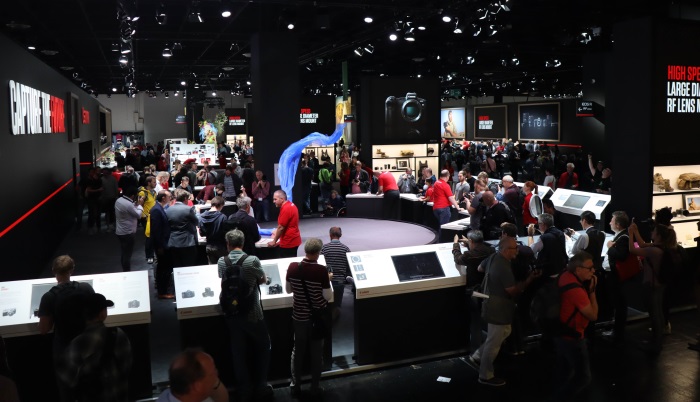
Canon at Photokina 2018

Canon’s state of the art stand was opened with an orchestrated display of lights, smoke and music to reveal what is undoubtedly Canon’s strongest and most inspiring line-up of imaging, print and video technologies ever.

The star of the show was most certainly the pioneering and revolutionary new EOS R System. Launched in September, the EOS R System delivers an entirely new level of innovation, enabling richer, more detailed results, with unparalleled levels of sharpness and detail. Taking photography and filmmaking into an exciting new era, the EOS R’s innovative new RF lens mount has been engineered with the perfect blend of optical, mechanical and electronic design, to capture unique moments in previously impossible ways. Visitors to the Canon stand can experience the EOS R’s remarkable features first-hand, including the world’s fastest autofocus[i] low-light shooting capabilities and impressive levels of customisation.

Dana Eitzen, Corporate and Communications executive from Canon SA said about Photokina: “For over 80 years, Canon has inspired and empowered photographers and filmmakers, from novice to professional, to explore their world and capture moments using the universal language of imagery. What a thrill to give expo visitors and Canon SA customers a chance to see and experience the revolutionary full frame EOS R and the RF lenses for the first time.”

Throughout Canon’s entire range, from the recently launched PowerShot SX740 HS and the award-winning EOS M50 to the standard-bearing EOS-1D X Mark II – Canon has a camera to meet all photography and videography needs, from professionals just starting out, to enthusiasts capturing special memories, or independent filmmakers shooting their latest film. Canon’s product experts were at the Expert Bar to help attendees pursue the perfect shot and expand photographic knowledge.

Pushing creative boundaries and championing visual storytelling, Canon’s globally renowned ambassadors were on the Spotlight Stage, hosting a series of insightful and compelling talks and workshops throughout the four-day show. From capturing stunning images to printing and sharing them with friends and family, Canon supports users at every stage of their imaging journey. The full PIXMA and Pro Print range was also in action to demonstrate how Canon’s world-class print technology and inks transform digital image libraries into high-quality prints.

[i] As of 5 September 2018, measured using CIPA-compliant guidelines, and internal measurement method with the RF 24-105mm f/4L IS USM lens at 24mm setting and AF set to one-shot AF

Canon Europe joins Netflix’s new Post Technology Alliance

Canon Europe, a leader in imaging solutions, has announced that the company will be joining Netflix’s brand-new Post Technology Alliance, which brings together industry leaders committed to working closely with Netflix to innovate production workflows and support creatives globally.

As a part of the Post Technology Alliance programme, products will receive the Post Technology Alliance designation logo – a mark of quality, service, and support. The logo signals that a product meets Netflix technical and delivery specifications and will continue to do so in the future.

Four Canon Cinema EOS cameras have been selected for the programme, including Canon’s first full frame cinema camera, the EOS C700 FF, along with the EOS C700, EOS C300 Mark II, and EOS C500. These cameras have been chosen by the filmmakers behind many Netflix Originals, including the Academy Award-winning documentary Icarus, feature film Our Souls at Night, and Emmy-nominated series Grace and Frankie. Other Netflix Originals shot on Canon include Afflicted, Abstract: The Art of Design, Chelsea, Hot Girls Wanted, Strong Island, The Confession Tapes, The Mars Generation, and The Ritual, with more currently in production.

“Netflix’s Post Technology Alliance programme aligns perfectly with Canon’s unwavering commitment to providing state-of-the-art, high-quality products, complemented with outstanding service and support for the global filmmaking community,” said Roger Machin, product manager at Canon South Africa. “With the shared goal of supporting filmmakers, and an ambition to serve the evolving needs of the production and post-production community, we are delighted to continue working closely with Netflix to champion the power of visual storytelling.”

“At Netflix, empowering our creative partners is incredibly important, and the Post Technology Alliance will build a more seamless experience from production through to post-production,” said Chris Fetner, director of post partnerships and integrations at Netflix. “Products that bear the logo are committed to better interoperability and faster innovation cycles, which will allow artists to focus their energy on what matters most – the storytelling.”

For more information about Canon, visit their website or follow Canon on Facebook, Twitter, Instagram or LinkedIn.

Canon launches the PowerShot SX70 HS camera

Canon Europe announces the launch of the PowerShot SX70 HS, a bridge camera with a powerful 65x optical fixed lens zoom, equivalent to a 21-1365mm focal length. Featuring DSLR-style looks and handling, a 7.5 Vari-Angle LCD screen, 20.3 Megapixel sensor and 4K Ultra High Definition video, the Canon PowerShot SX70 HS is an ideal all-in-one camera, capable of handling all types of shooting scenario, without the need to carry multiple lenses.

The classic DSLR-style ergonomics of the camera and its high-resolution OLED electronic viewfinder delivers sturdy handling and control when composing photographs, particularly helpful at popular tourist attractions or while on the move.

The power of the Canon PowerShot SX70 HS lays with the cutting-edge and superfast DIGIC 8 processor, which produces high resolution images, 4K Ultra High Definition video and a continuous shooting speed of 10 fps (frames per second). The autofocus is highly responsive and adaptive, even in low-light and continuous autofocus is possible when shooting at 5.7 fps, allowing spontaneous moments to be captured with ease.

The DIGIC 8 processor also powers the cameras 4K Ultra HD video capabilities, including 4K time-lapse and 4K frame grabs, so stunning landscapes or special memories can be captured and preserved in the highest of resolutions.

The camera’s enhanced 20.3MP 1/2.3-type CMOS sensor delivers a 25 per cent increase in resolution, compared to the Canon PowerShot SX70 HS predecessor, the SX60 HS at 16.1MP, bringing a new level of detail and vividness to images. This sensor upgrade also means that large photo prints look beautiful when taken on the camera, doing justice to precious family memories as they take pride-of-place on the wall.

In addition to sharp JPEGs, the Canon PowerShot SX70 HS can capture images in uncompressed RAW format, opening a world of professional post-production techniques, providing limitless ways to impress with optimised photographs.

It has never been easier to sync images or videos to a smart device, PC or Mac via the Auto Image Sync and Transfer mode using the Canon Camera Connect app (iOS/Android), or Image Transfer Utility 2 for PC and Mac. The PowerShot SX70 HS also features Remote Live View, which enables images to be taken remotely via a smartphone, meaning no-one is ever left out of a family portrait.

Canon’s new premium bridge camera delivers a truly portable and versatile shooting experience, capable of capturing everything from a vlog to wildlife on the African Savanna or a portrait of a loved one at a family occasion. This multi-purpose camera will get users closer to the action, when it matters.

 Key Benefits:

  • Look and feel of an all-in-one DSLR with an easy-to-use interface
  • Versatile shots with a 65x superzoom and 10 fps shooting
  • Capture important memories in RAW and 4K UHD video
  • Reliable, fast autofocus even in low light
  • Phone and computer support via Bluetooth or Wi-Fi

 What’s in the box:

  • Canon PowerShot SX70 HS
  • Compact Power Adapter CA-DC30E
  • Battery Charger CB-2LHE
  • Rechargeable Li-ion Battery NB-13L
  • Interface cable IFC-600PCU

For more information visit the Canon website or follow Canon on Facebook, Twitter, Instagram or LinkedIn.

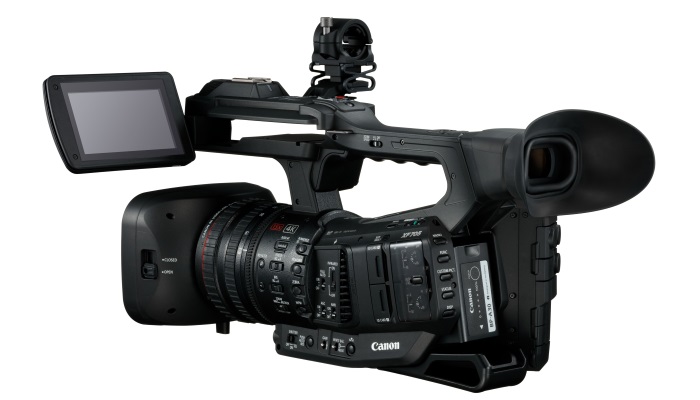
Canon launches new flagship XF-HEVC capable XF705 camcorder

Canon Europe recently launched the newest addition to its XF range of camcorders – the XF705. Equipped with the next-generation XF-HEVC format, XF705 offers 4K UHD 50P 4:2:2 10-bit recording to SD cards, with impressive image quality and superior levels of detail. Combined with a 1.0 type CMOS sensor and DIGIC DV6 processing, the XF705 delivers vastly improved noise performance, sensitivity and cinematic depth of field. With a host of enhanced HDR capabilities, including an advanced 12G-SDI interface and IP streaming, the XF705 is poised to revolutionise UHD HDR production workflows for the better.


Versatile file formats to transform workflows

Underpinned by High Efficiency Video Codec (HEVC) video compression, and leveraging the industry standard Material eXchange Format (MXF) as the container, Canon has developed the XF-HEVC file format. HEVC offers a newer encoding technology that is about twice as efficient as mainstream H.264/AVC. By using XF-HEVC the XF705 streamlines the handling of 4K UHD data, offering the ability to record high-quality 4K UHD 50P 4:2:2 10-bit files directly to widely available SD cards.

The XF705 is capable of recording HDR files internally using both the Hybrid Log Gamma (HLG) and Perceptual Quantisation (PQ) HDR formats. The camcorder also features extensive HDR assist functions to support the user when controlling exposure.
The XF705 can also output a SDR signal at the same time as recording a HDR file internally to a SD card, enabling simultaneous HDR/SDR production. Equipped with an advanced 12G-SDI interface, which sends a high-quality and uncompressed UHD 50P signal over a single SDI cable, the XF705 also has the ability to stream 4K UHD HDR using the HEVC format via the network. Ideal for broadcast and video production applications, the XF705 meets the requirements of any user who needs to capture 4K UHD HDR video with a streamlined production workflow.

Shoot with confidence

To make critical focus easier with the larger 1.0-type CMOS sensor, the XF705 also has Canon’s unique Dual Pixel CMOS AF. This provides accurate and fast autofocus with touch focus control, Face Detection AF and object tracking. The Dual Pixel Focus Guide also provides a graphical guide to support accurate focusing when manually adjusting the focus.

Image capture starts with excellent optical systems and the XF705 offers incredible versatility combined with ease of use. It offers a 4K L-series quality lens which has a 15x optical zoom range, a maximum aperture of f/2.8, a wide angle of 25.5mm and effective IS to ensure maximum control for stable 4K UHD footage. This is combined with three independent control rings with end stops to ensure that the camcorder has the level of manual control that professionals expect.

XF705 – Key Features
• UHD/50P 4:2:2 10-bit support with XF-HEVC
• Simple HDR workflow
• Advanced 12G-SDI and IP streaming
• Accurate and reliable Dual Pixel CMOS AF
• 15x L-series lens with wide-angle

For more information about Canon, visit their website.

- Advertisement -
- Advertisement -
- Advertisement -

Pin It on Pinterest