


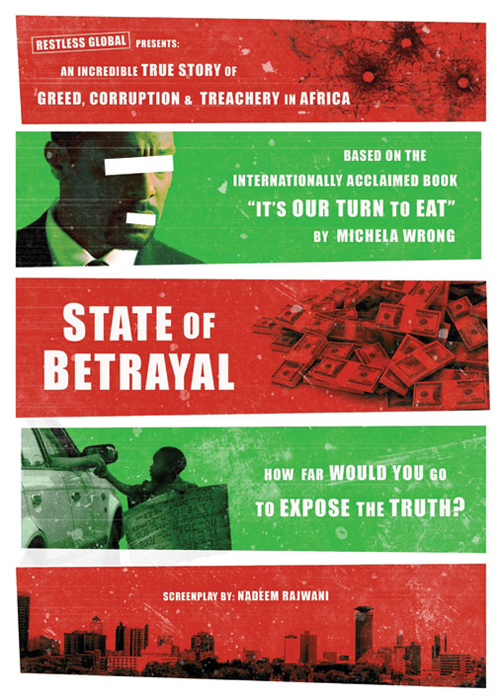
Integrated pan-African studio Restless Global – launched in 2015 by Marie Lora-
Mungai and Tendeka Matatu is producing the screen adaptation of author and
journalist Michela Wrong’s 2009 bestseller It’s Our Turn to Eat: The Story of a
Kenyan Whistle-Blower, under the name State of Betrayal. The book and the film
recount the courageous true-life tale of former journalist and anti-corruption activist
John Githongo.
All the right elements
After Kenya’s 2002 elections, which saw the end of president Daniel arap Moi’s 24-
year monopoly on power in the country, Githongo was handpicked by the new
government to head up the country’s anti-corruption department. After some time
working in government, Githongo made the shocking discovery that the country’s
senior officials and the new president himself – Mwai Kibaki – were at the centre of
a massive corruption scandal.
Despite the consequences to his career and his own safety, Githongo decided to
“blow the whistle’ on his own government, pushing forward with his investigation to
uncover their misdeeds. Fearing for his life, Githongo fled to the UK, taking with
him secret recordings that would later incriminate the upper echelons of the Kenyan
government.
He later sat down with the BBC, revealing the extent of the scandal in a historic
tell-all televised interview – exposing a £500 million corruption scandal that
implicated Kibaki and numerous senior politicians.
Producer Lora-Mungai explains that upon first reading Wrong’s book, she knew it
would translate well on screen. That, coupled with a strong personal connection to
the story led her to pursue the project: “I bought Michela Wrong’s book It’s Our Turn
to Eat immediately after it came out in 2009, and from the very first pages it was
clear to me that it was meant to be a movie. The story had all the right elements: a
complex and conflicted hero, a multi-million dollar corruption scandal, shady and
dangerous characters, and a strong universal theme in the opposition between
moral values and loyalty to one’s community.’
“I also felt a deep personal connection to the story. I had just arrived in Kenya as a
budding 24-year-old reporter when John Githongo went on the BBC from his UK
exile to make his shocking revelations in February 2006,’ she says. “It was obvious
to all those in Kenya at the time that we were witnessing a historic event and the
entire country, including myself, became fascinated with Githongo and his
journey.’
Optioning the rights
In 2011, after spending nine months convincing Wrong and her representatives –
who had received a number of requests from other producers wanting to option the
rights – that she was the right person to produce the screen adaptation of the book,
Lora-Mungai received the go ahead.
“Michela’s book had a bombshell effect when it came out, and several other
producers were interested in optioning the rights… Michela and I connected on our
shared experience as journalists and foreign correspondents. She also knew I was
deeply familiar with Kenyan politics and controversy…’ she explains. “In the end I
believe she trusted that I would be committed to protecting the authenticity and
truthfulness of the story while giving it another life as a thrilling piece of
entertainment.’
Packaging
The State of Betrayal screenplay was penned by Nadeem Rajwani, a young Kenyan
screenwriter trained in the UK and Canada. Wrong (the book’s author) has been
closely following the development of the screenplay, but has not been involved in
the actual screenwriting.
The film is still being packaged; a director and cast have not yet been selected.
Lora-Mungai says that the film is likely to be financed through a mix of international
co-productions and institutional funding, and efforts will be made to have it at least
partially shot in Kenya.
Resonance
“Despite all the progress achieved by many African countries in recent years,
corruption remains a major issue across the continent. Corruption, graft and
nepotism are slowing down reforms, economic growth and social change,’ Lora-
Mungai says. “But, in opposition to that, we’re also seeing a strengthening of the
civil society discourse in many countries with citizens taking to the streets to
protest MPs’ high salaries in Kenya or in South Africa with the “Fees Must Fall’
movement.
“I believe African audiences will be very interested in, and hopefully inspired by,
the personal journey of one individual who is fighting for change in a particularly
dramatic way.’
State of Betrayal is set to be a complex political thriller that promises to keep
viewers across the globe engaged. Githongo’s battle between his morals and
personal belief in justice, as well as his unwavering loyalty to his family and
community are universal themes which Lora-Mungai likens to classic films such as
The Godfather – a theme that will connect with audiences worldwide, whether they
are familiar with Kenya and Africa or not.


