


Collaborative post-production is increasingly being employed by media organisations, allowing multiple editors, graphic artists and audio engineers to work on complex multi-part projects.
It’s not uncommon to work on a major production with cutting rooms in LA; visual effects houses in New Zealand, Taiwan and India; a producer in New York; and a director in Cape Town. The score may be recorded in London and the final mix scheduled to take place in Berlin. Technology is changing the way we do business, faster internet speeds make it possible to share large files with someone across the world and connect with them to interactively discuss the contents.
A collaborative video production application is a cloud-based software package designed to help people involved in a video production project to communicate in a shared environment during all stages of video production from concept to production, editing, review, completion and distribution. In other words, a collaborative video production platform should let multiple stakeholders join in the creative process as easily as if they were working together in person behind the camera or at the video-editing console.
Apart from software the solutions required to support collaboration in post-production starts with shared storage. But a truly collaborative editorial infrastructure must go beyond shared storage and solve the problems of large groups of contributors working from the same source materials using non-linear workflows. From a broadcast or generic video post-production perspective, there is a set of baseline requirements for a suitable shared storage system: it must for example support high capacity to contain all of the materials that may be needed for currently active projects, and also for completed projects that might be used as sources for current or near-future projects.
Scalability has to be in the extreme, to be able to effectively support new workloads that will be addressed in the immediate or near future. Adequate, sustained, consistent performance (in terms of bandwidth and low latency) is critical for the toolsets used in the workflow. Shared storage for video workflows requires extreme levels of bandwidth that exceed traditional needs and overall, the systems must satisfy access requirements imposed by all the tools and non-linear applications that are used by the collaborative group.
Once the basic source material centralisation requirement is satisfied, more complex management requirements must be addressed. These requirements solve problems that are seldom addressed by the typical post-production solutions in the market. As the industry and supporting IT technologies continue their evolution, companies can now address other group post-production requirements via their technology infrastructure. The additional functional requirements can be satisfied by implementing four discrete management disciplines in an environment already enabled for effective centralised shared storage: asset management, user management, process management and resource management. So how do you provide access to thousands of hours of material and enable collaboration among a wide variety of users without missing a beat?
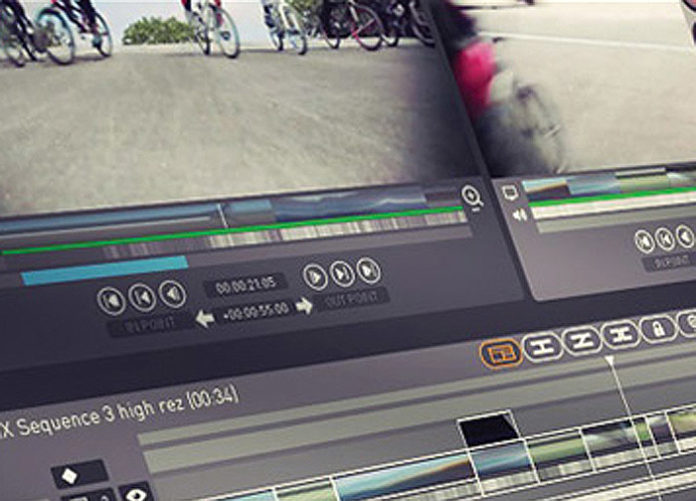
FORscene, for example, is a system created by Forbidden Technologies that enables such collaboration using cloud-based tools for editing and review of large volumes of source material. Footage that is shot in the field can be uploaded, reviewed and logged just as easily by the editor, producer or correspondent in the field. The web interface allows for shared editing and review online by multiple participants. Original footage that is copied to the local server is automatically uploaded to the cloud as proxies. While it offers a fully functional timeline editing system as part of its package, it can also import or export an EDL to or from Avid.
Both Avid and Adobe offer their own solution to this seemingly daunting task:
Avid Interplay Access is a web-based client for Interplay Production, providing access to the Interplay workgroup from any location worldwide. Interplay Access unifies a breadth of capabilities previously available only by running multiple applications, and makes them available anywhere. With Interplay Access, team members distributed around your facility or collaborating around the world can easily work with and add value to any media and any asset, on any connected workgroup.
On the audio front, Avid’s new Cloud Collaboration for Pro Tools platform allows you to connect to a premier network of artists, musicians, producers, engineers and mixers, enabling powerful yet easy collaboration.
Adobe Anywhere takes a slightly different approach to connecting multiple users of Premiere Pro, After Effects and Prelude. Like Avid, Adobe elected to use a centralised asset management and storage system, but they have chosen not to use proxies. Adobe acknowledges the creation of proxies takes up time and additional storage, so to solve this they created a scalable streaming system known as Adobe Mercury Engine.
Depending on the network connection, the server can throttle back the data rate while playing back the native file format. The other core component of this system is the Collaboration Hub, which contains the database of project information and metadata, and resides on a separate server.
It’s a big world out there but collaboratively it’s getting smaller and smaller.


