


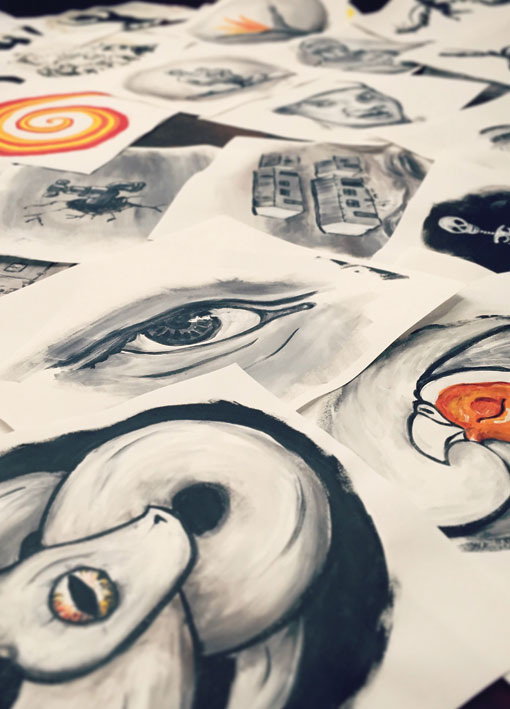
Johannesburg-based studio Maan Creative stepped outside of its usual line of animation work for commercials and worked with stage producer Janni Younge on a theatre piece that combined puppetry, dance and animation.
In a burgeoning and competitive local animation landscape, Maan Creative are carving out an intriguing niche as animators to the live theatre world with a distinct, tactile aesthetic.
Headed up by directors Michael Clark and Johan Scheepers, Maan recently completed work on The Firebird, a visceral theatre experience combining puppetry, dance and animation with, on its US leg, accompaniment by a live symphony orchestra. Commissioned by LA’s IMG Artists, The Firebird is the brainchild of producer Younge, formerly of the famous Handspring Puppet Company – renowned for their collaborations with artist William Kentridge, as well as their work on the West End blockbuster War Horse.
Having opened with a brief but highly successful run at Artscape in Cape Town, followed by sold-out performances at this year’s National Arts Festival, The Firebird has now embarked on its US tour.
The show has attracted shining reviews both locally and abroad: The Philadelphia Inquirer said of the performance at the Mann Centre: “It was a wonderful thing to feel risk in the air once again at the Mann – the essential element of art.”
Loosely inspired by Igor Stravinsky’s progressive 1910 ballet of the same name, The Firebird unfolds an abstract narrative drawing on South Africa’s recent history of freedom and conflict, while also evoking a deeper personal conflict between creativity and reason. Themes of restraint and subjugation warring with freedom and self-expression are conveyed simultaneously by the dancers, the otherworldly animal puppets stalking the stage, and by Maan’s animation sequences, projected on a huge white egg suspended over the action. The ambitious sensory smorgasbord climaxes with a great dragon looming over the stage, wings outspread, breathing fire.
“This was a challenging, but very rewarding project which helped us realise we want to make this kind of work a focus for Maan,” says Michael Clark, who was responsible for creating more than 70 original acrylic artworks that served as key frames for the animation. The sequences were then pieced together in Photoshop, TV Paint and After Effects.
“We enjoyed the artistic sensibility that the brief required of us,” says Clark. “We settled on a very painterly style. Rather than aiming for smooth animation, it was most important that our images were evocative and beautiful, and that they lived well with the hand-made aesthetic of the puppets.”
This is Maan’s second collaboration with Younge, the first being Ouroboros, a production she staged as winner of The Standard Bank Young Artist for Drama in 2010.
The process
It started with Clark spending time in Cape Town with Firebird director Janni Younge to workshop ideas, visuals styles and themes for the animation. The basic brief went something like this: about 15 minutes of 2D animation to complement giant puppets in front of 10 000 people at the Hollywood Bowl.
At this stage, the basic narrative of the piece had been laid down – loosely based on the Russian original – and the puppet building was well underway. Younge conceptualised the content of the animation – she had very specific ideas for what she wanted to communicate – while Clarke set about figuring out the style and the best way to execute the animation.
Clark and the Maan team eventually settled on the painterly, frame-by-frame style a hybrid of very tactile canvas painting and traditional animation. They felt this aesthetic fitted in well with the hand-crafted feel of the puppets and decided to focus on the quality of the illustration rather than the quality of the movement in the final piece.
From there they storyboarded the project in detail before doing a 2D frame-by-frame previs of the whole animation. This previs was used to create the painted key frames and also formed the basis of all of the rest of the animation in Photoshop. Some minor compositing in After Effects and final editing tweaks in Premiere finished off the process.
Technology
The technology used was, for the most part, fairly simple. The emphasis was to get a very tactile aesthetic, something that felt real without being interfered with by CG. As such, our most important tech was pencils, paper, canvas, brushes and acrylic.
Most of the animation was produced tradigitally with Wacom tablets, TV Paint and Photoshop. We used TV Paint and Photoshop to animate the 2D frame-by-frame previs. We then set up a purpose built (and surprisingly low tech) rig that allowed us to project the previs directly onto a canvas where key frames were painted by hand in acrylic and then captured with a DSLR and Dragonframe; sometime as stills, sometimes as sequences. These were then taken back into Photoshop and worked on top of with digital canvas brushes in Photoshop to create the final picture. Minor compositing was then done in After Effects to complete the shots.
The video for the live show is then all driven by QLab.
Challenges
The biggest challenge was obviously the sheer volume of work. To create 14 minutes of frame-by-frame animation within three months with a team of three to five people was no mean feat, especially when it all had to look like a canvas painting. Maan tried all sorts of things to combat this, from working at 10 or eight frames per second, to hiring extra freelancers.
The next major challenge was keeping the look consistent throughout the piece. Because painting as a medium or style is naturally so individualistic it was quite a challenge to keep the look consistent throughout. The solution to this was to have one person do all the physical painting of the keyframes and those images then formed the basis of most of the shots in the piece.
Another challenge was simulating paint in Photoshop. The team ended up buying a set of ‘wet media’ brushes for Photoshop and learned to get the best out of them. We also used the AnimDessin plugin for 2D animation in Photoshop.
The combination of animation and theatre is not a new one – War Horse, among others, used this conceit – but Clark would like to see the potential of the medium released in new ways. “I think animation has yet to be fully explored or utilised as a medium on stage. It could add a new dimension to a ballet, a live music show, or a traditional play. It can be used to add information or context that is hard to get across through actors or set design, and because it’s completed beforehand, it provides an anchor point for the other variables of a live show.”


