


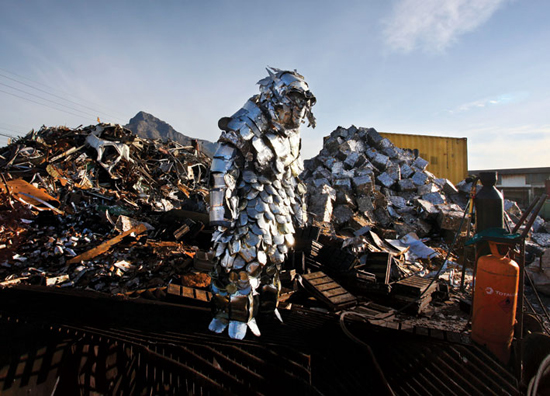
Francois Knoetze is a performance artist, sculptor and filmmaker currently based in Cape Town. His style brings together arresting visuals and incisive social commentary: a bold and unique body of work that shines a revealing light on the impact of consumerism on the physical and social landscapes of South Africa.
Knoetze’s style is difficult to put neatly into words. His films, such as Cape Mongo (2015), often consist of many elements, the most striking of which is his use of elaborate costumes constructed from discarded objects and waste materials. These costumes, when worn, conjure to mind “dispossessed zoomorphic trash creatures” (as Layla Leiman put it), lurching like zombie revenants through the urban spaces where, once, their many constituent parts were used and discarded. These images are juxtaposed, often violently, with found footage, fractured samples from news archives as well as popular culture (such as adverts and cartoons) – creating an effect that, Knoetze explains, “retraces the life cycles of discarded objects and explores junctures between material and social histories.”
The way narrative combines with documented history in Knoetze’s films recalls Adam Curtis (The Century of the Self, Hypernormalisation), a comparison Knoetze acknowledges, citing the British filmmaker’s ability to “bring different threads together into a narrative that is both cohesive and chaotic” as particularly influential on his own work.
The ‘chaotic’ element of Knoetze’s work, plain to see in the quasi-mythical ‘beasts’ that roam through his films, owes much to opportunism and spontaneity: a sense of play that Knoetze describes as “a way of counteracting the assembly-line psychology that makes machines out of people.” He says that since he often works “with materials that can be difficult to mould precisely, the outcome is almost always quite different to both the image in my head and any visual references I might’ve found. There is usually a point at which I give in to the material and let it be shaped in a way that looks interesting, rather than trying to impose a predetermined structure onto it.”
He first discovered this approach, which resonates with the rebuke of convention that underpins his work – and which Knoetze says “probably stems from a process of becoming disillusioned with the systems and aspirations that surrounded me during my high school years” – in 2012 while studying Fine Art at Rhodes University. “I had this idea for a slice of the local Grahamstown garbage dump standing up and walking back into town to try to make sense of its origins and place in the world,” he says – describing the concept behind his first short film, Refus.
Cape Mongo, a series of five short films each featuring a different trash creature, saw these ideas play out on a larger scale (‘mongo’ being a slang term for an object that is thrown away and then recovered). It paints a compelling portrait of how trash can function in society as a “lubricant of consumerism”; a mechanism that enables a mentality of carelessness and forgetfulness, a kind of invisible coach for the ‘out of sight, out of mind’ attitude that many middle-class South Africans adopt towards our county’s most pressing social justice and inequality concerns. As Knoetze puts it, paraphrasing a study done by Victor Munnik called Wasting The Nation, “in Cape Town, more than half of the 895 000 tonnes per year of domestic waste comes from mostly white minority of high-income households, which all goes to rubbish dumps located in mostly non-white, low-income neighbourhoods on the Cape Flats, where people produce far less waste, much of which is not even collected.” In this context, he suggests, every tonne of trash cannot help but be additionally freighted “with a long and violent history of the dispossession of land by settlers, the structuring of space according to crudely constructed racial categories, and the dubious methods of maintaining a hold on the wealth and privilege accumulated during these processes.”
In 2016, a residency in Tanzania spawned the equally adventurous The Great Circle – a “kind of examination of drone culture” – which also features sculptural costumes performing in public spaces.
Despite his work being so rooted in a specific sense of place – sensitive to both its history and its relative sense of political standing – Knoetze’s work has been widely and enthusiastically received on the international short film circuit. Cape Mongo alone has shown at the WNDX Festival of Moving Image 2015 (where it won the Jury Prize for Best International Work), the Paris Festival for Different and Experimental Cinema, Artvideo Koeln, the inaugural Addis Video Art Festival, Usurp Zone5 Film Festival in London, the FILMIDEO International Film Festival in Newark, New Jersey and Indonesia’s OK. Video Film Festival.
He is currently working on the Big Hole Counter Narrative Project in collaboration with Carina Truyts, Théogène Niwenshuti and Mkhululi Mabija – an attempt to “destablise our understanding of grand narratives” surrounding Kimberley and the formation of the diamond industry – and he recently built a robot character for Tertius Kapp’s short film adaptation of Jan Rabie’s story, Ek Het Jou Gemaak.
A rising industry talent, Knoetze is determined to keep exploring his ideas through exhibitions, performance and film projects. “Working as a visual artist allows me the space to spend time playing and looking for interesting relationships between people, places, stories and things, without necessarily having to produce a commodity in the end.”


