


“The film has a unique perspective. It has a tradition that is appropriated thousands of kilometres away from its home. That alone will spark interest.” – Davison Mudzingwa
The Diturupa Festival is an annual celebratory affair that takes place on 26 December at Makapanstad; a vibrant community in the North West province that is 100 kilometres north of Pretoria.
This historical event is influenced by Scottish traditions and was adopted by black South African soldiers who participated in World War I in Europe. The soldiers would come back to their hometown, to a ‘hero’s welcome’ by their community, however this iconic picture is a far cry from the reality experienced by these soldiers both in combat and upon return to their country.
The grimy untold story behind the glorious event is explored in the film, Troupes of War: Diturupa by Lucas Ledwaba and Davison Mudzingwa. “The film has a unique perspective. It has a tradition that is appropriated thousands of kilometres away from its home. That alone will spark interest. Most importantly, it is the perspective of black African soldiers and their role during World War I. It’s a story that has not been told exhaustively, so there is hunger for such a story,” shares director Davison Mudzingwa.
Mudzingwa is a former journalist turned filmmaker with a string of films and documentaries that have been featured on the festival circuit. His friend and journalist, Lucas Ledwaba has written a vivid account of his experience at the Diturupa Festival titled, Diturupa, relics from a tragic past.
“We had been friends for some time and Lucas had done a story about the Diturupa festival in the mainstream media publications such as the City Press and the Sowetan. He knew and admired our film work. He suggested that this festival was unique (and that) we could work together to document it through film,” explains Mudzingwa.
While conducting research for the film in 2014, the pair soon discovered that the content that was archived in history books did not really suit the kind of research they desired to pursue for their film, and for the story angle that they intended to explore.
“We have watched stories about World War I and II over the years. Nothing really struck us as focusing on African soldiers that played a role in these world wars. We thought their contribution to these wars that changed the course of world history deserved a proper place in history and by making such a film, we were in a way immortalising our fore-bearers’ role in shaping this world,” says Mudzingwa.
The pair went back to the drawing board; deciding to make the Makapanstad Diturupa Festival the focal point of their story. “The display and repertoire is the most amazing part of the festival. It is partly Scottish tradition appropriation as well as military drills that are transformed into dance and performance. This tradition is believed to have been brought back by black South Africans who went and participated in World War I. The significance is incredible; it’s an organic commemoration of the role of black soldiers in the Great War. It is a community organised event and the tradition has been passed through generations and it has managed to survive the evolution of time,” says Mudzingwa
“I was driven by the colour of the Makapanstad Diturupa Festival. We discussed as a team that every narrative that will be weaved in, will have to go with the rhythm of the festival. It was a challenge (at first) but once we were in the editing suit weaving the storylines together; the result was satisfactory,” he adds.
Shot in Makapanstad, Cape Town, Berlin (Germany) and France, the film took three years to complete and came with multiple hurdles and accomplishments: “The challenges were funding; we covered the first lap with our own savings. The National Film and Video Foundation came on board and their funding was helpful,” explains Mudzingwa. “The other challenge was finding the right characters to tell the secondary level of the narrative (that of the role and treatment of black soldiers in the war). It took us a lot of time but we managed to have an incredible cast. The last challenge was in post-production; the Diturupa festival and the role of black soldiers looked parallel, we had to find a storyline that would glue these two narratives together. Lucas’ research work and passion about this topic became the remedy.”
Troupes of War: Diturupa was shot using the Cannon FX 100 and the Canon 7D. “These cameras are less intrusive to characters and they reproduced amazing colour from the festival,” says Mudzingwa. “Lighting was also crucial for a film of this nature. We used a lot of a new generation of LED lights and sound, we relied on our external recording using the Tascam Field Recorder. Interviews were done with lav (lavalier) microphones. The editing was mostly driven by the rhythm of music and dance.”
Extra footage for the film was contributed by Ditsong Military Museum, South African National Defence Forces and Shutter Stock. Post-production was done by Mvura Ya Afika Productions; with editing by Themba Vilakazi and animation by Sequence Digital.
“The spine of the story is told through two major characters Frans ‘Rocker’ Monaledi and Simon Mputla. They are from rival troupe groups in Makapanstad. As we count down to the day of the festival, they speak about their knowledge of Diturupa and its origins and how it has evolved. Human stories are also weaved in the narrative. As this unravels the film through Lucas’ search for knowledge of how and when this tradition came to Makapanstad, we get to know that it was brought by black soldiers that survived World War I,” Mudzingwa explains. “
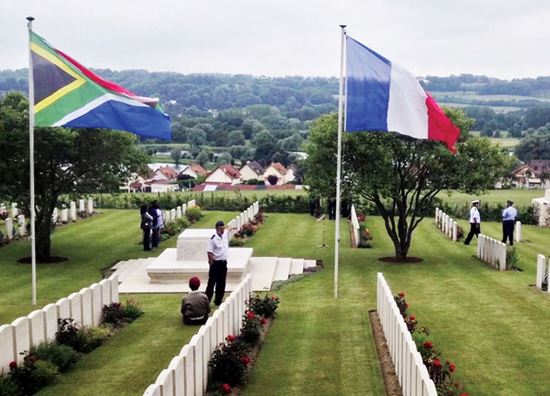
“We speak to military historians, who are also descendants (of those) who perished in the accident of naval ship SS Mendi that was on its way to France with the South African Native Labour Contingent. Over 600 men were aboard. These descendants are Chaplain General of the South African National Defence Forces, Monwabisi Jamangile and Jacques de Vries. We also spoke to a military historian based in Berlin, Romaine Devauchelle, who gave the world view of the role and treatment of black soldiers during World War I. It took us a long time, more than a year to find and convince them to contribute to this documentary, but I guess they appreciated the importance of such a story and we are grateful,” he adds.
“The film is just starting out its festival journey and after one festival; we are confident that it will go far. A major highlight for me was when school pupils in Alexandra township, Johannesburg watched it. They were passionate and interested about this history. This brought some sense of fulfilment that the film is resonating with young people,” shares Mudzingwa.
While the film hopes to shed light on the plight of these men in history, for the families who are left with the tradition, the film brings insight and appreciation of a history untold.
“We believe that once the story has been told like this, we have played the first part of the relay. Our hopes are that this will inspire more support from various players such as the government and corporate sector to support such initiatives thatcommemorate important events and people that risked their lives for future generations,” concludes Mudzingwa.
TECH CHECK
EQUIPMENT
- Cameras: Canon FX 100 and Canon 7D
“These cameras are less intrusive to characters and they reproduced amazing colour from the festival.”
KEY CREW:
Directors: Davison Mudzingwa and Lucas Ledwaba
Producer/Writer: Francis Yannicq Hweshe
D.OP/Editor: Themba Vilakazi


