


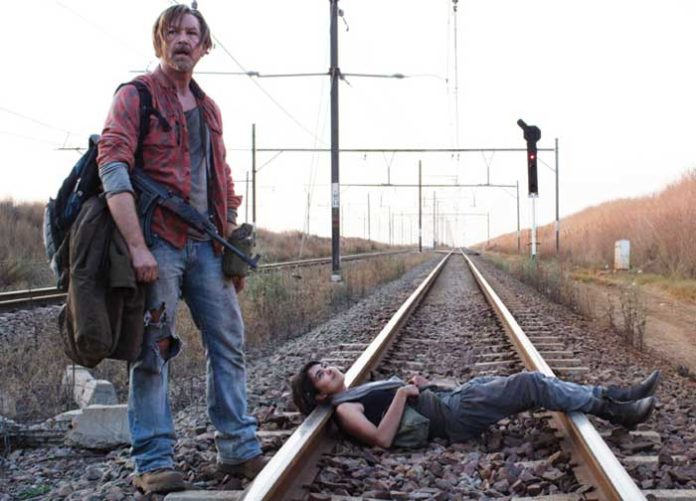
A global story, based in America and shot in South Africa with an almost entirely local cast, has been scooped up internationally. Last Broken Darkness (LBD), a post-apocalyptic Indie sci-fi feature film has been selected by Spotlight Pictures in the USA for worldwide release in 2017.
LBD is a story of the world destroyed by meteor showers where few survivors remain, including the protagonist Sam (Sean Cameron Michael, Black Sails), who has lost his wife and son.
Sam is forced to survive underground with his lifelong friend Troy (Brandon Aurett, Elysium, Chappie) and a young yet powerful Rose (Suraya Santos). They find themselves on the run with a crew of unkempt yet armed rangers while being hunted by mutated creatures, bandits and cannibals alike.
LBD is about friendship, courage and the will to live. So convincing were our local talent that Dos Santos says “The actors did an amazing job in bringing across American accents and every sales agent who approached us for distribution rights was convinced that the film was shot in America with an American cast and crew.”
LBD was brought to life in conjunction with DS Films Entertainment and Karoo Films. It was shot entirely in and around Johannesburg, including Springs, Pretoria, Kempton Park and the CBD. Principle photography started on 6 May 2015 for 26 days with the majority of the shooting taking place by night.
Director Christopher-Lee dos Santos takes us through the making of this film, which follows his début feature about South African pilots in World War II, which was released in twenty five countries. Dos Santos chose to shoot on a RED Dragon with Zeiss Primes as he says the combination gave him the perfect look for Last Broken Darkness.
“Through extensive research it was found that the RED Dragon’s 6k sensor boasted a high dynamic range, and when equipped with the low light optical low pass filter, allowed for the film to be shot and lit with practical lights such as flashlights, lanterns or natural light sources instead of the conventional way of lighting scenes,” he explains. “This allowed for the post-apocalyptic world to be captured in an authentic manner and not having to over light scenes,” Dos Santos adds. He was very specific in his choice of lighting characters with practical lights as much as possible and this camera allowed for that to be done. In addition, the RED Dragon was chosen for its ability to shoot at a high resolution which would assist in the addition of VFX and to ensure the highest quality of viewing.
The film was primarily lit with practical lighting (flashlights, lanterns, diffused light bulbs, and china ball lamps) and natural lighting. “At times 1.2k or soft box LED’s were used to light backdrops to provide assistance where needed,” says Dos Santos. “The use of practical lighting was utilised so as to embrace the darkness of both below and above ground to create the illusion of a larger than life post-apocalyptic world,” he adds.
Dos Santos describes that the look and feel of the film took on two opposing colour palettes for representing life below and above ground. Below the ground Dos Santos aimed for a post-apocalyptic look with a de-saturated colour palette. His original treatment was to take colour out, de-saturate the image and not crush the blacks but instead lift them slightly to create a milky texture in the darkness. “The use of varying hues of reds and oranges conveyed the urgency and danger,” he explains.
When the characters emerge from below the surface Dos Santos chose to push the whites in the picture so as to give the viewer a sense that the characters had not been exposed to sunlight for a long time. “The use of a lighter colour palette and expansive landscape shots assisted in creating the feel of a large and empty world which although dangerous still held an undercurrent of beauty and hope,” he says.
Dos Santos utilised leading lines both above and below the ground to attract the audience’s attention unknowingly and create a sense that the world was far larger than what was taking place directly in front of screen. “This was done to create a living dynamic for the characters to play in,” adds Dos Santos. “The world was as much alive and a character as the characters that lived in it,” he says. These techniques combined give the film a cinematic look while encompassing the feeling of the end of the world, lonely and filled with dangers.
The film was cut in Adobe Premiere on a 4k RED R3D raw timeline at 24fps using the original R3D files from the RED Cameras. No proxy files or ProRes were utilised.
Dos Santos explains that the greatest challenge faced was being able to pull off an international standard comparable to that of a Hollywood film, while being constrained by an extremely tight budget. As is the case quite often in Africa, and in this case, Dos Santos says, “My challenge was to fight tooth and nail to keep an international standard of quality in every decision from pre-production to post-production.”
The purpose of the film, aside from creating a story to entertain and inspire audiences, Dos Santos explains, was to show that young up and coming directors from South Africa can stand toe to toe with their international counterparts even when provided a fraction of their budgets.
“The reward and entertainment comes towards the end of the production as the film comes together,” adds Dos Santos.
“The greatest reward has been the unbelievable response from buyers and distributors who clamoured to purchase the rights to distribute the film and their utter disbelief at the cost at which the film was made in comparison to international productions.”
The film is attending the European Film Market at Berlin Film festival this February where it is being sold for international distribution by DS Films Los Angeles based sales agent, Spotlight Pictures. It will also be premiering at the 42nd Annual Boston Science Fiction Film Festival this February with invitations for more festivals later in the year to confirm. Contrary to the film depicting the end of the world, it is fast putting a spotlight on SA talent.
Key crew:
- Director: Christopher-Lee dos Santos, Producer and Executive Producer: Diony Kempen
- Music Composers and Sound Design: Geo Höhn and Richard Höhn
- Director of Photography: William Collinson
- On set Sound Recorder: Hendre Jacobs
- Art Department: Nerina du Plessis and Luarnae Roos
- Special Effects Makeup: Stella Kalymnios and Menio Kalymnios
- Wardrobe: Amalia Uys


