


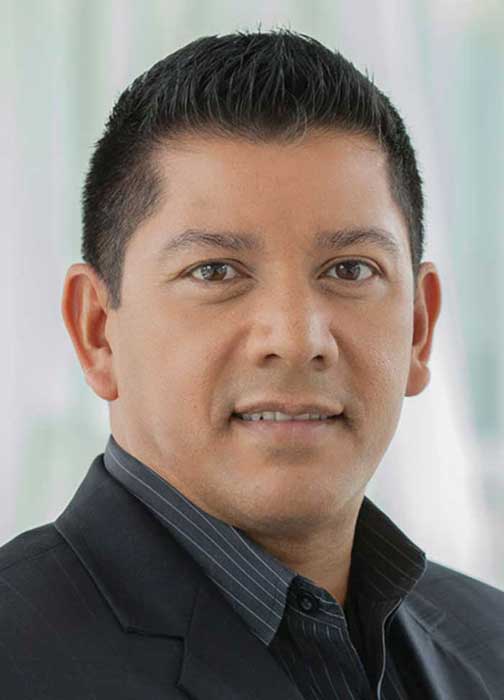
Screen Africa had the rare opportunity to sit down with Louis Hernandez Jr, the Chairman and CEO of listed global multimedia technology company Avid, on his whistlestop tour of the South African market, to hear more about the Avid Everywhere technology solution set, and its enabling Avid MediaCentral Platform.
Louis Hernandez Jr. is still fairly new in his role as CEO of Avid, having performed different executive roles in the business. His visit to South Africa is in order to share with existing and prospective client markets the current and future Avid strategy with regard to their previously launched Avid Everywhere solution set, and its enabling MediaCentral platform. In a wide ranging discussion, he analyses the current media market, describes the Avid strategy, and looks to the future – and South Africa’s place in it.
“In developing our current strategy, our first focus is to understand the market shifts in recent years – especially the digitisation of the connection between storyteller and consumer.
This fundamentally changes the economics of the market.
Some key challenges facing the media industry are:
- Increasing rate of content creation
- Exponential growth of distribution platforms
- Continued increase in content consumption
- Media tech budgets lagging behind
Given these challenges, media technology solution providers need to:
- Create high-quality, engaging content
- Distribute to more devices and channels
- Maximise and protect the value of media and content assets
- Ensure operational and capital efficiency.
It’s our job to facilitate this process. The Avid Everywhere ecosystem of products enables our customers to work more efficiently, collaboratively, flexibly and securely across the new media value chain, from media creation to distribution and monetisation.
Today we’re seeing digital content providers being disproportionately rewarded for providing viewers rather than profitability to the business. The upside is the huge upswing in digital consumption, which can happen anywhere. The challenge is that there isn’t a corresponding increase in budgets and profitability. Avid operates in 140 countries, and has a major stake in 70 per cent of paid music round the world, as well as the majority of feature films – including the top 10 grossing films of the year, which alone account for about 35 per cent of total film revenues. We count the vast majority of global broadcasters among our clients, and specialised broadcaster like sports and news channels. In South Africa we partner with state broadcasters and e.tv, MultiChoice, and DStv, as well as the large production houses. What they all say is that they need more great content, so they need the best tools to create content across more channels and devices. That costs them money, so they need to do this more efficiently because media budgets aren’t keeping up with channels and consumption. So a big industry change is optimising the lifetime value of media content assets – which means repurposing content, and extending digital rights over it. The business challenge for media houses and broadcasters is to move from Capex to Opex. Our response has been Avid Everywhere. The connection between content and consumption can now be entirely digitised. As a consequence, the heritage processes which kept content creation and its packaging and broadcasting entirely separate is now conflated. So now, creative and content provision and the monetisation of media assets can all be fully digitised.
Like many workflows in many industries, the broadcast industry grew activities to create scale. Each step in the value chain was infused with different technology iterations. But this means the chain itself, and the media enterprise, is not flexible, and is too expensive to fundamentally change. We tried to take all that was common to the various players and links in the value chain and put them onto one platform, called MediaCentral. This acts as the operating system for any media company. The platform connects the applications we offer with anyone’s apps in one common operating system. It now offers various service suites, for example, our well-known Artist suite, then we acquired the software or organically built the Studio suite, the Media suite, as well as a Storage suite and a cloud-based marketplace. This last one offers real-time collaborative synchronisation, between our app stores, cloud storage, and the content marketplace. It can work on any device, any operating system and on any platform. It’s all Avid software, but once we’ve certified it, users can use any app on the platform to connect with any others. The cloud storage advantages the platform offers are ones of scale and flexibility, from individual artists right up to enterprises, even though we think large media houses and broadcasters will continue to work mostly on private cloud for proprietary and security reasons for the foreseeable future, rather than through pubic cloud. But there has
been huge uptake in individuals for
cloud storage – we’ve seen 400 per
cent growth.
What are the services that the platform offers exactly? What does it do for all the apps that sit on top of it? No matter what app is on top of the platform, services can be shared. All the media services have an indexing capability, so any app you connect, creates a floating taxonomy so you can search across the platform for all media. This creates a taxonomy for any object on the platform, so that once you search for a media asset, the platform calls it up from its native source. With
our enterprise clients the platform grew 43 per cent because of this huge efficiency gain.
The real value proposition is facilitating the ability to monetise content at the same time as providing access to application and collaboration in order to stimulate workflow. Media houses need tools to create, to distribute, and to optimise content. So Avid offers a way for them to pick whatever they want – they can use Adobe and media composer concurrently on the same asset, and it indexes the use – artists and creative don’t have to choose one or the other. In this way the platform offers scalability and efficiency gains. We think it’s about 25 per cent in time and money. It’s in the nature of the networked world that if one vendor or organisation in a network changes an app or connection, it harms everyone connected. So we are taking all that away. Avid will certify everyone on the network, which reduces costs. We monitor the platform and its use in realtime, so can say what will work, what needs upgrading, etc.
The number of suites and services we offer on the platform is growing, and our key strategic move will be into the cloud. At IBC this year we demo’ed a totally cloud based platform solution. The growth of uptake for the concept is rapid – sales of the platform now total 50 000 units, with 42 per cent sales growth in major media companies, who can see the scale, cost reduction and flexibility it offers. Media asset management is growing because it’s critical to optimising the value of the platform.
As Avid moves into selling the enterprise suite rather than point solutions, we’re dealing with more sophisticated clients. Taking over their workflow operations requires a sophisticated design and deployment model. That’s where Avid is going – we want to have the best and most complete tools for every step of the workflow, on the most open and extensible and efficient platform in the world, with the most flexible deployment and pricing options. Clients can run it any way they want and pay for it any way they want. As we mentioned, our next big thing for us is moving everything to the cloud. Our first certified partner to do so is top European media service provider Dock 10 in Manchester, UK, which offers all MediaCentral services in the cloud. This is offered on a managed service model, so for Dock 10 and other such partners, this is Opex, not Capex.
As a value proposition for cloud technology, we offer enterprise pricing, rather than by seat. And once you put the abstraction layer and the event bus in the cloud, all the apps on the platform are available in the cloud.
The possibilities offered by the cloud are also changing our distribution model: Many direct to consumer businesses abandon reseller networks when they move to cloud. But for us, dealing with large and complex enterprise clients, means there are lots of services around deployment that Avid doesn’t have capability in territory to do. So we really need partners – in fact, in most markets we are expanding partner networks that can offer such services. What we found in the tier3 space, selling direct to consumers or end-users, is that we need resellers to support individual users. When we move up to tier one, large media companies deploying the platform model, we usually need more than one reseller in the same space.”
Asked about how he sees Avid developing in the local market, Hernandez concludes optimistically: “Our market reach is now 140 countries. We’re now shifting to peer growth mode – that is, we’ve identified certain markets that we think, because of their market dynamics, fit into our strategy well. South Africa is a market in transition, so we want to help the market help us make the transition for them. It’s not an explosive growth market, but it has the opportunity to leapfrog other markets by moving immediately to Avid technology. So we’re excited about the market here, which is why it’s the first time an Avid CEO has been here in two decades! The market in South Africa has as much sophistication in its people as anywhere in the world, and we think it will be ready for the adoption of cloud in two to five years, and partnering with the right company to do it in Avid.”
Louis Hernandez Jr
Louis Hernandez Jr, Chairman and CEO of Avid, is a growth-oriented technology executive with expertise in operational execution and results-driven performance in a variety of complex technical fields including content management, e-commerce, workflow management and financial services. His focus and passion is to advance technology initiatives that specifically enable the active collaboration and connection between individuals, teams and businesses. Before becoming CEO, he served for five years on Avid’s board of directors, including a period as lead director. Appointed CEO in February 2013, he is now leading the company into its next phase of growth and market leadership. To that end, he oversees Avid’s strategic investments in product innovation, solutions and services that help content creators and media organisations better connect with and inspire their audiences, both now and in the future.
He is the author of two books, Saving the American Dream – Main Street’s Last Stand and Too Small to Fail, numerous articles and has received many professional distinctions for his expertise in business and technology. He has also been a featured guest on Fox Business, CNBC, ABC News and Bloomberg TV, where he discusses technology, economics, strategic planning and gloabalisation.
By James Sey


