


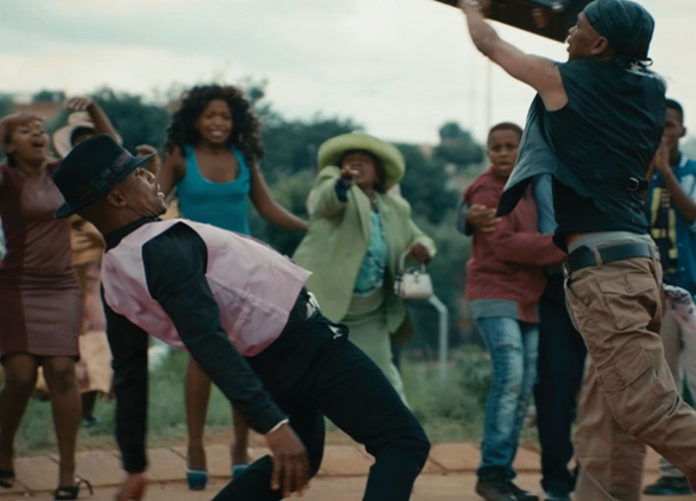
A fight scene can determine the impact a film has on its viewers. Screen Africa asked the key crew members about the making of this scene in For Love and Broken Bones – the story of a stoic debt collector who falls in love while on assignment. A jazz infused mise-en-scéne, an ominous antihero and vibrant wedding planner set the tone for this epic finale.
Dylan Lloyd on production design
This scene was a pivotal point in the film, where our hero and antagonist finally engage physically. Visually, this was a point where four worlds combined.
The look and feel of this fight scene was loosely based on an African film noir ideal. Motheo’s (the debt collector’s) environment is cold and inert while Refilwe’s (his assignment) is colourful and hopeful.
Here we see Motheo wearing a pink waistcoat, a reflection of him warming to Refilwe’s life. While his hat remains firmly on his head during the fight, resonating with his character.
In this scene there was money flying everywhere and we needed to have enough to do another take straight away. With experience you learn to over prepare yourself for an action scene by considering everything that could possibly go wrong.
Zeno Petersen on cinematography and lighting
This fight scene takes place right in the end of the film and basically concludes the story. It took careful planning days before we rolled the cameras, because we only had one day to complete the whole sequence. Using movement and people crossing the frame helped us cheat and hide action in the scene, which would normally take more time to complete.
We looked at the movie as a whole to chose the camera and used the Arri Alexa. This camera was used with a handheld rig for this scene. It was shot outside during the day so no light was used. I added in some fill with two pollyboards on the edges of the shots.
I shot the most important shots earlier and later and the cutaways mid day. This allowed some control over my backlight and fill. For the opening of the scene the crane allowed me to achieve the shot that looked down on the final scene and all the people running around. For the second half we used tracking shots to help us with the movement and action in the scene. That was intercut with all the hand-held shots I did between the people.
Andrew Traill on editing
The shots I had to work with were so perfectly composed for the fight scene that all I really needed to do was make it look extremely sexy. The entire scene was shot at hi-speed giving me the opportunity to do a lot of ramping of most of the shots, letting me do what I do best: edit.
The challenge was that it was a single camera shoot, there was not the perfect continuity for crossover editing luxury. That said there were quite a few well thought out cutaways in the scene allowing me to get around the fight without any continuity issues at all.
Tebogo Malope on directing
Every aspect of a film needs to serve the narrative. Can this fight scene tell the protagonist’s emotional arch?
It’s emotion before physicality and once we are happy with that then the dance begins. Working closely to choreograph the movements to assure that it read as an authentic fight scene, the challenge was to find the balance between aggression and gentleness. With the limited time we had to execute, it was a blessing in that we had no time to question our creative choices.
By the time we got to the set, the actors knew their blocking, my DP knew the camera movement and I could sit behind the monitor and enjoy the show.
Mduduzi Mabaso on acting
With every scene one needs to be mentally prepared but with fight scenes especially you’ve got to be alert, hence I meditate and centre myself to clear anything else from my current head space and allow myself to be in that scene, in that moment mentally, physically and emotionally. Besides, anything can happen so I prepare myself for just that.
I strongly believe in researching each character. Training is very important to me because I get to relieve stress and clear my mind. So I’m always doing some kind of physical exercise just to pump up my craft. A bit of skipping or weight lifting does help. I am meticulous about my craft. I love acting so I always welcome a challenge.
Philip Miller on sound
Right at the beginning of the film, we discover that Motheo plays the trumpet. As the composer I understood that the trumpet was his soul, depicting a man with a big heart trapped in a violent profession. The fight scene needed to cover the ambivalence of his character. The music had to convey both the danger and tension of the fight but at the same time his unwillingness for violence.
I chose to use the harmonica to emphasise the mood, worked with electronic drones and drums, which I mostly created myself and brought in the trumpet right at the end of the scene.
The scene was cut and slowed down which made it mesmerizing and stylized. It was at times like a dance as the actors lunged at each other. This unusual approach in the editing and direction helped me to take a risk and compose something that was poetic as if I was composing ballet music to accompany the choreography of their fight.


