


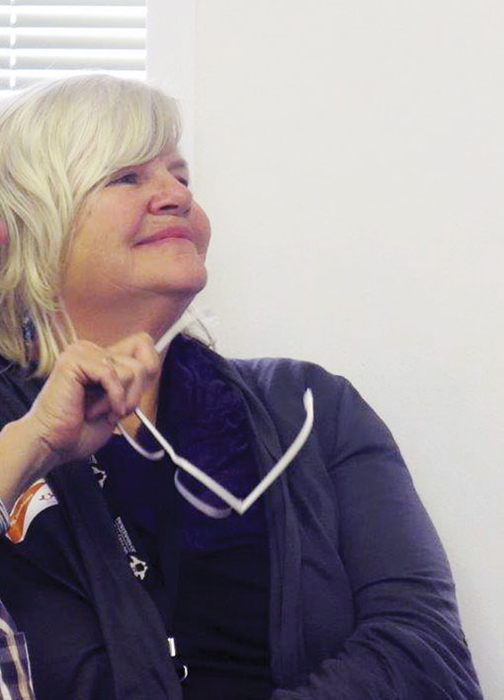
Phyllis Dannhauser is a lecturer at the University of Johannesburg who has nearly 30 years of experience in South Africa’s film and television industry. She has been an active academic for over a decade, and her latest research explores community filmmaking and identity, towards promoting and developing authentic South African stories.
What’s the biggest challenge facing South Africa’s film industry today?
Phyllis Dannhauser: I don’t want to say funding, because there are structures in place that have given the industry an enormous boost in recent years. The biggest challenge, I believe, is that filmmakers in South Africa chase the ‘great South African film’ and international recognition, instead of concentrating on telling our own stories in our own unique way, and developing a South African aesthetic.
According to the National Film and Video Foundation’s (NFVF) box office report for 2014, South African films made up less than 7% of the earnings, with Afrikaans films earning around a two-thirds majority (foreign flicks, of course, dominated). Research published by the NFVF also reveals that audiences would like to see more content in indigenous languages, particularly isiZulu. How can we respond to these facts moving forward?
PD: Although the NFVF has done much to encourage film production across all the languages in South Africa, my belief is that truly indigenous production starts on grassroots level. Let’s move the conversation away from budgets and international recognition and build the industry at grassroots level, telling the stories that people are interested in, in the language that they use every day. Also, distributing in the communities where the stories originated first of all. These films may not be technically as proficient as productions funded by the existing agencies (and there is room for those as well), and the themes will definitely be more in the line of Nollywood, for example, than potential Oscar winning material. We need to build the base of the pyramid, with people telling their own stories, in their own languages, and showing them to the people who identify with those stories.
In terms of Afrikaans film, this is in fact what Afrikaans producers have been doing – it started with young producers, fresh from film school, making films like Bakgat, targeted at a very narrow band of high school pupils, and aggressively marketing to that demographic. Now, we have the phenomenon of romantic comedies and popular musicals, which do not deviate from the Hollywood recipe and will not win the big awards at international film festivals, but which draw the crowds.
The film-thinker Béla Balázs wrote after WWII that: “We must be better connoisseurs of film if we are not to be as much at the mercy of perhaps the greatest intellectual and spiritual influence of our age as to some blind and irresistible elemental force.” Are South Africans getting exposed to all sorts of cinema to sharpen our visual culture?
PD: The lack of serious engagement with global film culture has been lamented by film scholars and critics in the past few years – amongst them Professor Martin Botha of UCT. As long as distributors do not give South Africans access to so-called ‘arthouse’ films beyond a very limited selection, the visual culture and development of these connoisseurs will suffer.
The American analytical philosopher Carl Plantinga notes that, “Documentary films have the potential to significantly alter public perceptions and to seriously affect the lives of those whose images appear on film.” How have documentaries featured in telling African stories and what role are they currently playing towards developing authentic African narratives?
PD: Documentary production has flourished in South Africa since 1994, and in the first few years after democracy the national broadcaster supported the drive towards building a culture of documentary production. However, this initiative has dissipated. Documentaries are the perfect way to reflect current social issues and to ‘bear witness’ for future generations, as Michael Rabiger states in his landmark book Directing the Documentary. Rabiger also notes that the production of documentaries is a stepping stone to fiction production. As such, documentary producers in South Africa are playing a crucial role in highlighting South African and African stories which can lead to a vibrant industry based on authentic narratives.
How can South Africa’s film industry encourage community storytelling?
PD: Many people in South Africa are still marginalised to the extent that they feel that their stories do not matter. In my PhD research, I look at how storytelling in a structured environment can help these stories to emerge. By telling their stories, marginalised South Africans can become part of the grand narrative of post-apartheid South Africa and filmmakers can tap into this rich vein of previously-unheard narratives. In encouraging storytelling and filmmaking in grassroots communities, we can also build a film culture and the kind of community filmmaking that I mentioned before, not to mention building audiences for South African stories. So it’s a win-win.
Your research is ‘autoethnographic,’ can you explain this approach and how it relates to participatory storytelling and community filmmaking?
PD: I believe that knowledge is built in interaction with other people. In examining the stories that emerge in communities, I cannot avoid becoming part of the story myself. I therefore opted for this methodology in writing my thesis, where my story of coming to filmmaking, storytelling and participatory community work is interwoven with the stories that emerge during workshops. In this way, the central themes of marginalisation and the use of narrative to reflect on community and identity, can be explored more effectively. I am also writing the thesis as a form of Creative Arts Practice (CAP) as identified by Caroline Ellis and Laurel Richardson; so the thesis itself is a montage of a film script, theoretical conversations and reflections.
In your experience, in the industry and academia, what can South Africa’s film and television industry do to help the next generation of storytellers flourish?
PD: The industry is sometimes critical of training institutions, especially universities. There is a perception that a few years’ work in the industry can replace a degree. I believe that in practice, anyone who does well in a particular area of production, for example in graphics, will get ahead, but only in that area. It just doesn’t make sense for a small company (or even a large one) to move young people around so that they can learn. I can only speak for UJ, but what we aim at is giving students a broad introduction to several areas of production, but focusing on conceptualisation and storytelling. We want to produce thinking artists, who can find creative solutions to problems, and who will work hard at getting ahead.
What films have had the biggest impact on you personally and what African films would you recommend?
PD: In terms of documentary, Guzman’s Nostalgia for the Light enchants me whenever I watch it, for its conceptual density and visual richness. Locally, the most important, goosebump inducing documentary of the last year has been Rehad Desai’s Miners Shot Down, which unfortunately has yet to be broadcast on the SABC (perhaps unsurprisingly). My favourite short film from Africa has always been The Little Girl Who Sold the Sun (Djibril Diop Mambéty, Senegal, 1999). What attracts me to this film is that it is a small, local, story with universal significance. Where recent feature films are concerned, I really like the visual richness and social significance of Man on Ground, directed by Akin Omotoso.
By Christopher Wheeler


