Home Authors Posts by Lara Utian-Preston

Lara Utian-Preston

76 POSTS 0 JOBS
Lara Utian-Preston is a passionately committed marketer and strategist with a focus on promoting African content and events. Two decades of working across Africa have provided her with insights and experience that she puts to work for the projects she manages. In 2006, Lara founded, and still personally manages, Red Flag Content Relations, a full service below-the-line agency that also focuses on African entertainment and lifestyle brand marketing, strategy, and publicity.

Turner Africa chooses Greenworld Communications

Turner Africa has announced a new partnership with Greenworld Communications in Nigeria. This partnership will offer Greenworld’s clients access to advertising solutions on some of its iconic, high-quality channels operating across the continent: newly launched TNT, Cartoon Network and Boomerang.

“We are extremely excited to work with Turner Africa and its prestigious brands” says Greg Anobili, Vice-President & CEO, Greenworld Communications Limited. This partnership furthers the multi-channel vision of Greenworld, where we can provide advertisers with desirable audiences over multiple platforms. The implication is that we will make it possible to greatly amplify advertising campaigns and brands alike, working closely with the brands to drive better ROI and reach for clients”.

A key driver is definitely Turner’s outstanding reputation for creating premium content and delivering exceptional experiences to fans no matter how they are consuming content, from on-air, on the ground or digital.

The agreement expands the reach of the Greenworld TV sales division into new genres being blockbusters movies (such as the epic I am Legend with Will Smith or the latest Miami Vice) and highly desirable kid’s programming as well as into new audiences across the SEM spectrum. Greenworld offers Turner Africa dedicated television and integrated sales and a back-end team with the experience to produce cost-effective, high-impact advertising, content and sponsorship solutions on the Turner channels.

“Concluding this significant partnership with one of the world’s leading content providers and distributors will strengthen Greenworld’s offering to the market” says Greg Anobili. “Television is an increasingly important part of our strategy and we will now be able to offer our clients a more extensive media buy that delivers diverse content opportunities, audiences and return on investment.”

Guillaume Coffin, VP of sales and Business Development – France and Africa said, “The partnership with Greenworld is an important move move for TURNER’s developments and regional relevance in west Africa. Its expertise and its ability to innovate as well as its event-based advertising know-how convinced us to sign this new partnership. We are convinced that with this new offer we will bring even more value to clients.”

Generation Africa steps into the future

As the African narrative starts to take its place on the global stage, African produced documentaries will be more and more important in cultivating and articulating African voices.

In the past, and even in the current environment however, many of the documentaries that look at Africa are effectively doing just that – looking AT Africa and in many ways objectifying its people.

Regardless of the topic, too often foreign funded and produced documentaries are litanies of grief and victimisation that tend to talk about Africa and Africans, rather than creating spaces and platforms for Africans to share our own stories and speak with our own voices.

Thankfully, this is starting to change, and as I have written about before, African filmmakers are pushing the boundaries of documentary film in ways that bring to life rich characters, and diverse cultures, and through a depth of approach, are able to transcend the negativity and stereotypes even when dealing with painful subjects.

For many years organisations such as STEPS (Social Transformation and Empowerment Projects), a non-profit organisation, passionate about the power of documentaries to disrupt, shift and move the world around us, have been working with, and developing the skills of African filmmakers to enable them to produce exactly these kinds of documentary films.

Through their various workshop and development projects, STEPS works on the production side of the process, and with their AfriDocs free streaming platform, they also push distribution and develop audiences for these films.

One of the topics that STEPS will be focusing on for the next few months is that of migration. Once again, much of the content that currently exists on this issue has been created from a Western perspective that sees the situation quite literally in black and white terms, and cultivates the view that a crisis of epic proportions is taking place as a mass exodus of Africans try to reach Europe.

This content often portrays Africans as homogenous, one dimensional victims of forces out of their own control, masses with little or no agency.

In an attempt to disrupt this dominant narrative, STEPS is currently launching two major initiatives both on the production and distribution fronts. AfriDocs will be presenting six powerful documentaries focused on migration that share a diversity of stories, voices and experiences.

These films will be available to stream from mid-October via the AfriDocs free streaming platform and also will be broadcast in Nigeria, Ghana, Somalia and Ethiopia on free-to-air TV, as well as the LifeTV satellite channel across West Africa.

By making these documentaries available across these multiple platforms, AfriDocs aims to open up the dialogue and re-frame the narrative. The films that will be streamed and broadcast include the following:

My Escape, directed by Elke Sasse, is a film made up from mobile phone footage of migrants or refugees from Syria, Afghanistan and Eritrea during their escape journeys to Europe, plus interviews after their arrival in Europe.

Revenir is a collaboration between the filmmaker David Fedele and Kumut Imesh, a political refugee from the Ivory Coast, currently living in France. Part road-trip, part memoir, part journalistic investigation, this film follows Kumut as he returns to the African continent and attempts to retrace the same journey that he took more than ten years ago.

Days of Hope, from filmmaker Dittte Haarløv Johnsen, tells three immigrant stories that interlace to offer a portrait of the brave souls who leave Africa for Europe but who always stay connected with home.

When Paul Came Over the Sea follows filmmaker Jakob Preuss as he becomes enmeshed in the life of Paul, who has made his way from his home in Cameroon across the Sahara to the Moroccan coast. When Paul decides to continue on to Germany, Jakob has to make a choice: will he become an active part of Paul’s journey or remain a detached documentary filmmaker?

Those Who Jump from director Moritz Sebert visits northern Morocco and the Spanish enclave of Melilla: Europe on African land. On the mountain above, live more than a thousand hopeful African migrants, watching the fence separating Morocco and Spain.

Aji Bi, Under the Clock Tower, directed by Raja Saddiki, follows the small community of Senegalese women who are living and working in Casablanca, in limbo between “regularisation” in Morocco, or attempting to “cross” to Europe.

As many films on migration (including most of these) are not being produced by Africans, it is clearly imperative to promote and develop opportunities for African filmmakers, and particularly for young Africans who make up the majority of the continent’s population.

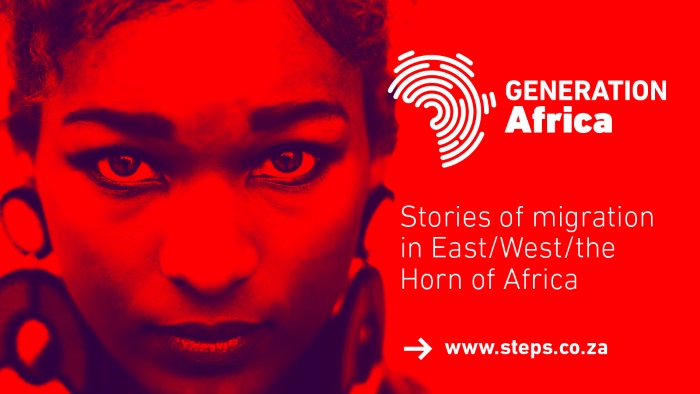
To foster this process, STEPS has launched Generation Africa, that, in its own description, “is a documentary film project to produce a new narrative on migration through stories made by African filmmakers”. Whether on the move or at home the spotlight is on this generation of young Africans and how they see their future.

The call for submissions for stories has gone out across Africa with a focus on West (Anglophone and Francophone) and East Africa, but open to all.

The brief to filmmakers is simple, submit story concepts that are original, fresh, authentic, moving and even revolutionary or challenging. It’s through a multitude of young voices that Africa’s stories will be told and that the dominant narrative will be subverted.

Applicants whose stories are selected will have the opportunity to take place in intensive workshops and development. Filmmakers are encouraged to submit up to three stories. All of the relevant information can be found on the STEPS website: http://steps.co.za/

Mobile content platforms: Who is watching the gatekeepers?

SCREEN AFRICA EXCLUSIVE: The exponential rise of mobile-driven (and funded) content platforms is starting to have some interesting, and potentially problematic side-effects in terms of selection (curatorship), censorship and the freedom of creative expression.

As the emergence of short form content as an industry driver becomes more and more clear, producers find themselves in a complex situation in terms of what they produce and how it is distributed.

Social media, and of course YouTube, have been the dominant platforms for sharing and monetising this content over the past decade. Brand and digital agencies have also looked to short form producers to produce impactful content around specific narratives and briefs.

Short form content then could be broken down into two main categories; firstly, creative driven short films are often developed on the hopes of securing a place and accolades at film festivals, going viral on social media or similar platforms and possibly promoting the career of the producer/filmmaker or securing funding for a full feature or TV series.

A second category of commercially driven content has been driven by brands and agencies looking to capitalise on the power and impact of social media. The prevalence of this content has opened up lucrative career paths for many young producers, but ultimately falls within the world of advertising.

The reality for purely creative driven short form producers has been that apart from niche categories at film festivals, and social media sharing, opportunities to drive or monetise their content were slim.

However, as mobile platforms start to become the primary platform for more and more people to watch any kind of video content, creative short form is now taking its place as the most lucrative and essential format on the market.

The massive hunger now being shown particularly by mobile operators for short content however must not only be seen as a positive driver of the industry. While it is true that the opportunities for exposure and monetisation, especially for young African producers, are real, there is a cost to this process.

The biggest area of concern, as I see it, is in terms of selection and curation. For all its ills and algorithms, social media, at least to a certain extent, and in certain countries is somewhat democratic. Commercial content often goes viral due to massive budgets and boosts, but often, quirky and original producer uploaded content manages to go global based purely on word of mouth and sharing.

Mobile content platforms however are heavily curated, moderated and gate-kept. Is anyone asking who exactly within the mobile platforms is selecting the content, on what criteria and for what markets? Clearly its all about expected profit. The content selected by any mobile platform, especially the content promoted within those platforms, is going to be that which is determined to gather the most eyeballs for as long as possible.

The gatekeepers of these mobile content platforms then are often found within the marketing departments – and content is selected often not for any kind of creative originality but rather on projected returns or within very narrow prescriptive norms.

As these platforms become more dominant destinations for content consumption amongst consumers, one has to consider the role of these all-powerful gatekeepers and what it means for the future of creative and perhaps even controversial content. Mobile platforms will inherently shy away from political content, or any content that offends certain governments, think Google in China. So if mobile platforms become the main source of news and information for an entire generation it is essential to look at the impact that this highly curated environment will have on both the viewers and the producers.

Already many bemoan the apparent censorship and narrowcasting of content on social media, but this will be exponentially increased when mobile operators control both the access and the content itself.

Producers will find themselves having to make more of the same – shorter and shorter bits of content aimed to please the most number of viewers without offending or taking any risks. This is the kind of content that will be rewarded financially leading to a process of self-censorship within the industry.

So while we celebrate the income and opportunities that arise from the growth of mobile content platforms – let’s also be mindful of the potential pitfalls in terms of creative, free and fair expression.


Canada selected as guest country for DISCOP Johannesburg 2018

DISCOP, the leading content, adaptation rights and project market dedicated to Africa and the Middle East, has announced that Canada will be the guest country at its Johannesburg edition set to run from 14 to 16 November.

This announcement was made possible thanks to the Canada Media Fund (CMF) and the National Film and Video Foundation (NFVF), an agency of the the Department of Arts and Culture of the Republic of South Africa, who have launched a dedicated incentive for the co-development of audiovisual projects between Canadian producers and South African producers.

The total amount of funding available through the incentive is approximately CAD $120,000 or ZAR 1,200,000 with each funding organisation contributing half of the funds.

“In the past 20 years, we’ve seen content produced between Canadian and South African creators hit international markets with great commercial success and critical acclaim. Producers in both countries have partnered to tell stories that are culturally-relevant to audiences in both countries and around the world,” said Valerie Creighton, president and CEO, CMF. “Through our matching fund with the National Film and Video Foundation of South Africa, we have further enabled the development of strong partnerships between producers in both countries. As we aim to create yet more partnerships between Canadian and South African producers, we look forward to participating in DISCOP Johannesburg 2018 where Canada will be Guest Country.”

The tribute to Canada will be marked by the presence of the Canadian Broadcasting Corporation who will be in Johannesburg to present PANORA.TV, its new B2B online platform facilitating transactions, from searching and shopping, to contract generation, payment processing and content delivery.

Canadian producers and government representatives attending DISCOP Johannesburg 2018, including André Ferreira, communication manager of the CMF, will be hosted at the Made in Canada Pavilion, a networking and communications hub that will provide visibility and market exposure to Canadian delegates.

Two important sessions scheduled in the context of DISCOP’s sidebar NEXT GEN development and knowledge-transfer programme will also examine co-production and distribution opportunities between Canada and South Africa.

1500+ delegates are expected to take part in DISCOP Johannsburg 2018 including 400+ acquisition and development executives representing broadcasters, premium cable channels, mobile operators and streaming platforms operating in Sub-Saharan Africa and 200+ global and regional distributors will also be at the market to showcase their latest offerings and seek new representation deals.

In a move to accelerate the development of a sustainable production and distribution ecosystem across Africa and the Middle East, DISCOP content, adaptation right and project markets are held several times a year in strategic regional industry hubs.


Generation Africa: Filmmakers submit your story now

Generation Africa is a documentary film project aimed at stimulating a new narrative on migration through the stories made by African filmmakers, and particularly young filmmakers.

The project is presented by South Africa-based non-profit Steps (Social Transformation and Empowerment Projects) through AfriDocs, the first and only free global streaming platform for African documentaries.

The topic of migration has dominated world news for some time, polarising societies in the West as governments scramble to get a handle on what they view as a dire ‘immigration crisis’. As the ‘crisis’ grows, negative images and portrayals of Africa and Africans are proliferated more and more.

Cumulatively these images contribute to a singular narrative told about African migration without the inclusion of African voices. Therefore, many facts that go untold such as the fact that migration within Africa is higher than from the continent, or that Uganda hosts the third highest number of refugees in the world.

Africa also currently is the continent with the largest population of youth in the world, and is projected to have a population of over 840 million young people by 2050. This could spell a boom of growth for the continent, or escalating challenges, depending on how the continent responds.

Generation Africa is a collaboration with African filmmakers to create documentaries that will shift this narrative on migration, and also give insights into a young generation on the move and making moves.

“We are looking for compelling, nuanced and unpredictable stories that celebrate the achievements of African youth on the continent,” explains STEPS executive producer, Don Edkins. “The focus for the project is East and West Africa as well as the Horn of Africa, but we will consider stories from the entire continent if they are compelling.”

Filmmakers can submit up to three story ideas in the form of a one page synopsis, along with a CV, filmography, and links to previous works. Submissions are invited from filmmakers who have made at least one documentary that has been broadcast or shown at a film festival.

Selected stories will be invited to take part in development workshops in East Africa, and West Africa (Anglophone and Francophone).

Steps is passionate about the power of documentaries to disrupt, shift, and transform the world around us. They work with organisations and individuals around the world to create documentaries on relevant social issues.

Through its streaming platform, AfriDocs, and through a network of organisations that host community based screenings, Steps uses a multi-platform distribution approach to bring documentaries to audiences across Africa.

Generation Africa is presented in partnership with Docubox in Kenya, NAFTI in Ghana and OuagaLab in Burkina Faso. The project is supported by Deutsche Welle Academie, The Federal Ministry of Economic Cooperation and Development, and the Robert Bosch Stiftung.

CTIFMF announces official 2018 selection

The Cape Town International Film Market and Festival (CTIFMF) has announced its official selection including 80 Feature Films, 20 documentaries and 61 short films for the 2018 edition of the festival. Festival screenings are open to the public and will run from 10 to 19 October at various cinemas within the V&A Waterfront, including free family-friendly films at the Amphitheatre.

The programme is a cinematic feast with some 120 world-class films on show to the public, festival delegates, and the jury. The meticulously curated selection include a significant and diverse array of African content amongst the independent feature films, short films and documentaries on show.

Feature films, documentaries, shorts and LGBTQ films have been selected from various countries across Africa including Ghana, Nigeria, Zambia, Sudan, Sierra Leone, Kenya, Togo, Egypt, DRC, Egypt, South Africa, Niger, Zambia and Tanzania.

The festival’s Opening Night film is South Africa’s official submission to the Oscars, Jahmil X.T Qubeka’s Sew the Winter to My Skin is an epic existential-adventure film that has wowed audiences at Cannes L’Atelier 2017, and had its world premiere at the Toronto International Film Festival.

Set in South Africa’s rural Great-Karoo region in the 1950s, the film chronicles the exploits of the outlaw John Kepe and the various individuals his escapades affected. This Robin-hood-esque figure would steal primarily livestock from the white settler farmers, terrorising them for over a decade. Led by the hardliner General Botha, a mammoth manhunt ensues in the mountain where Kepe was rumoured to occupy a Noah’s Ark like cave.

Kenya is especially well represented by two films; the much celebrated film Rafiki from the multi-award winning director Kanuri Kahiu, along with the beautifully moving Supa Modo, directed by Likarion Wainaina.

Rafiki (“Friend”) was inspired by Ugandan Monica Arac de Nyeko‘s 2007 Caine Prize Winning short story Jambula Tree; Rafiki is the story of friendship and tender love that grows between two young women, Kena and Ziki, amidst family and political pressures. The film had its international premiere in the Un Certain Regard section at the 2018 Cannes Film Festival.

Supa Modo tells the story of a young girl whose dream of becoming a superhero is threatened by terminal illness, inspiring her village to rally together to make her dream come true. This uplifting debut film from Likarion Wainana has won seven awards in various international film festivals.

Tanzania’s award-winning director Amil Shivji’s film T-Junction is a poignant tale of Fatima who makes an unlikely friend at a hospital, Maria. Bound by pain, Fatima keeps coming back to hear Maria’s tale of the T-junction where she found love and loss in a ragtag community.

Ghana’s entry into this year’s festival is Peter Sedufia’s film, Keteke that tells a story focused on the 1980s rail service system in Ghana. A couple living in Puna, is bent on delivering their first baby in their home town Akete – but they miss the train, what will happen?

I am not a Witch is set in Zambia, the birthplace of writer-director Rungano Nyoni, and revolves around a 9-year-old girl, Shula who is accused of witchcraft.

Amongst the 10 South African feature films in competition is Captive (Ko nkanga), from director David Kabale that tells the story of an immigrant woman, who after moving into her aunt’s house, experiences sexual abuse at the hands of her in laws. She must now make a choice of whether to submit or fight. Joseph Jones Umba’s Epiphany is a thoroughly modern story. After a clerical insemination error, an acquiescent woman must choose between her conservative husband and a child that has eluded her for so long.

Included in the selection is also a strong contingent of women filmmakers, including the world premiere event for the film Cut Out Girls, a Cape Town-made South African film from director, Nicola Hanekom that is is loosely based on her award-winning stage play that deals with the uneasy subject of date rape. The Wedding Ring from Niger is Rahmatou Keïta’s second feature film and slowly reveals itself as a story of female empowerment that also doesn’t shirk from the uncomfortable realities of Western influence on African cultures.

Florence Ayisi’s  latest documentary Marie Madeleine: A Female Chief from Cameroon tells the story of the repercussions that take place when a woman is enthroned as chief in a small village in Cameroon.

Other African documentaries being screened include award-winning South African director Rehad Desai’s, Everything Must Fall. The film is an unflinching look at the #FeesMustFall student movement that burst onto the South African political landscape in 2015 as a protest over the cost of education. Having its world premiere at the CTIFMF will be another South African documentary, Hear My Music- the Dizu Plaatjies Story from director Ron Stuart. The documentary tells the story of local musical hero, Dizu Plaatjies, the scholar and cultural activist who has devoted his adult life to indigenous African music. Whispering Truth to Power, from filmmaker and human rights lawyer Shameela Seedat, tracks Thuli Madonsela, South Africa’s first female Public Protector, as she builds her second case against the country’s President, Jacob Zuma. This is documentary filmmaking at its most relevant and powerful.

Kinshasa Makambo by Dieudo Hamadi from the DRC as well as the award-winning New Moon from Kenyan filmmaker Philipa Ndisi-Herrmann, are also amongst the selection.

Once again, the CTIFMF is proud to present a series of films focused on LGBTQ stories from around the world. This diverse selection of films speak to the diversity of experiences from within the LGBTQ community and yet also resonate strongly with universal themes of love, acceptance, and self-discovery. The South African premiere of the film Kanarie will take place on 10 October. The film, directed by Christiaan Olwagen and starring Schalk Bezuidenhout has won numerous awards.

Set in South Africa in 1985 against a backdrop of apartheid, religion and war; Kanarie follows a teen boy, Johan Niemand, who has always been bullied in his small town for his flair for British new wave music and love of Boy George. After he gets called on by the military and auditions for the Kanaries (the South African Defence Force Church Choir and Concert Group), he believes the choir will be his ticket out of fighting the war, but he begins to see the role he plays in the oppression and injustice around him.

The Nigerian/UK co-production Walking with Shadows will have its world premiere at the CTIFMF and is based on the novel by Nigerian author Jude Dibia, the film tells the story of a man who has to come to terms with his dark secret and choose between keeping his family or accepting a life of possible loneliness and rejection.

Within the 61 short films in selection are 17 South African films as well as films from Zimbabwe (Give a Man a Mask and He will Tell You the Truth), Togo, (ViZa), and Egypt, (Red Velvet and Major Tom).

South African shorts include award-winning director Reabetswe Moeti’s Mma Moeketsi that stars Keketso Semoko known for her role as Ma Agnes on Isidingo. She is a domestic worker from rural Lesotho working for a suburban family in Johannesburg. Her son, Moeketsi, is an illegal miner at the North West mine. In the wake of the wage strike, Moeketsi’s phone is off and he is nowhere to be found.

Fatima is a short from a South African director (Imran Hamduly), that tells the story of a young woman who defies her family’s wish to enter into an arranged marriage and suffers a tragic consequence thereof. Masqerading: To Hell and Back is Sofia de Fay’s bittersweet tale of a letter written by a 58 year old Cape Coloured drag queen Sandra Dee, to her best friend, Samantha Fox celebrating their complicated 30-year friendship. The letter takes us on a funny and poignant journey through their shared memories.

Another notable film is Cast Iron Can’t Be Welded, a short set in rural South Africa during the 1970’s and directed by Buks Rossouw. A farmer transporting a broken cast iron stove learns something about humanity from a hitchhiking schoolboy – but only after dropping him off.

This year’s official video can be seen here. For a full list and information on all the feature films that will be screening at this year’s CTIFMF, visit the website.

The Cape Town International Film Market and Festival is proudly hosted by the City of Cape Town.

The Cape Town International Film Market & Festival 2018 industry programme

The 2018 edition of the Cape Town International Film Market and Festival (CTIFMF) will take place from 9 to 19 October 2018 at venues across the V & A Waterfront in Cape Town.

For this year’s Industry Programme, the CTIFMF has made a concerted effort to focus on outcome driven programmes with tangible results that will benefit both emerging and experienced filmmakers and industry professionals.

The 4-day programme offers an array of skills development master-classes, highly informative panel discussions, and intense and engaging networking opportunities. With an eye to the CTIFMF’s themes of CREATE, COLLABORATE, CELEBRATE, the industry program is a truly inclusive offering that proudly celebrates the diversity of the South African and African film industries whilst also focusing on the importance of global cooperation and collaboration.

The various sessions include experts from the South African context, from across Africa with strong representation from Kenya and Nigeria, and from further afield, industry talent from Brazil, Canada (TIFF), the UK, Germany (Berlinale), France (Cannes), and the USA.

Highlights of the four days include panel discussions on topical and relevant issues such as the importance of emerging technologies within the industry. An exhibition space for audience to experience VR at its best will also be on display at the EXPO.

A comprehensive session on VR (virtual reality) and AR (augmented reality), as well as the importance of crypto currencies and blockchain, will include experts Brian Afande, (Black Rhino VR Kenya) Ingrid Kopp (Electric South), Toni Caradonna, (Ethereum Movie Venture), and Karl Carter, (Snake Nation, USA). Toni will also present a separate Masterclass focusing on block chain and cryptos for Dummies.

Within the focus on tech and digital, there is also a look at web-series with case studies that will include producers in this space such as, Dorothee Wenner – Kinshasa Collection and Kelly-Eve Koopman – Coloured Mentality.

With a strong emphasis on diversity as well as the importance of the space that African content occupies globally, the CTIFMF will also present a range of highly topical panel discussions.  A key session on diversity will be presented by Flourishing Films’ Themba Bhebhe.

Additionally, Africa is in the spotlight in a number of sessions including Positioning Africa, the Opening Assembly of the Industry Program that will include both African filmmakers as well as top international gate keepers. These experts will have a frank and open discussion on the way that Africa and African content is currently positioned. The panel will include Remi Bonhomme from Marrakesh and Cannes Semaine de la Critique, Andrew Orgel – Quality of Life Media, USA, Cara Causmano –  Tribeca Film Festival, and filmmakers Zamo Makwenze, Amira Tajdin, and Phillipa Ndisi Herrmann.

The Ladima Foundation will also focus on the importance of Pan-African networks specifically for women in the industry with their panel discussion.  A range of influential women from the industry from across Africa will take part, including Mildred Okwo, a producer/director from Nigeria, from Kenya, Phillipa Ndisi Herrmann and Catherine Gitahi of the Kenya Film Commission, as well as international filmmaker Tessa Boerman.

The book adaption programme, ADAPT, will also present two sessions open to badge holders that will focus on the journey from Book to Screen, and these will be presented by Selina Ukwuoma, Selina is a freelance script consultant who began her career at literary agency Curtis Brown working on a number of adaptations including 2008 BAFTA winner BOY A. She has since gone on to advise on award-winning indie films such as 2014 Teddy winner THE WAY HE LOOKS and this year’s Goyas triumph SUMMER 1993, both Foreign Language Oscars entries from their respective countries.

Various other sessions such as the Meet the Makers series will provide various perspectives and “behind-the-scenes” insights into iconic and successful African films. These sessions will cover themes such as Performance, Visual Style, Lo-Fi, Children Content, Documentaries and Local / Global Success.

CTIFMF market director Elias Ribeiro sums up the industry programme this way, “We are incredibly excited by the support and enthusiasm we have had from the dozens of experts and professionals who have committed to taking part in this programme. They all share our collaborative vision that is based on creating real value and tangible outcomes for all participants. We urge everyone with an interest in the growth of the South African and African film industries to take part in these events and reap the real rewards that will come from these informative sessions and truly remarkable networking opportunities.”


CTIFM&F announces opening night film: Sew the Winter to My Skin

The Cape Town International Film Market and Festival is proud to announce the official opening night film that will be screened at the Artscape Theatre on 9 October 2018.

Jahmil X.T Qubeka’s Sew the Winter to My Skin, is an epic existential-adventure film that has wowed audiences at Cannes L’Atelier 2017, and will have its world premiere at the Toronto International Film Festival this week followed by it’s European premiere at the The BFI Festival in London and the Busan International Film Festival in Asia.

Set in South Africa’s rural Great-Karoo region in the 1950s, the film chronicles the exploits of the outlaw John Kepe and the various individuals his escapades affected. This Robin-hood-esque figure would steal primarily livestock from the white settler farmers, terrorizing them for over a decade. Led by the hardliner General Botha, a mammoth manhunt ensues in the mountain where Kepe was rumored to occupy a Noah’s Ark like cave. This spectacle ingratiated Kepe in the hearts of the marginalized indigenous-population who turn Kepe’s miscreant deeds into the stuff of legend making him a threat to the very fabric of the colonial society.

Director Jahmil X.T Qubeka says this of the making of the film and its selection as the CTIFMF’s opening night film, “It is my intention with projects like this to explore and to dissect the impact of the apartheid experience on the psychology of self. The very roots of external struggles such as land redistribution are inherently imbedded in an internal meditation or yearning. Dignity seems to be the pursued pot of gold at the end of this rainbow. I wanted to offer some insight into what I believe to be mankind’s inherent need to feed into mythologies that conveniently suit the order of the day. With this film, I am endeavouring to create a visual experience that crosses the boundaries and limitations of spoken language.”

Qubeka added, “I am honoured to have Sew the Winter to my Skin invited as the opening film for the Cape Town International Film Festival, it is important for us to bring the film to its intended audience and celebrate South African cinema.”

The film’s producer Layla Swart, who hails from Cape Town and studied film at The University of Cape Town, elaborates further, “Sew the Winter to my Skin is an epic ballad to the art of visual storytelling and is a benchmark film in the tapestry of South African cinema. Selected in 2017 for the prestigious Cannes L’Atelier programme, the film was also awarded the Berlinale World Cinema Fund 2017 and has garnered incredible responses at screenplay level alone. I believe that films like Sew the Winter to my Skin not only contribute to a universally accessible understanding of African storytelling, but raise the benchmark for the young South African directors who are emerging with a burning desire to canonise their experience, their heroes, their legacy. We are indeed very excited to share this film with the audience at the Cape Town International Film Festival.”

CTIFMF marketing director Jehad Kasu also has this to say of the selection, “Having access to this level of quality South African filmmaking that conveys a local story as an opening night film, is half of the reason why the CTIFMF exists – to exhibit the excellence in local story telling and production. The other half is to create an enabling film business environment for this kind of content to reach as many other parts of the world as possible.”

“This second objective has the dual benefit of educating/entertaining global audiences with African cultures, traditions and daily life, while simultaneously boosting the economic growth of the local film and television industry.”

“We also congratulate the whole team, including Layla and every other woman blazing a blinding trail of success in this industry. In years to come we look forward to the problem where our programmers have the difficulty in selecting an opening night film from an array of world-class local productions – that are later snapped up by foreign sales and distribution companies.”

See the official film trailer HERE.

Tickets to this glamorous red carpet event at Artscape are available to the public and can be purchased here.

From 10 to 19 October, 80 feature films, 20 documentaries and 66 short films will be screened at various venues at the V & A Waterfront. Full schedules and ticketing information can be found  on the CTIFM&F website.

The Cape Town International Film Market and Festival is proudly hosted by the City of Cape Town.

The CTIFM&F 2018 Market badges are now available

The 2018 edition of the Cape Town International Film Market and Festival will take place from 9 to 19 October 2018 at venues across the V & A Waterfront in Cape Town.

For film professionals, an expanded and content-focused Market and industry programme will run from 10 to 13 October, aimed at inclusive and constructive engagements that foster the development of quality content and support the growth of a cohesive African film industry.

Highlights include a Works in Progress programme, a Book Adaptations programme and an Audience Development workshop as well as Work Cafés, keynote speeches, panel discussions and networking opportunities.

Throughout the four days a range of discussions will cover topics including capacity building and skills development, virtual reality, festival strategies, curatorship, financing, blockchain and cryptocurrency, amongst others.

Delegate registration is now open, and we encourage everyone to register now, ahead of the 12 September deadline to be included on the delegate book to be distributed at the event. The complete industry programme will be announced on 15 September 2018.

The CTIFM&F Works in Progress programme has also extended its deadline for entries to Friday, 17 August. This programme will see six works viewed and evaluated by high calibre decision makers and experts, with the goal of increasing the artistic quality and challenging the core creative teams to think about audiences beyond their own territories. To submit an entry email zahrah@filmfest.capetown.

The CTIFM&F expo will run alongside the Market programme from 10 to 13 October at the North Wharf Harbour, a prime location in the V&A Waterfront with a natural flow of attendees from the various CTIFM&F venues.

Industry stakeholders, film-related agencies, governmental agencies and production service companies such as logistics, location support and scouting, crew agencies, gear sales and rental, security, catering, transport, post-production, technology and software, are invited to take part by exhibiting their products and services in the official expo space. Further opportunities for these companies include networking lounges, speaking opportunities, press conferences for product announcements and more. For more information and to book a stall email sales@filmfest.capetown.

To make this year’s revamped Market programme and expo as accessible to film industry professionals, the CTIFM&F has made Market badges as affordable as possible. Market director Elias Ribeiro explains further, “We want to see as many industry professionals as possible taking part in this year’s programme, and we also want to ensure that delegates experience the real value that the programme presents. The full Market pass is the ideal way for both seasoned professionals and those just starting out in the industry to benefit from the skills sharing, networking, and other opportunities that will be part of the programme.”

CTIFM&F Market badges can be secured here. Prices are as follows:

Full Market Passes
4 day market pass incl. screenings: R750
4 day market pass excl. screenings: R500
4 day market pass – student ( incl. screenings) R400
4 day market pass – student (excl. screenings) R350

Day passes:
Per day (10 or 11 or 12 or 13 Oct) – incl. screenings: R250

East Africa wins: DISCOP Zanzibar and ZIFF 2018

SCREEN AFRICA EXCLUSIVE: The Zanzibar International Film Festival (ZIFF) 2018 and inaugural DISCOP Zanzibar marked a key turning point for the East African region. Both events were remarkably well-attended and their combined impact has been tangible for the industry, with some notable outcomes.

The prominence of Kenya and Kenyan filmmakers was on everybody’s agenda at both events, and as the nine days wrapped up with the ZIFF Awards night on 14 July, the success of women at this year’s festival was also the top talking point.

The rise of the Kenyan film industry is not news to anyone who follows the region, however, their strong showing in Zanzibar this past month signals even more growth to come. The Kenya Film Commission (KFC) was one of the key sponsors of both DISCOP Zanzibar and ZIFF, and not only did they support the screening of the Golden Dhow winning feature film Supa Modo at the event, but the organisation also sponsored at least another 15 to 20 filmmakers from Kenya to attend ZIFF. Along with the Kenya Film Classification Board, the official Kenyan delegation to Zanzibar numbered well over 30, with at least another 100 or so guests also taking part across the two events.

This delegation also included six members of the Kenyan parliament who were sent specifically to investigate and research the needs of Kenyan filmmakers, as well as the importance of festivals and markets such as ZIFF and DISCOP. These MPs will be drafting a report that will be used as the basis for new policy development aimed at further promoting and supporting Kenya’s film industry.

The results of this kind of support are obvious. At this year’s event, as in previous years, Kenyan filmmakers did exceptionally well on awards night. Apart from scooping the night’s top award for Supa Modo, Kenyan filmmakers won awards in 10 categories.

This prominence of the KFC was in stark contrast to the complete lack of appearance of the Tanzania Film Board (TFB). The TFB was invited many months ago to be part of these events, for whatever reasons, they have failed for two years running to leverage on this key opportunity taking place within their own country. Tanzanian filmmakers feel very much on their own, especially when compared to their Kenyan counterparts.

The other group that came out shining this year at both ZIFF and DISCOP Zanzibar were women filmmakers and professionals. In fact, the development and recognition of women within the film industry was a reoccurring theme throughout both ZIFF and the inaugural DISCOP Zanzibar.

Women filmmakers took home a total of 10 awards, with the documentary SILAS, directed by Anjali Nayar and Hawa Essuman taking home two awards; Best Documentary and Best International Film.  Best Short Film, Best TV Series, the Sembene Ousmane Award, the Emerson Award, and the Chairman’s Award amongst others, were all taken home by women.

The overall number of films submitted by women increased this year, and the history and status of women in the industry was also the focus of some key programmes at both events this year.

The Ladima Foundation hosted two events and also awarded the Adiaha Award for Best Documentary from an African Woman to New Moon, from Philippa Ndisi-Herrmann.

A full-day event at ZIFF saw the Africa in Motion Film Festival’s Lizelle Bischoff, along with fellow Stephanie van der Peer, present two restored African Lost Classics from women filmmakers, Fatma75 and Mossane. The screenings were followed by a discussion on the lost history of African women filmmakers.

The Ladima Women of Influence Panel was especially well-received with its focus on tangible steps to be taken to assist the development and recognition of women within the film and media industries. The panel included Bikiya Graham-Douglas, a Nigerian actress, singer, entrepreneur and the founder of Beeta Universal Arts Foundation; Biola Alabi, an African media expert with over 25 years of local and global media experience; Theresa Hill from South Africa, general manager for STEPS and acquisition manager for AfriDocs; Dr Mzuri Issa Ali from Zanzibar, director of the Tanzania Media Women’s Association (TAMWA); Giselle Portenier, a Canadian award-winning journalist and filmmaker; and Farida Nyamachumbe, a filmmaker from Zanzibar.

Some key outcomes of this discussion will see the development of a Pan-African list of women in the industry that can then be used by production houses to source qualified women across a range of film industry services. The Ladima Foundation will also be focussing on lobbying for policy change in Tanzania and Nigeria to promote film education in schools from an early age.

The overwhelmingly positive energy and impetus for change and development that was expressed throughout this year’s ZIFF and DISCOP Zanzibar bode well for the entire East Africa region, not just for Kenyans and not just for women. It will be essential however to keep focussing on the necessary support mechanisms that are proving to be successful when implemented properly.

By Lara Preston


- Advertisement -
- Advertisement -
- Advertisement -

Pin It on Pinterest