Home Authors Posts by Ian Dormer

Ian Dormer

49 POSTS 0 JOBS
Ian Dormer was born in Zimbabwe and has been in the TV business since the 1980s, having served in various positions a the SABC, M-Net and SuperSport. Ian currently works and resides in New Zealand.

Artificially Intelligent Media

SCREEN AFRICA EXCLUSIVE:

There is no doubt that artificial intelligence (AI) will touch every aspect of business across all industries in the years ahead. In broadcasting and media, it is already having a profound effect. The technology is widely being used to analyse and understand video content, speeding up processes like searching and logging, for example. AI is now developing into an intelligent video creation tool, being able to film and edit complete productions thanks to machine learning algorithms.

Media, in general, holds large amounts of unstructured data, which requires humans to understand it. Tasks like content management, processing, interpretation, quality checking, all take a lot of time and effort. However, current AI and machine learning (ML) algorithms have reached a level of accuracy close to human capabilities. This means many labour-intensive processes are now taken over by AI instead.

All major cloud providers are offering varying forms of AI to assist with post-production. From shot logging and speech-to-text, to scene and object identification, AI augments human logging, providing richer metadata for each scene and shot. Some post-production software integrates directly with cloud AI for a seamless in-application experience.

Over the past few months, most major post-production edit software has included some form of AI into their platforms. Blackmagic Design Resolve, for example, introduced DaVinci Neural Engine which uses deep neural networks, machine learning and artificial intelligence to power new features like speed warp motion estimation for retiming, super scale for up-scaling footage, auto colour and colour matching, as well as repetitive time-consuming problems like sorting clips into bins based on who is in the shot, for example.

Avid’s new AI tools are available through Avid | AI, which is also part of the Avid | On Demand cloud services. Avid | AI is a set of cloud services (a combination of Avid-developed tools and tools from Microsoft Cognitive Services) that utilise machine learning, including facial and scene recognition and text and audio analysis. Also released recently was Avid | Transformation, a new suite of automated services including auto-transcoding, watermarking and content repackaging for delivery to any device, anywhere.

Adobe has also updated its video editing applications with useful new features for both After Effects and Premiere Pro users, and some really cool Adobe Sensei AI integration specifically for Premiere Pro. First and foremost, the new Colour Match feature leverages the Adobe Sensei AI to automatically apply the colour grade of one shot to another. This feature comes complete with Face Detection, so Premiere can match skin tones where necessary, and a new split-view allows you to see the results of your colour grade as you go – either as an interactive slider, or as a side-by-side comparison.

In addition to Colour Match and Split View, Adobe has used its Sensei AI to make some audio improvements as well. Autoducking will automatically turn down your music when dialog or sound effects are present, generating key frames right on the audio track so you can easily override the automatic ducking, or else simply adjust individual key frames as needed.

Adobe After Effects, meanwhile, rolled out a new feature that can automatically remove objects from a video. While Adobe Photoshop has long offered a tool that can conceal areas of a still image with a camouflage fill, the software giant said the ability to do so across multiple frames was made possible by improvements to its machine learning platform, Adobe Sensei. The feature is the latest example of how artificial intelligence is transforming the video production process, making professional content quicker and easier to produce at scale. The new tool is able to track a discrete object across a given clip, remove it and fill the space it occupied with pixels that blend with the surrounding imagery. Adobe suggests that it can be used for anything from removing anachronistic giveaways within a period piece to erasing a stray boom mic.

AI has suddenly become one of the most important technologies and the most in-demand tool for the video creation market owing to its ability to sense, reason, act and adapt. The general popularity of automation (in various business practices) is another contributing factor. But do we think that AI will ever replace human input?

There are many applications that are starting to hint that it is possible. An early example has to be GoPro’s QuickStories, a quirky piece of software that copies the latest footage from your camera to your phone and – using advanced algorithms – automatically edits it into an awesome video.  Another intriguing piece of kit is SOLOSHOT3. Described as ‘your robot cameraman’, SOLOSHOT3 is a 4K camera on a tripod that automatically tracks a subject wearing a tag, keeping them perfectly in frame and in focus whilst recording the action. SOLOSHOT3 can quickly produce an edited and shareable video of highlights using its automated editing tools and post the video online – with no human intervention required.

The BBC’s Research and Development arm has been experimenting with how machine learning and AI could be used both to automate live production and search the broadcaster’s rather large archives. Their experimenting resulted in a documentary, screened late last year, made entirely by algorithms – and while it wasn’t the best bit of television ever made, it was a pioneering achievement from a machine learning perspective.

In Tel Aviv, Israel, a company called Minute have developed a deep learning AI video optimisation tool that automatically generates highlights from full-length videos. Minute’s AI-powered deep learning technology analyses video content to identify peak moments, allowing the system to automatically generate teasers from any video content with simple, seamless integration. Whilst pessimists claim this kind of application could one day replace humans altogether, the developers at Minute believe that their technology complements, rather than replaces, content creators and storytellers.

Most organisations today are exploring how they can best leverage and embrace these new technologies. This technology is also proving to be a boon for video editors and production teams. It enables professionals to focus more on artistic aspects rather than editing, which is considered a rather boring and mechanical task by many. Learning how AI technologies can help the entire production chain by improving quality and efficiency should benefit everyone. New things shouldn’t frighten us, they should excite. Two decades ago, we were all worried about non-linear editing – and look what happened to that concern!


Is OTT over-subscribed?

SCREEN AFRICA EXCLUSIVE:

To say that OTT (over-the-top) technologies have disrupted the world entertainment landscape would be a major understatement. Subscription-based, on-demand OTT platforms have risen in popularity over the past couple of years and are fast-displacing traditional TV programming as the preferred medium of entertainment for many. But the huge amount of options has also made streaming TV an expensive and a bit of a complicated mess. With even more streaming services set to launch this year, are we ‘over-subscribed’? And will the newcomers be forced to adopt ad-supported streaming models?

It’s hard to imagine that the OTT space could get even more crowded than it already is, but that’s what 2019 is about to usher in. A number of new streaming services will arrive on the scene, competing with current big players like Netflix, Amazon Prime, Hulu, Showtime, HBO Now and YouTube Premium. Late last year AT&T, the American telecom giant, completed its purchase of Time Warner and immediately announced an October 2019 launch of their own OTT service will rely heavily on content from WarnerMedia and the Warner Brothers library. AT&T doesn’t see their platform becoming another Netflix, but rather a huge warehouse of quality content available for purchase. There are no details on the model to be used nor its pricing as of yet.

Last month Apple announced Apple TV Plus, a brand-new streaming service that, according to its CEO, Tim Cook, “is unlike anything that’s come before.” Apple TV Plus will offer exclusive shows, movies and documentaries and will be ad-free from the start. It will be available in 100-plus countries through a section of the Apple TV app from September 2019 on smart TVs (surprisingly, even on Samsung smart TVs), MacOS and iOS.

Not to be outdone, Disney has also announced the launch of its upcoming OTT channel, Disney+. The channel will feature a second live-action Star Wars series, currently in development, and programming from other Disney brands such as Pixar, Marvel and Lucasfilm – and don’t forget, they also own National Geographic. Not only is National Geographic’s content attractive, they have renewed relevance with younger generations of consumers, with 100 million Instagram followers! Disney has assured potential viewers that their new service will be cheap – with some touting the figures of $6 to $8 monthly.

Even Discovery, Inc. executives have said they’re considering a direct-to-consumer offering, especially now that the company has 17 networks in its portfolio following their recent merging with Scripps Networks Interactive. Although, so far, the executives have said they’ve only considered the options – which could include bundling a number of brands, like HGTV, Food Network and TLC, into one channel. In theory, it could cost as low as $5 to $8 per month, said president and CEO, David Zaslav.

Cutting-edge technologies are enabling OTT players to gather, analyse and generate insights from vast volumes of digital data pertaining to user viewing patterns, mostly thanks to artificial intelligence and machine learning. This not only helps players to streamline the way they curate and recommend content to their users, but also enables them to create original content which is in synch with the viewing preferences of different audience demographics.

Armed with research data, BBC Studos – the commercial arm of BBC and ITV, the UK’s biggest commercial broadcaster – recently launched Britbox, a service that offers high-quality British TV to North American audiences for $6.99 a month. Britbox has 4,000 hours of content on it at present, which makes it the largest collection of British content available to US and Canadian customers. It has some archive classics but also brand-new shows that are available within hours of UK transmission. Essentially, the Britbox model is all about offering subsets of passionate fans the kind of high-quality content that they simply can’t get anywhere else. The less the content resembles what is available elsewhere (e.g. Netflix), the more consumers will be inclined to pay for it, according to the BBC.

Low-cost services may be the key to ongoing OTT success, despite survey results indicating that the majority of consumers will subscribe to only 2.25 streaming services, potentially leaving many players out in the cold. As the growing number of digital publishers and broadcasters enter into the OTT space, it’s becoming increasingly clear that a subscription-based business similar to that of incumbents like Netflix and Hulu would not be able to sustain newcomers.

These newcomers will need to rely on ad-supported streaming models (AVOD) and this presents a tremendous opportunity for advertisers. AVOD models offer ‘free’ premium programming as a viable consumer alternative to a subscription service. However, there are inherent complexities to maintain consistent revenue. OTT advertising is in its infancy when compared to broadcast television. Brands and ad agencies have been slow to ditch the traditional cost measurements (such as CPM) that rely on gross impressions to assess cost-effectiveness and profitability.

For the AVOD service provider, this means success is directly tied to scale—more viewers, more revenue. But building, maintaining and growing a large and sustainable audience can be an expensive marketing proposition.  On the plus side, the OTT consumer trend is not lost on advertisers looking to reach segmented audiences. The ability to deliver non-skippable pre-roll ads that can be hyper-targeted and localised with back-end performance metrics is very attractive to advertisers, but – for the viewer – will this model simply be over-the-top?


Strangler Application Pattern approach to Media Asset Management

SCREEN AFRICA EXCLUSIVE:

Back in 2004, a Chicago-based software designer, Martin Fowler, visited the rainforests of Queensland on the east coast of Australia. He was intrigued by the huge strangler vines, which seed themselves in the upper branches of fig trees and gradually work their way down the tree until they root in the soil. Over many years they grow, strangling and killing the tree that was their host. Equating this to rewriting critical systems software – where the chosen route is gradually to create a new system around the edges of the old, letting it grow slowly over several years until the old system is no longer used – he coined the metaphor ‘Strangler Application Pattern.’

The strangler pattern is commonly used in technology fields these days and the terminology is best understood as incrementally migrating a legacy system, by gradually replacing specific pieces of functionality with new applications and services. As features from the legacy system are replaced, the new system eventually replaces all of the erstwhile system’s features, ‘strangling’ the old system and allowing you to decommission it. There are hundreds of media asset management (MAM) systems out there and as technology develops, some organisations are adopting artificial intelligence (AI) to help them create and use the strangler software development pattern to slowly take over legacy MAM system functions until nothing is left but the new system. There are, furthermore, also many MAM systems out there that are allowing third-party AI applications to enable their users to train their machines to think like them – with the end goal of eventually replacing the user in order to cut costs.

I have been fortunate enough to be involved in the beta testing of software being designed as a potential plug-in to many existing MAM systems, with the aim of utilising AI to do all the hard graft in terms of logging and metadata creation – by having the system learn to do what the operator does.

The ultimate objective of these initiatives is to provide a completely unmanned media asset manager: a system with no human involvement at all, and a typical strangler pattern in practice. The software was originally developed to count and identify the sex of salmon swimming through a canal leading to an upstream river breeding area. The software not only extracts enough metadata from a camera clip to make presumptions about seasons, GPS locations and time of day, but also ‘visualises’ the clip to identify species type (human, animal, insect, etc.), identify the species itself (e.g. lion, leopard) and even possibly its gender. Another method used is audio sampling, which further assists the system log the shot.

While all of these things can easily be done by human eyes and ears, the advantage of having artificial intelligence perform the tasks is phenomenal when it comes to speed. Though it is still in a very rough beta stage, this system – in a test conducted using footage that I supplied – was able to identify all the species of animals around a watering hole, and from the camera’s metadata, told me where it was filmed, the time of day and season of the year. There were 27 shots and the logging took less than a second and even in this early stage of development, it was 100% accurate.

The beauty of AI is that the system continually learns from any errors it generates. When human intervention overrides incorrect information, the system remembers the changes – and even improves on them.

This developmental software is not unique at all. Third-party plug-ins are being used in many asset management solutions, such as Squarebox Systems’ CatDV, one of the pioneering media asset management solutions out there. The CatDV developers have started integrating video and image analysis options from AI vendors into their suite of systems and, through these integrations, CatDV is offering a range of advanced capabilities, including:

  • Speech-to-text, to automatically create transcripts and time-based metadata;
  • Place analysis, including identification of buildings and locations without using GPS tagged shots;
  • Object and scene detection, e.g., daytime shots or shots of specific animals;
  • Sentiment analysis, for finding and retrieving all content that expresses a certain emotion or sentiment (e.g., “find me the happy shots”);
  • Logo detection, to identify when certain brands appear in shots;
  • Text recognition, to enable text to be extracted from characters in video; and
  • People recognition, for identifying people, including executives and celebrities.

Another example is Avid | AI Media Analytics, which provides a framework that automates content indexing, such as facial detection, scene recognition and speech-to-text conversion, by using Microsoft Cognitive Services (Azure Video Indexer) to auto-index content using machine learning algorithms, creating a library of rich metadata that can readily be searched.

Avid have also teamed up with Finnish start-up firm Valossa, which grew out of one of Europe’s leading computer science and AI labs at the University of Oulu and integrated their software into Avid | Media Central. The comprehensive audio/visual recognition solution from this partnership can detect and identify people based on their age, speech patterns, sounds, emotions, colours and dialogue.

Dave Clack, CEO of Squarebox Systems, sums it up: “An AI-powered MAM solution offers a way forward. A great approach is to add to the MAM’s existing logging, tagging and search functions through integrations with best-of-breed AI platforms and cognitive engines, such as those from Google, Microsoft, Amazon and IBM, as well as a host of smaller, niche providers. These AI vendors and AI aggregators enable media asset managers to leverage AI analysis tools for speech recognition and video/image analysis, with the flexibility to be deployed either in the cloud or in hybrid on-premises/cloud environments.”

With the media and entertainment industry slowly being transformed by artificial intelligence, the future is bright for AI-powered MAM. In the right hands, AI becomes the key that unlocks the next generation of MAM technologies, and – just like the strangler vine found in the forests of Queensland – artificial intelligence is slowly, ever-so-slowly growing in many broadcast applications, and in some faster than you think.

From Absconsion to Obsolescence: current challenges facing the rental equipment industry

SCREEN AFRICA EXCLUSIVE:

Camera rental houses have been in business from around the 1920s. Scouring through an archived 1924 edition of American Cinematographer magazine, I found numerous ads for ‘equipment for rent’. Even back in those days there were DoPs who owned their own cameras but couldn’t afford lenses, lights or hefty equipment like cranes and dollies, and so – through necessity – the rental industry was born.

The unique specialty of any good rental house is the ability to stay on top of technology and changing trends. In the mid-1990s, there were really only two video camera choices: the Sony Betacam SP (analogue) and Sony Digital Betacam (digital). Nowadays the industry is awash with formats, codecs, cameras and hundreds of different types of lenses, offering TV producers more choices than ever.

The first big shift was when, after years of development, the ATSC (Advanced Television Systems Committee) established 18 different categories of High Definition. Sony and Panasonic took different paths, towards 1080i and 720P respectively, and both manufacturers began developing cameras and technologies to handle their chosen solutions. Meanwhile, TV networks, production companies and cinematographers also had to choose, because cameras couldn’t do both, and so created a battle that challenged rental houses by making them have to support more formats. What’s more, when cameras used to cost six figures, rental companies had a monopoly – but with the increased use of ‘prosumer’ cameras being used for at least portions of TV shows, that is no longer the case.

Travis Boult, of Camera Hire in Adelaide, Australia, maintains that: “Rental facilities have to offer lots of choices, but choices that make sense in the bigger financial picture”. Even the smaller rental companies generally carry selections like the ARRI Alexa, the Phantom, RED, Sony FS7, FS5 and F55, Canon Cinema EOS C300 and C500, as well as the Canon 5D Mark II, the Sony a7S Mark II and various SD-card based POV cameras. Each rental house has had to decide what video cameras to purchase and support.

As the number of formats and, more recently, codecs change rapidly, rental houses must be cautious about amortising technology that may be obsolete before it’s paid for. Although changing technology and time would seem to strike a blow against the existence of rental houses, Dave Kenig of Panavision in the USA says they are, in fact, doing better than ever. “Today there are probably more camera rental houses than ever due to the proliferation of digital equipment. Many of the older survivors have now transitioned over to digital cameras, while many new smaller houses have appeared.”

Meanwhile, Stacey Keppler of Zootee Studios in Cape Town feels technology changes are not felt as severely in South Africa as in the States or European markets, because the South African market seems only to rent what they know. “For example, the Panasonic Varicam seems hugely underrated here, or even the newish EVA1 gives you 10-bit 4:2:2 and dual native ISO onto an SD card, which is really great and certainly better than Sony’s FS5 – but we haven’t bought one yet, as people would rather rent an older Sony FS7, which is tried and tested amongst their peers, than ‘experiment’ on other camera formats,” says Keppler. “This is peachy for rental companies though, because we don’t have to stock every camera under the sun. So local filmmakers and content creators being sceptical of what they don’t know actually makes stocking our inventory a lot easier.”

Jenny Balee van Vlerken of Bangkok Video Services agrees, maintaining that technology shifts are a double-edged sword. “While it’s good to offer your customers a choice, the problem is that you can’t own everything and it doesn’t make financial sense to have every grade of camera in your rental house.”

Many, if not all, rental companies no longer have a monopoly on the cameras used in film and television productions, and so lenses and accessories have become the emphasis.  For Camera Hire in Adelaide, lenses are a big investment. “Digital cameras have a shelf life of about three years,” says Boult, “but lenses will be around for twenty years plus.”

Similarly, Rule Boston Camera, a rental facility based in Massachusetts, USA, has a full line of accessories and has concentrated its inventory on building out this part of the market. “We have an eye towards what people need, be it lighting or dollies, jibs and so on,” says general manager Brian Malcolm. “Lenses in particular are a great investment, as their price has gone up — not down — and there are more choices out there.”  According to Malcolm, ten years ago, almost everyone rented a complete camera package. “Now, every other job is to accessorise someone’s C300 or Epic,” he says. “DPs are being hired because of their talent, but also on the basis of their personal camera package. And they come to us for the accessories.”

Embracing change is usually the way to keep the doors open and the company flourishing – and, while rental houses have demonstrated nimbleness in adjusting to industry changes, at the same time their executives realise that their business has become more precarious and changeable than ever before. Which brings us on to an unfortunate challenge that rental houses of today have to cope with: theft.

Theft in the rental industry has, unfortunately, become an unavoidable issue worldwide. American and Canadian rental companies have formed a trade organisation called the Production Equipment Rental Group, which runs a collective database to try track and recover missing equipment being offered for resale throughout the world. Last year’s listings were valued at more than $20 million for small rental houses alone. Most thefts fall into one of three categories. Some are direct break-ins to rental facilities, others have been cases of theft from production vehicles. Some of the thefts are clearly done by professionals who know exactly what they are after, while others appear to be random crimes of opportunity. Perhaps the largest category has been by fraud, where customers with fake ID have rented gear and disappeared.

Insurance for rental equipment is different in each country, and for Stacey Keppler of Zootee Studios, it’s a tricky subject in South Africa. “There is essentially only one underwriter that will insure smaller camera rental companies and it would be ideal if there was some competition in the market, or even if insurance excesses weren’t so high.” Keppler continues, “The threat of absconsion holds us back a lot. It is seen as a ‘trade risk’ and not covered by the insurance underwriter. ‘Absconsion’ is essentially when we hand over our equipment willingly to someone who then does not return it. Ever. Yes, one would think this is just plain theft – but to the insurance underwriter, it is not. These scammers have different ways of deceiving us and, as a result, our registration protocol has become more and more elaborate which frustrates honest customers. Every year these scammers get smarter which forces us to do deeper background checks into our new customers. But the fact is, every new customer is a risk – and this shouldn’t be the case”.

As a matter of interest, do you know which camera is the most-rented world-wide? The humble Sony a7S Mark II mirrorless camera tops the list, while ARRI’s Alexa takes a close second spot!

Brainstorming for Better On-Air Graphics

SCREEN AFRICA EXCLUSIVE:

Integrated media organisation and recognised leader in global entertainment, World Wrestling Entertainment (WWE), decided during the course of last year that it was time to up their creative game and develop new and innovative visual content to enhance the production values of their flagship product, WrestleMania. They embarked on an ambitious project to improve their on-air graphics presentation, by incorporating high-end Augmented Reality (AR) content and technology to enhance their already action-packed productions in new and exciting ways. The powerhouse of smack-downs and take-downs threw out many questions, searched high and low for the perfect solution and ended up in Spain to find the answer.

World Wrestling Entertainment consists of a portfolio of businesses that create and deliver original content 52 weeks a year to global audiences, reaching more than 800 million homes around the world in 25 languages. WWE’s events, especially WrestleMania, are some of the world’s most visually stunning when it comes to graphics production value, which could – arguably – be called more realistic than the wrestling action itself.

For WrestleMania 34 in 2018, WWE wanted to include high-end AR content and technology to enhance both production values and the WWE Superstars’ presence. After research and deliberation, they chose Spanish company Brainstorm to help them in their quest. Jointly headquartered in Madrid and Valencia,  Brainstorm is a global company that provides real-time 3D graphics solutions for broadcast, feature film production and corporate presentations. Brainstorm’s flagship product, eStudio, is unique in the market due to its sophistication, open architecture and versatility, enabling both design and real-time playout of virtual studios and 3D graphics, as well as the easy creation of customised products and applications.

WWE chose InfinitySet, Brainstorm’s virtual set solution, because of its ability to render realistic content with convincing reflections and transparencies in real-time. WWE especially liked the quality of InfinitySet’s rendering with PBR materials and advanced shaders like refractions, which they could add to their existing models. WrestleMania was phase one of an ambitious project aimed to create new ways to impact global audiences by using advanced imagery mixed with live entertainment. The AR graphics package they developed for WrestleMania included substantial amounts of glass, as well as other semi-transparent and reflective materials. They also needed an engine that could render particles well, which was something InfinitySet was very capable of.

In the virtual environment, WWE required a powerful graphics solution to create content that is a convincing representation of real life mixed with virtual elements, where the goal is to create a composite that feels married together and where one cannot discern the real from the computer-generated. The toolset available in InfinitySet has allowed WWE to accomplish this objective better than all the other solutions they researched in the market. Especially useful were the depth of field/focus feature, and the ability to adjust the virtual contact shadows and reflections to achieve very realistic results. InfinitySet also allowed the WWE production team to create a wide range of content, from on-camera wraparounds to be inserted into long-format shows, to short, self-contained pieces.

INSIDE THE BOX

The complete setup comprises three different studios: a multi-render Virtual Studio, a smaller AR Studio and a portable AR system. The Virtual Studio includes three cameras with an InfinitySet Player renderer per camera (with Unreal Engine plugins), all controlled from the InfinitySet Controller via a touchscreen in the control room and Blackmagic Ultimatte 12 chroma keyers. For receiving the live video signal, InfinitySet integrates with three Ross Furio robotics on curved rails, two of them on the same track with collision detection. The setup also includes an OnDemand license to manage the playout of data-driven AR graphics.

The AR Studio, meanwhile, is a compact version of the multi-render one, and relies on a single camera on a jib with Mo-Sys StarTracker with InfinitySet + Track license. The AR Studio receives only video from the camera, and all the keying required is done using InfinitySet’s internal chroma keyer. This smaller studio, suitable for more compact events, allows the creation of AR content with simpler setups and requires less resources to install, drive and derig.

Finally, the Portable AR system is a custom-made road case with a redundant InfinitySet with tracking and internal chroma keyer for live AR productions on the road. This sytem will deliver  advanced AR content to a wider range of WWE productions and special events held throughout the year. This kit was designed to be sent anywhere in the world and requires minimal installation. Operators just need to take it to the event, open the lid, plug the power in-  and they instantly have a turnkey AR system with redundancy to ensure reliable operation on remote sites. InfinitySet is used to create content that airs across WWE’s many media platforms, including their award-winning direct-to-consumer WWE Network, as well as their various digital outlets and through their broadcast partners.

Brainstorm Multimedia is a relatively young company who started activities in 1993 as a provider of 3D graphics services to broadcasters. These services were based on the software previously developed by the company’s founder, Ricardo Montesa, later commercialised as the eStudio suite, a 3D graphics and virtual studio solution currently regarded as the industry’s fastest 3D real-time rendering engine. Today, Brainstorm’s product portfolio covers a wide range of solutions, from news clients like CNBC and sports affiliates within the European Football League to financial and elections graphics, weather or film pre-visualisation, not forgetting branding applications like those of the WWE.

Brainstorm is currently immersed in an ambitious technological partnership with Avid to provide eStudio’s sophisticated and highly intuitive real-time 3D rendering technology embedded in AMG (Avid Motion Graphics), Avid’s new line of broadcast graphics products. Through this agreement, Brainstorm provides Avid, one of the most influential companies in the broadcast sector worldwide, with the core technology behind eStudio’s 3D real-time rendering engine.

Virtually real – studios from the future

SCREEN AFRICA EXCLUSIVE:

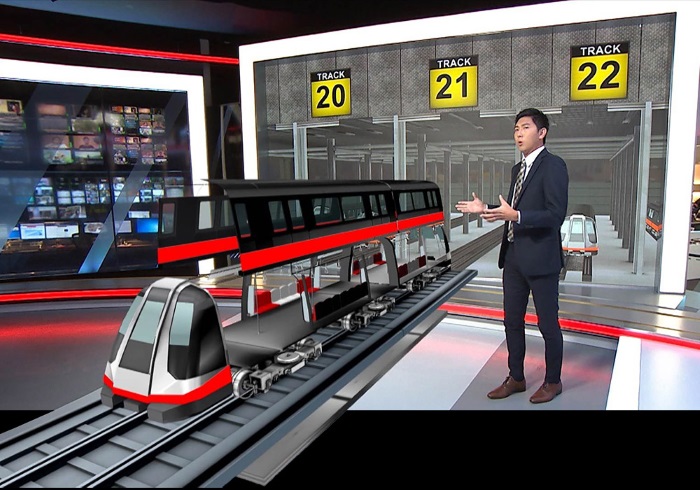
Advanced design and production tools that enable broadcasters to create virtual objects that appear as if they’re actually ‘in the studio’ have been available for a few years now, but have only become a mainstream feature of major TV networks over the last 12 months. Political elections, weather updates, news coverage and major sporting events – from the Olympic Games to the FIFA World Cup – have all made augmented reality graphics one of the broadcast industry’s hottest trends, and there is a wide range of solutions to enhance the viewing experience.

Broadcasters are increasingly adopting augmented reality (AR) graphics for enhanced storytelling, allowing for better interaction between presenters and graphics objects (or even remote locations) to get the story across. For example, the BBC’s coverage of the 2018 FIFA World Cup took advantage of the latest in augmented reality tools to help further its Match of the Day broadcast, featuring AR graphics to help experts and hosts tell the story of each match with stats and team news. Denmark’s TV 2 built a new studio for coverage of the Tour de France, featuring on-air personalities, virtual backgrounds and a large touchscreen tabletop that displayed 3D content to aid the analysis of the race. In the US, Fox Sports has just completed building a massive new state-of-the-art, multi-purpose augmented reality studio set to become the new home of the 2019 NASCAR Racing Hub and the 2019 Daytona 500.

AR gives broadcasters the tools they need to tell a complex story in a very visual way, with the presenter driving the narrative by presenting visually-engaging representations of data. With a few years of experimentation behind them, broadcasters now have a much better idea of where AR makes sense, how to use it and what kind of AR elements are effective.

Recently, the Weather Channel in the US showed off its augmented reality broadcast prowess, taking viewers inside a virtual version of Hurricane Florence. Guided by a host surrounded by ‘virtual peril,’ the network employed the approach to show residents in the path of the hurricane why they should evacuate their homes. The insert went viral and the internet couldn’t stop talking about how immersive the presentation was and the impact it had on viewers. Although nothing like the kind of immersion one experiences while wearing an AR headset, or even using an AR app on a smartphone, what The Weather Channel’s technique achieves is getting viewers accustomed to consuming content in the context of immersive environments.

Moreover, the growing maturity of the industry has helped graphics vendors develop better solutions. As technology develops, costs decrease – and we’re now seeing more realistic graphics, with the introduction of hyperrealism, using more cost-effective render engines that are bridging the gaps and removing barriers to entry. Denmark’s TV 2 Tour de France coverage used 3D graphics software from Vizrt for their visual content. The Viz Engine platform produced the studio’s virtual backgrounds, AR content and touchscreen board, while Viz Pilot enabled the production team to create 3D content using journal templates. Viz Virtual Studio gave TV 2’s producers the ability to tell stories easily without worrying about the limitations of physical studio facilities.

AVID has also moved into the market, offering a full solution for virtual studios, camera tracking, augmented reality and video wall control – enabling the broadcaster to work within a single unified workflow. Maestro | Designer is a tool for real-time graphics creation which seamlessly integrates with Maestro | AR, a suite of augmented reality tools, which – when paired with the new Maestro | Engine real-time graphics and video rendering platform – gives broadcasters the power to manage their entire production process simply and easily.

The race to perfect virtual environments and AR production solutions has largely centered on games engines, like the Unreal Engine from Epic Games – the technology behind the mega-popular online video game Fortnite. The Unreal Engine is what Fox Sports are using to power the graphic elements in their new NASCAR studio. This is because graphics packages tied to game engines give you better animation and higher-quality content, and create a level of realism unrivalled by any broadcast character generator.

Therefore it’s no surprise that VR solution providers like Ross Video and Vizrt are currently integrating the Unreal Engine into their products. XPression is Ross Video’s line of real-time motion graphics systems, clip servers, workflow tools and software applications that power its augmented reality offerings. The Canadian company’s solutions have impressed the audiences and marketing partners of NBC Sunday Night Football, Eurosport, BBC World, Google, YouTube, Space London and China’s eSports powerhouse VSPN with their AR solutions, virtual studios, real-time motion graphics and robotic camera systems.

Recently, CBS announced some big plans for its Super Bowl LIII broadcast in February, including 8K cameras and the use of augmented reality. The network will have 115 cameras at the game, with “multiple” 8K cameras intended for “dramatic close-up views” of the action: a first for any US network. In addition to these Ultra HD 8K shots, CBS plans to use augmented reality graphics as a major part of its Super Bowl feed. Four cameras will be used to present live AR images, with a total of 14 cameras being used as part of its virtual graphics strategy.

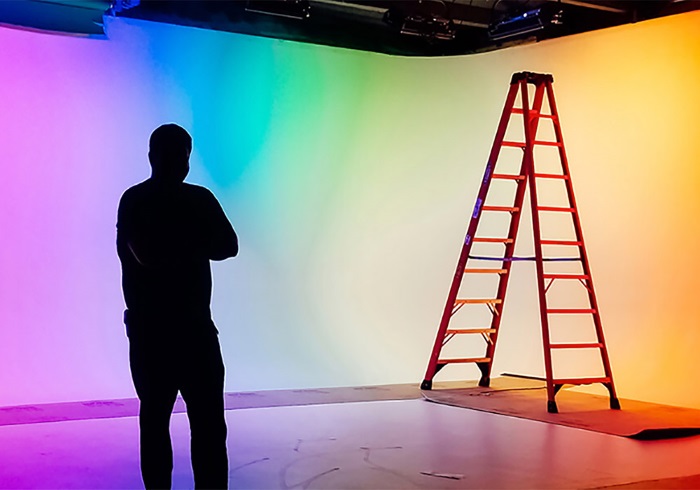
After decades of just presenting in front of a green screen, AR now gives the likes of TV news presenters and weathercasters, sports broadcasters and documentary makers incredible new tools and technologies that can enhance storytelling capabilities and permit them to engage more deeply with viewers. As TV audiences become more distracted (and distractible), broadcasters should look to use every device available to them to secure the viewer’s attention and loyalty. Augmented Reality is an ever-evolving and exciting way for TV stations to meet the audience’s desire for differentiated big screen experiences, and to do so without really breaking the bank.

Lighting perfection

SCREEN AFRICA EXCLUSIVE:

Not many production tools have had a more profound impact on the television broadcast industry than set lighting. Not only does lighting enable the audience to see clearly what the director wants them to see, it creates mood, focuses attention and – more technically – affects and controls the colour temperature, quality and intensity of the broadcast image, making lighting a powerful element of any television production.

Studio, stage and production lighting has recently undergone the most significant transformation in the technology in over a century thanks to the development of the blue LED.

Relatively low cost, low-power portable light-emitting diode (LED) lighting solutions have been on the market for more than 10 years now, but have been more of a compromise than an improvement on existing lighting. LEDs have traditionally been limited by power requirements, size and inaccurate or poor spectral performance.

Just four years ago, Japanese scientists Isamu Akasaki, Hiroshi Amano and Shuji Nakamura were jointly awarded the Nobel prize in physics for their 1990s research and subsequent invention of the blue light-emitting diode, a technology that has touched society in innumerable ways and which has enabled technologies in the broadcast industry that we didn’t think were possible.

As you all know by now, LEDs are devices that emit light when subjected to an electric current. Green and red versions have been around since the 1950s, but creating blue-emitters was a technical challenge that stumped industry efforts for decades. It wasn’t until the 1990s that engineers Isamu Akasaki and Hiroshi Amano, both at Japan’s Nagoya University, in tandem with electrical engineer Shuji Nakamura, then working at Japanese chemicals firm Nichia, succeeded in creating a blue LED.

LEDs are sandwiches of semi­conductor materials. The layers are ‘doped’ with other elements, which provides some layers with extra electrons and others with a surplus of ‘holes,’ where missing electrons leave behind a positive charge. When an electrical current is applied, the electrons and holes combine at the junctions between the layers and emit light as a result.

From the 1980s, physicists focused their efforts on the material gallium nitride as a target for making high-power blue LEDs, but they were faced with several technological hurdles. One was creating thin, high-quality crystals of the material, which are notoriously difficult to grow. Another was ‘doping’ gallium nitride in such a way that it emitted light efficiently. However, Akasaki, Amano and Nakamura persisted with gallium nitride long after their competitors had moved on to other materials, and so the blue LED was born and led to a revolution in the lighting industry.

Blue LEDs, in combination with red and green LEDs, make it possible to produce white light. In more recent times, the development of RGBW (a four-in-one LED chip made up of red, green, blue and white chips) and RGBWW (a five-in-one solution with an extra white chip) has allowed us to make truly accurate, and fully colour-tunable LED lights offering significant power output in the form of large and small studio lights.

Although RGB and RGBW can produce a colour close to white, a dedicated white LED in a RGBWW array provides a much purer white tone and allows you the option of an extra warm or cool white chip. The additional white chip also provides extra scope for colour mixing with the RGB chips to create the huge range of unique shades necessary for film and television productions.

Using software to map and control individual red, green, blue and white LED chips, it has become possible to implement truly accurate correlated colour temperature (CCT) curves over a wide colour temperature range by adding or subtracting (+/-) green in an LED lighting fixture. CCT is a specification of the colour appearance of the light emitted by a lamp, relating its colour to the colour of light from a reference source when heated to a particular temperature, measured in degrees Kelvin (K). It is also possible to precisely factory-calibrate every light individually to match a target profile, which means that every light performs identically. It has also become possible to dial in any colour within the gamut of the light, and so imitate entire gel libraries. Special effects and any number of control protocols can be enabled entirely in software. This kind of precision and control is the future of lighting whether in studio or on location, and has never been possible before.

German motion picture and lighting giants Arri were early adopters and perfectors of LED lighting technology when they formed a subsidiary post-production and creative services company, Arri Media, back in 2015. Their LED lighting technology dominates the market these days, especially their SkyPanel range, which includes the S360 – the largest and most powerful LED soft light available. The SkyPanel is a compact, ultra-bright and high-quality LED soft light that has set new standards for the industry. With a design focused on form, colour, beam field and output, it represents the culmination of more than a decade of research into and development of LED technology at ARRI.

Not to be outdone, US-based Litepanels, a company foundered by a group of Hollywood-based lighting designers, released their flagship RGBWW lighting rig, the Gemini, late last year. The company claims that the Gemini has been designed to give users a daylight-to-tungsten light foundation that then enables them to finely adjust colour shades throughout the full, 360-degree colour wheel. The philosophy behind doing it this way is that users should be able to match a broad range of ambient lighting conditions with more ease. Another plus to the Gemini is the multiple control offerings, through standard DMX, Wireless DMX or Bluetooth control, via an app on your iOS device. These lights have been designed to be stackable and also daisy-chained together, allowing a single designated “master” light to control the others.

There are numerous other players entering the RGBWW field, such as Kino and Cineo Lighting – who produce the Kino Flo Celeb 250, Kino Flo Select 20 and Cineo HSX range, among other offerings – but these battle to compete with Arri and Litepanels on the technical front. If you don’t need all the features like Effects Mode, Colour Mode or even CCT adjustment, then there are plenty of other more value-friendly alternatives available. If you are simply just after a two-by-one soft light that is highly portable and provides pretty accurate colour rendition, then something like the Aladdin BI-FLEX 2 or Westcott Flex Bi-Color LED Mat make a lot more sense.

RGBWW technology has led to a revolution in the lighting industry, so we – and the environment – must thank the research efforts of the three Japanese scientists who successfully developed blue LEDs. It is predicted that by the end of this year, nearly 20% of all power generated worldwide will be saved by people adopting LED lighting solutions in their homes, streets and offices…and, of course, their studios and film sets. Arigatou gozaimasu, guys!

Global music on the up

SCREEN AFRICA EXCLUSIVE:

The music industry touches all of us in one way or another. We’ve all happily sung along to the latest hits while driving to the office, or jogged around the block to the beat of our favourite rocker on the old iPod and watched iconic ‘70s bands strumming away on MTV in the background in the pub after a hard day’s work. We take our consumption of music for granted these days, but the music industry itself is on an extraordinary and challenging path, commercially and technologically speaking, and the business – after 15 years of continual decline – is finally on the up, with more fans purchasing and listening to more music around the globe in increasingly rich and immersive ways, mostly thanks to streaming.

Rob Stringer, CEO of Sony Music Entertainment, describes 2018 as “the most fast-paced and innovative chapter of the music business in decades.” After declining revenue characterised the global recorded music market for 15 years in a row, it’s finally on the up, with positive revenue growth for the third consecutive year. The record industry is finally rebounding in the wake of Napster and the internet’s unravelling of physical record sales, and streaming services are the main driver behind these recovering revenues.

For the first time, streaming has become the single largest revenue source with 176 million users of paid streaming services contributing to year-on-year streaming growth of 41.1 per cent. According to the International Federation of the Phonographic Industry’s Global Music Report 2018, streaming now accounts for 38.4 per cent of total recorded music revenue, and its growth has more than offset a 5.4 per cent decline in physical revenue and a 20.5 per cent decline in download revenue. Total digital income last year accounted for more than half of all revenue (54 per cent) for the first time ever.

It took a long time for record companies to face the challenges of digital and technological innovation, something they have finally embraced as they work with existing and start-up technology companies, licensing their music to create better listening experiences for fans. This is happening both with traditional partners, such as audio streaming services, and new ones, such as social media platforms.

A major factor behind recent growth in the music industry is streaming services, which also offer music subscriptions and are taking music consumption to the next level by integrating Artificial Intelligence (AI) within their platforms..The internet has played the role of catalyst in online music streaming growth, and the growth is attracting the attention of investors worldwide, who have renewed interest in the rebounding music industry. The Swedish company Spotify was recently listed on the stock market, and on its first day of trading on the New York Stock Exchange, the music streaming service finished with a valuation of $26.5 billion.

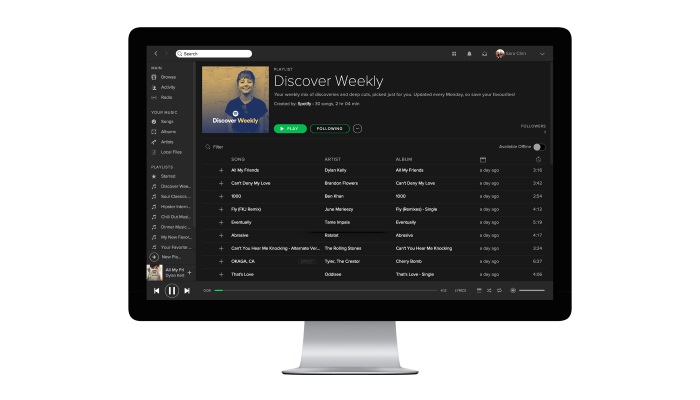
Despite a lot of criticism from their contemporaries, Spotify have evolved themselves into a ‘new record label’, functioning – in many ways – similarly to how a traditional label would. When they launched Spotify for Artists recently, it gave musicians themselves a tool to optimise the way they want to be seen and heard. Spotify describes their data tool as “a one-stop shop that helps the artist get to know their fans better by finding out where they live, how old they are, what features they’re using to discover the artists music, and what other musicians they are listening to.”

The Spotify for Artists tool is likely to worry traditional labels, who conventionally acted as gatekeepers between artists and fans. Spotify themselves have said that since the launch, more than 67,000 artists and labels have submitted music through the tool and more than 10,000 artists have been added to Spotify editorial playlists for the first time. With Artists being able to put their music up the way they want to without any interference from Spotify, counters any claims that the company’s play lists are often biased in favour of relationships within the industry, making it a win-win situation for all concerned.

Spotify is not the only streaming entity around: services such as Google Play Music, Apple Music, Amazon’s Music with Alexa, Pandora and YouTube Music have all emerged as serious competitors, so much so that Apple Music recently surpassed Spotify for the most paid subscribers within the US. Unlike Spotify, these companies have big bank balances that they have invested in artists and are under no pressure to maximise their revenue from streaming music, whereas Spotify has shareholder obligations and needs to become profitable. It’s no coincidence, therefore, that Spotify launched Showtime and Hulu streaming packages and have ventured into the podcast domain, diversifying their product offering and increasing paid subscriptions.

Streaming continues to open and expand territories where there have previously been barriers to generating revenue through licensed music. Countries where there used to be vast differences between population size and consumer-spend on music are finally beginning to realise their potential.

A big coup and potential subscriber surge for Spotify came at the stroke of midnight on the 14 November, when they officially launched Spotify Mena in a range of countries across the Middle East and North Africa. Users in the UAE, Saudi Arabia, Morocco, Egypt, Algeria, Tunisia, Lebanon, Jordan, Kuwait, Oman, Qatar, Bahrain and Palestine can now access the free ad-based, or premium subscription-based service, for the first time. Spotify Mena can be accessed in the Arabic language, and there is also a generous amount of content created specifically for the region. Through its select curators based in Dubai and abroad, more than 40 new region-specific playlists have been added.

Traditionally in business, an owner uses analytic tools to diagnose and understand customer requirements to make an appropriate business change. For the music industry, due to the rapidly-growing number of customers and the wide variety of choices now available, traditional tools don’t cut it anymore. Incorporating AI and machine-learning technologies into music streaming algorithms has quickly become the new norm. If a music service provider can’t ‘guess’ what a user wants to hear, the user will most likely switch to one that can and, if that happens, they lose the listener forever.

Technology, ultimately, rules over all of you melophiles out there, and it’s only just the beginning…

Streaming Sports: A wake up call for broadcasters

SCREEN AFRICA EXCLUSIVE:

Sport broadcasting is going through an interesting phase at the moment. Over the past two years, YouTube, Facebook, Twitter, Amazon, and Yahoo (amongst a host of others) have all been buying non-exclusive rights to live sports packages. More recently, over the past few months, broadcasting giants like Fox Sports in Australia, for example, have seen the need to change the way that they deliver sports content to their audiences.

Are we on the edge of a watershed moment in sports broadcasting? I think indeed we are, and here’s why: over-the-top sports video content is set to generate revenue of $30.6 billion as we approach 2020, and everyone wants a cut!

Just twenty-four months ago, British tech start-up The Perform Group launched a subscription video streaming service called DAZN (pronounced “Dazone”), headed by former ESPN president John Skipper. The group, who has invested hundreds of millions of dollars in buying up sports rights across Europe, Japan, Canada and the USA, had obviously seen the potential of live streaming and on-demand video services in the sports broadcast arena.

Today DAZN, who employ over a thousand staff members, offer more than 8,000 sports events a year, ranging from major to minor competitions, including the Premier League, Bundesliga, La Liga, NBA, NFL, MLB, Formula One, and is the host broadcaster of Japan’s J.League, screening every game of the season across all three divisions. The two-year-old sports streaming platform has millions of subscribers across seven countries and plans to be in 13 more by 2022. They have a massive team of developers and engineers, who constantly gather and interpret data to gauge how the audience is reacting to an event and what methods they can develop to retain them, for example, to keep engagement up when matches get boring. A team of user-experience designers work on trying to get people to interact, similar to how people do on Facebook, by crowdsourcing information from other fans and passing it on to encourage communication between fans.

Last year, DAZN showed tremendous growth, with revenues rocketing from £8.7m to £90.8m, and is not the only brand to start to see the potential to disrupt the sports broadcasting market.

Recently, Amazon struck a $130m non-exclusive streaming deal for NFL matches, alongside NBC and CBS, and in the UK it has deals for the US Open tennis and the ATP Tour, while also being close to securing streaming rights for the Premier League. Also in the USA, Disney is gearing up to launch a streaming service based on ESPN content.

The traditional sports broadcasting market, therefore, has become fragmented, and the rise in costs fuelled by the rivalry between traditional broadcasters has undoubtedly made it harder for new entrants.

As high-speed internet access spreads, and younger consumers increasingly opt for viewing events on mobile devices, it’s also clear that the sporting bodies themselves have seen the potential behind their massive fan bases and have started experimenting with streaming as an alternative to traditional broadcasting.

Cricket Australia live-streamed their controversial ‘sandpaper’ tour of South Africa in early 2018 to hundreds of package-deal subscribers in the Pacific region as a test, which – by all accounts – was a great success. A few months back, the New Zealand public were perhaps pleased to hear that Sky Sport (a pay-tv service) had lost the bid to broadcast the upcoming Rugby World Cup to Spark Sport, a newly-formed streaming service run by the telecommunications company, Spark. In a matter of months, Spark also secured the exclusive rights to the English Premier League for three years, the Women’s Rugby World Cup in 2021, the UEFA Champions League and UEFA Europa League. Linear and traditional television is still Sky TV’s bread and butter, but they have been slow to adapt to the public’s changing consumption habits, and Spark are gearing up to fully capitalise on the streaming space, with low-cost subscriptions being talked about prior to the 2019 launch of the service.

Across the Tasman Sea, FOX Sports (Australia’s equivalent to Sky Sport) has been far more pragmatic in their approach to the changing times. They have quietly launched Kayo, a new streaming service for their sports fans. Already dubbed the “Aussie Netflix of sport”, Kayo is currently in beta testing and has been opened to the general public to sign up as they await the full service in 2019. There are more than 50 sports channels already covered by Fox Sports, ESPN and Bein on offer, at a low-entry price point and no lock-in contract. The service also includes HD streaming and is available on laptops, mobiles and streaming via Chromecast, with apps on Apple TV, iOS and Android to follow soon. FOX Sports doesn’t seem too worried about declining traditional TV viewership in light of their big shift towards streaming: their new mobile plans are all about reaching more people at a more affordable price, and therefore adding to and expanding their pay-tv platform.

The big concern among many sports fans, however, will be the cost of potentially having to pay for several different services in order to keep up with the whole range of live sports available. No more ‘one-stop shops’ is something that fans might just have to come to terms with, although DAZN -who are charging just US$12 a month – intend to keep costs low by amassing tens of millions of customers. In their words: “We have seen in music with Spotfiy and Pandora, in TV with Netflix and Amazon, that people will pay a sensible amount of money for a good service, so we want to do the same for sport. We want to be a Netflix for sport.”

I don’t believe that this is the end of linear televised sport. The sporting bodies, tech companies and broadcasters all have the opportunity to capitilise on the amazing era of technological development we are witnessing. In the prophetic words of Bob Dylan: “Come writers and critics, who prophesise with your pen/Keep your eyes wide, the chance won’t come again/For the loser now, will be later to win…/The times they are a-changin’.”


Audio over IP, re-thinking audio delivery

SCREEN AFRICA EXCLUSIVE:

Since the early 1980s, complex audio signal routing has most often been done with the help of Time Division Multiplexing (TDM), a method of transmitting and receiving independent digital signals through a single cable that can carry more than one channel.

The broadcast industry first adopted a standard developed by the Audio Engineering Society (AES) for the exchange of digital audio signals between professional audio devices called AES3, and later Multichannel Audio Digital Interface (MADI), in order to transport signals. The growing number of audio channels required in production and broadcast called for digital audio routers that could handle a larger capacity of digital signals. However, TDM connections were not very efficient as the traffic grew, and the industry needed a re-vamp to address the situation. Today, network technologies finally allow the industry to fully realise real-time applications: networking standards have evolved to an extent that turns interactive audio applications into a realistic possibility.

Throughout this year we have seen a huge push in technologies to facilitate IP-based infrastructures in the media industry. With terminologies like High Frame Rate (HFR) video, High Dynamic Range (HDR) and Ultra High Definition (UHD) being bandied about in the broadcast arena, which all reference video production and broadcasting, we have started to see a new term being thrown around in the audio world: that of Next Generation Audio (NGA).

NGA is a term being used not only to describe the emerging object or channel-based immersive sound formats (Dolby Atmos is a good example) that go together with the new broadcast and media distribution video formats, but also to describe new practices that are now acknowledged to be dependent on IP-based workflows and distribution platforms, as recommended by both the Society of Motion Picture and Television Engineers (SMPTE) and the Institute of Electrical and Electronics Engineers (IEEE).

Riding on the back of all the exciting changes that are currently happening in the media business, the topic of audio-over-IP (AoIP) and the ongoing transition to fully IP-enabled operations in all platforms has become big news.

Internet Protocol (IP) technology is revolutionising the broadcast industry, pushing aside traditional approaches that relied on a mass of cable connections running from one point to another, each restricted to transporting a given type of media or data between the two locations and, in audio terms, limited to a relatively low channel count. These are being replaced with network connections that allow for higher audio channel counts and the ability to pass different types of media and data over the same connection.

In an IP-based operation, a device only needs one connection to a network to be able to send and receive audio and data to and from any other device on the network, rather than needing a direct connection with every other device. Not only is the number of cables massively reduced, but the cables themselves are shorter, since they only need to connect with the nearest switch, rather than running all the way to the piece of kit they connect with. As is well known, network-based systems rely on conventional and inexpensive off-the-shelf IT technology originally designed to forward a large number of data packets without having to deliver them in real-time. It is precisely for this reason that IP technology has been at a disadvantage with regard to audio transportation.

Yet the technological progress that has been made in this field makes it increasingly attractive for broadcasters, post production houses, concert venues and sound studios to implement AoIP technology. Besides the tremendous cost-saving effect on equipment, network-based solutions for audio delivery hold the potential of enabling broadcasters, recording studios and live venues to leverage their existing infrastructure and to achieve greater flexibility in terms of set-up, network configuration and content sharing.

While established AoIP standards like Dante, Ravenna Network and AVB have been designed with the fields of broadcasting and live performance events in mind, they have also paved the way for multi-channel setups and the distribution of real-time high resolution audio streams in recording and mix-down studios.

It is, for instance, now possible to work with multiple loudspeaker setups like 5.1, Dolby Atmos, or Auro 3D simply by using a single Ethernet router to distribute audio material among several devices. AoIP has expanded to become one of the most progressive audio technologies today, so much so that even home-based studio musicians are ditching their USB interfaces for networked solutions.

The audio industry as a whole, in collaboration with the Audio Engineering Society (AES), has developed an interoperability standard called AES67 which allows existing protocols to connect to each other and interchange audio. The standard is not intended to be a solution on its own, but rather one that provides a means for exchanging audio streams between areas with different networking solutions or technologies. AES67 defines a minimum feature set: if two devices are AES67 compliant, then they can exchange audio streams with each other.

Last September, the approval of the first broadcast IP standards (SMPTE ST-2110) moved the potential of IP for broadcasting to a completely new level. Whilst audio can be streamed as part of a video signal, ST-2110 looks towards “elemental” streaming, in which audio, video and metadata is streamed separately, but over the same network and in perfect alignment. The ST-2110 standard defines the use of AES67 for audio as part of its elemental streaming. This means the audio component and its metadata are easy to access and don’t require unpacking a video stream, therefore removing the latency issues introduced by encoding and decoding.

Audio professionals, whether they are working in post-production facilities, recording studios, live productions or the broadcast field, are now conscious of the advantages of working with networked systems, and they seem to be confident that they are able to adopt flexible solutions based on any of the existing popular protocols (such as Dante and Ravenna), knowing they will be able to connect and interchange audio whenever needed thanks to the AES67 interoperability standard.

For the audio engineers out there, the emergence of these key standards will smooth the path – but it’s critical that you gain a keen understanding of AES67 and SMPTE ST-2110, as well as the nuts and bolts of configuring and managing IP switches. As if you don’t already do enough!

- Advertisement -
- Advertisement -
- Advertisement -

Pin It on Pinterest