Home Authors Posts by Durban FilmMart Press

Durban FilmMart Press

60 POSTS 0 JOBS
The co-production market for African filmmakers, a joint programme of the Durban Film Office & the Durban International Film Festival.

DFM 2018: How to unlock up to $2 billion of annual box office revenues in Africa

If Africa were to follow China’s example and broadly invest in cinema infrastructure, it could achieve annual box office revenues of $1.5 to $2 billion; with Nigeria and South Africa accounting for as much as $500 million. This is one of the main findings of the 2018 Framing the Shot: Key Trends In African Film report, which was conducted by founder of 234 Media, Dayo Ogunyemi, in partnership with the Goethe-Institut and with support from the German Federal Foreign Office. Launched at the Durban International Film Festival (DIFF) 2018, the study aims to fill the substantial gap in information and analysis about the fast-changing film industry in sub-Saharan Africa.
 
Framing the Shot particularly recommends improving access to finance, incubating film-specific business skills and capacity and developing effective distribution. Says the report’s author, Ogunyemi: “For too long, Africa’s film industry has been the subject of many anecdotes and much supposition; the absence of credible, comprehensive data has led to wasted resources and lost opportunities which the continent can scarcely afford […] If African countries do not plan, invest and collaborate today, the trade deficit around content consumption will widen and the opportunity to shape the tastes and preferences of future generations of Africans will be lost.”
 
The Framing the Shot report catalogues and analyses the major opportunities and challenges that Africa’s film industries face through four substantive parts:
  • A survey of African filmmakers and general analysis of the African film landscape
  • Country studies of Africa’s two largest film industries: Nigeria and South Africa
  • Case studies of three African films from development through completion; a comparison of the commercial performance of an African and a European film; as well as lessons drawn from the diaspora — specifically in the context of African-American film.
  • Conclusions on African film in the global industry context and recommendations on priority steps to address the main opportunities and challenges identified
Says Noemie Njangiru, Culture and Development coordinator at the Goethe-Institut: “There are two reasons behind our investment in reliable information about the continent’s film industries: Firstly, the sector has a huge potential to contribute to economic growth and create employment opportunities. Secondly, we believe that strong film industries and better conditions for pan-African collaborations can contribute to undoing stereotypes, particularly in the context of the Western gaze on ‘Africa’.”
 
Taking a closer look at the South African film industry, the report suggests extending the current “generous incentive system that is primarily centered on production […] to the post-completion value-chain — sales, marketing and distribution.” The study continues: “For filmmakers and audiences that continue to endure the historical disadvantages meted out under apartheid, more must be done. Cinema infrastructure must be extended to under-served townships in order to unlock latent spending power on film. One of the most promising ways in which South Africa can do this is to support entrepreneurs and SMEs to close the gaps in distribution capacity and the deficits in exhibition infrastructure in townships and rural areas.”
 
Meet Dayo Ogunyemi at DIFF and DFM:
  • Distribution: Debunking the Myths – Understanding the Exploitation Value Chain
– Sunday, 22 July / 14:00 – 15:00 / Suite 5


The National Film and Video Foundation at DIFF 2018

The National Film and Video Foundation (NFVF) has had a strong presence at the Durban FilmMart (DFM) and Durban International Film Festival (DIFF), which is currently taking place in Durban and running until 29 July 2018.

Five NFVF-funded films were included in the official festival selection this year; Farewell Ella Bella, Mayfair, Not In My Neighbourhood, The Adventures of Supermama and Table Manners. “It is encouraging to the see the content funded by the NFVF dominating local festivals along with other continental productions,” said an NFVF representative.

Through the DFM conference strand, the NFVF has been engaging with the broader South African film industry and sharing its key strategic objectives for this new financial year. As the national film funding body, the NFVF has spearheaded engagements with all the provincial and national structures in an effort to lead the strategic alignment of all programmes and services.

“As a finance and co-production market which aims to create partnerships and further the development and production of a film on the African continent, DFM is perfectly positioned to advance the NFVF’s objective of establishing and building partnerships within the African continent. The time has come to create fruitful relationships with other African countries,” commented an NFVF representative.

“Congratulations to all the NFVF funded films that will be screened in the official programme at the Durban International Film Festival. The NFVF will be making various announcements during the festival, which are aimed at creating more opportunities for the production of content and galvanising collaborations and partnerships. Collaborations and partnerships are very important to us, we know that if we are to develop and promote a transformed, equitable, and sustainable film industry, we cannot do this alone. I look forward to productive engagements at DFM and a display of world-class cinema through DIFF as well as the third BRICS Film Festival also taking place at the Playhouse from 22 July,” said NFVF acting CEO, Shadrack Bokaba.


DFM2018: Are there any scared cows in filmmaking?

On day two of Durban FilmMart (DFM) 2018, running until 23 July – alongside the 39th Durban International Film Festival at the Elangeni Hotel in Durban, KwaZulu-Natal – the South African Screen Federation (SASFED) held a panel discussion titled ‘Are there any sacred cows in filmmaking’.

In recent times the film industry has seen a number of productions, dealing with culturally sensitive subject matter, spark intense debate and challenge laws regarding freedom of expression – this is the difficult and often messy part of working with cultural content. The panel discussion brought together a group of informed African speakers who presented opposing arguments about filmmaking and cultural sensitivity. The questions posed included, where is the line drawn and when can it be pushed; and by whom?

The panel, facilitated by Jean-Pierre Bekolo, included filmmaker Sechaba Morejele, film programme curator Katrina Hedren, member of the Documentary Filmmakers’ Association Patricia van Heerden, and producer Lwazi Manzi.

A large part of the debate was centred on the recent controversy surrounding previously banned, award-winning South African film Inxeba (The Wound). Panellists made the point that when dealing with issues surrounding culturally sensitive content there are three important aspects to consider:

  1. Who is making the film and what is the intention in making it?
  2. Who is funding the film?
  3. The cinematic gaze.

With the aforementioned in mind, the overarching question is ‘what is the function of art in society?’ While to some (filmmakers), it is to ‘disrupt, to spark debate, to push boundaries’, to many – particularly in a country like South Africa, with our history of Apartheid – art is there to enforce Ubuntu, to challenge the status quo, to give a voice to the oppressed. Manzi said that because of our history, we need to ask ourselves ‘how do we protect freedom of expression while still protecting human dignity?’

Morejele said that when approaching the issue regarding how we deal with culturally sensitive content, context is always important, and in this instance the ‘white elephant’ in the room is that the issue – to many South Africans – is largely who is telling the story. “When a previously dominating group, decides to tell the story of a previously oppressed group, and dominate that perspective, problems will arise,” he said. “Especially in SA… in such a historically unequal society, who is telling the story is such a sensitive but important issue that we need to talk about,” he added.

Van Heerden argued that “the right to freedom of expression supersedes the right to be offended” and added that it’s a slippery slope to say that certain stories and cultures are off limits to certain artists.

In response Manzi said that “life really brings out nuance and finesse when you are faced with restrictions.” This means that as filmmakers, we need to approach certain subjects with respect: “work through those restrictions and limitations and still tell your story while being respectful of the culturally sensitive issue,” she said.

“The common misconception is that a ‘sacred cow’ is a secret, it’s something to hide. It doesn’t occur to us that it may be a ‘sacred cow’ because there are things to preserve… because there are beautiful things that should not be misappropriated,” added Manzi.

Hedren concluded saying that as artists, filmmakers and storytellers, we are by nature empaths, and we should use our empathy to guide us when telling these culturally sensitive stories.

Follow Durban FilmMart and Durban International Film Festival on Twitter, Instagram and Facebook to keep up with all the action.

DFM 2018: A bird’s eye-view of global industry trends with Stephen Follows

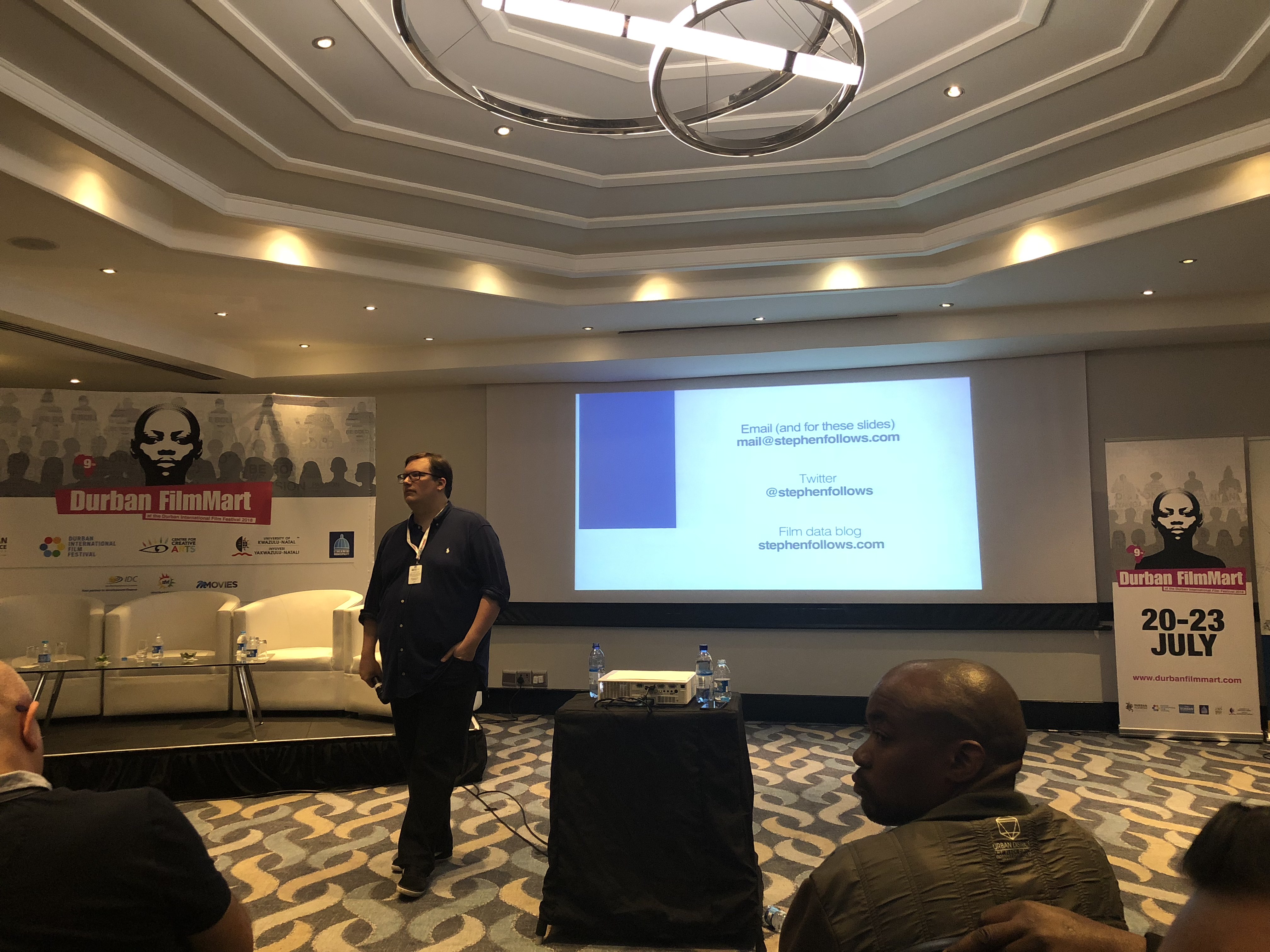
On day one of the 9th Durban FilmMart – taking place in Durban, KwaZulu-Natal, from 20 to 23 July 2018, alongside the 39th Durban International Film Festival – Stephen Follows presented an informative and highly entertaining two hour session titled ‘A bird’s eye-view of global industry trends’.

An experienced film industry consultant and active researcher based in London, UK, Follows is no stranger to the industry. In his two-hour session he gave attendees an incisive overview of the current market shifts and trends shaping the film industry across key markets. Using current stats, he discussed and demonstrated what’s being made, what’s changing and how we (filmmakers) can apply this knowledge to our benefit.

Key take outs from the session:

  • In the past 10 years the global supply of movies has increased greatly: Thanks to camera phones, changes in the sharing of information, and the fact that – in Follows’ words – people are getting richer on average, the amount of films being made has more than doubled.
  • Even though there is a vast increase in the number of films being made, the bulk of these are coming from independent filmmakers.
  • With regards to which genres are winning and which are waning, in general there are a lot more films made of every genre. However, Sci-Fi, horror, and history films are on the rise while romance films are becoming less popular. Why is that? According to Follows, if you take a look at what’s currently happening globally – be it politically, economically, socially or culturally – that should give you your answer. Viewers are favouring subject matter that challenges, opens their minds and educates.
  • Over the past 20 years, the number of Hollywood studios releases have stayed the same and continued to dominate the list of top 50 grossing films – this despite more independent films being made than ever before. This means that regardless of changes in the global film industry Hollywood – for the most part – remains the same.
  • Notably, China has shown the greatest percentage increase in cinema admissions between 2012 and 2016. This thanks to changes in their legislation.
  • In the past 10 years men and women have occupied a more or less equal share of cinema audiences, with women moviegoers leading with 51 per cent. Women are dominating the audience share for romance, family and animation films, with men dominating the audience share for crime, action and Sci-Fi. This has resulted in a rise in targeted films being made, meaning that there are more films being made aimed at the female audience alone, as well as more films being made solely for men.
  • Interestingly, fewer young people are going to the movies than ever before.
  • In 2017, 25 per cent of films released in US cinemas did not feature the English language. Of that 25 per cent there was a decline in French, Italian and German films and an increase in Hindi, Mandarin and Korean films. Why? Because China is influencing the film industry more than ever before. Not only is China producing more films than ever before, they are also purchasing more than ever before and with this, making their own rules regarding content.

In conclusion Follows urged filmmakers to not focus on the data itself but to use these statistics to understand how the world is changing and how we are changing as humans, and let that influence the kind of films we make.

“Don’t focus so much on the money… make beautiful films with universal appeal because we are more similar than we are different in this world,” Follows concluded.

Follow Durban FilmMart and Durban International Film Festival on Twitter, Instagram and Facebook to keep up with all the action.

9th Durban FilmMart open for business

Echoing government’s reassurance to investors into South Africa’s economy, the Durban FilmMart, one of Africa’s premier film industry events will be open for business when it begins its four day event on 20 July during the 39th Durban International Film Festival (DIFF).

The DIFF in partnership with the eThekwini Municipality’s Durban Film Office, the City’s film industry development arm under the Economic and Development cluster has for nine years presented this important gathering for filmmakers from across the continent and further afield with the specific aim at growing the African industry.

“The DFM attracts an array of filmmakers including directors, producers, scriptwriters, investors and financiers, distributors and broadcasters as well as curators for festivals and other markets, and is globally renowned for providing an important springboard for African stories and ideas, collaborations and investment into film projects,” explains Toni Monty, head of the DFO and DFM. “Essentially this is how film projects are given a leg up to help them on their way.”

Speaking on behalf of the DFO, Monty says, “As a government entity, in partnership with the DIFF, we take our role very seriously in working on a highly professional level with filmmakers to ensure we provide an environment that is enabling for them.”

“The Mart brings in over 400 experts, people and organisations interested in potential film projects for further development. Here they are able to meet filmmakers from Africa, discuss and engage and then it’s over to them to conclude their business independently. The event ultimately seeks to build Durban as an important hub for doing film and television business in Africa.”

The DFM includes a series of masterclasses, seminars and panel discussions to help filmmakers keep up to date on trends, innovations and policies. There are also many networking opportunities for them to build strong business connections on both a continental and international level.

New for DFM is the appointment of local arts and culture administrator, Russel Hlongwane as the curator of both the DFM and DIFF’s industry programme, which has enabled a consolidation that speaks to the DIFF’s theme – ‘Leave No Filmmaker Behind.’

Hlongwane explains, “We have sought a programme that provides delegates with innovation and new thinking, and thought-leadership that we believe will provide insightful and meaningful engagements that can be taken forward.”

Key speakers this year include Dayo Ogunyemi, a Lagos-based creative entrepreneur and investor who will give presentation that foregrounds African markets as lucrative territories. Stephen Follows from the UK, is a leading trainer and thought-leader in how storytelling can be used to change hearts and minds. Follows is also a data researcher in the film industry, and will present a high level session which unpacks key shifts and trends shaping the market from an international perspective. LA-based Peter Russell is a screenwriter and story doctor in Hollywood who will present a session in which he will share the secrets of how film storytelling can be adapted into the red hot television storytelling market.

Another major highlight, which is sure to have filmmakers interests piqued, is that Richard Ray Perez, director: Creative Partnerships at the Sundance Institute’s Documentary Film Programme will address a gathering for delegates entitled ‘Stories of Change: A Collaborative Model for Impactful Storytelling.’

Sessions at DFM will look at the aesthetical and fundamental values that will define films from the African continent; insights into ways African filmmakers can source and work the often hard and tricky world of financing structures on the continent; how to work towards a more “entrepreneurial approach’’ to filmmaking without compromising creative content; distribution, and what makes a successful documentary.

Speaking to current issues, the South African Screen Federation will lead a discussion entitled, ‘Are there any Sacred Cows in Filmmaking?’ following the recent public debates around handling of sensitive social and cultural issues within film, and Sisters Working in Film and Television (SWIFT) will lead discussions on issues of sexual harassment, race and transformation in the industry. Other important discussions taking place include ‘The practicalities and importance of Co-Production Treaties and Copyright vs Copyleft – where to from here?’ The National Film and Video Foundation will also present a series of workshops and discussions on policies and local industry trends.

Additional insightful sessions will include the Department of Trade and Industry’s launch of the Industries Film Incentives Guidelines and Emerging Black Filmmakers’ Fund Guidelines. The programme will include a set of discussions, led by the Department of Arts and Culture, on current and future collaborations within the BRICS member countries. Filmmakers will have the opportunity to network with member country filmmaker delegations in attendance.

The official pitching forums will include representatives from sixteen pre-selected African film projects that will be pitching film projects to leading financiers, broadcasters and other potential funders and investors at the DFM’s finance forum.

Running parallel to the DFM, and supported by the experts and visiting speakers, is the Durban International Film Festival’s open industry programme, Isiphethu, aimed at introducing entry level, emerging filmmakers, micro-budget filmmakers as well as interested members of the public to the inner-workings of the world of cinema.

Manager of the DIFF, Chipo Zhou says, “Our strategy for Isiphethu, is to support filmmakers in developing quality content. We want to be able to offer these filmmakers opportunities to incubate projects, be mentored by experts, network with seasoned and experienced peers, and be included in the overall vision of the DIFF and DFM, to grow quality African content. In short to include this sector of the industry into the greater industry fold, “leaving no filmmaker behind.”

“The “economy” of film, is central to the objectives of the Durban FilmMart to encourage African filmmakers to look within to collaborate, finance and develop content,” says Toni Monty. “We are very excited to see so many DFM alumni projects that have come to fruition, doing very well on local and international festival and cinema circuits and many with good distribution deals: these include films like DIFF’s closing film Rafiki, Inxeba: The Wound and, Five Fingers for Marseilles, as well as Silas which is also screening at DIFF to name a few. This is exactly the strategy created by the DFO and DIFF nine years ago, and it is heartening to see the long-term value it provides for the African film industry. This year’s programme is rich in diversity and complexity, and we are looking forward to seeing Durban come alive with a real buzz of the business of filmmaking.”

The 9th Durban FilmMart takes place in Durban, at the Tsogo Sun Elangeni from 20 to 23 July 2018, during the 39th edition of the Durban International Film Festival (19 to 29 July 2018).

Online registration closes on 29 June 2018, but there is still opportunity to register on 19 July  from 14h00 manually at the event. For more information on the Durban FilmMart and to register as a delegate visit the DFM website or for Durban International Film Festival, visit the DIFF website.

CaribbeanTales and DFM renew partnership

CaribbeanTales Media Group (CTMG) and the Durban FilmMart (DFM) recently announced the renewal of their partnership to support the development of original, serialised television content and films created by women from Africa and the African Diaspora.

CineFAM is the CaribbeanTales programme that supports bold, original films and television series by women of colour worldwide. In the Haitian-Creole language, Cinefam means “films by women.” This Accelerator Incubator Programme builds capacity and creative leadership among women of colour who are traditionally under-represented in leadership roles in the film and television industry globally.

“We have invited a select group of experienced South African women producers to bring their original television series projects that are currently in development to the second edition of CineFAM – Africa to be held during DFM2018,” says CaribbeanTales CEO Frances-Anne Solomon. “We know they will enjoy CaribbeanTales’ unique two-day intensive Accelerator Programme that ensures an excellent overview and close guidance on the nuts and bolts of production within the context of Canada and South Africa. They will learn how best to meet the co-production demands of these two countries with their stories, finance and marketing strategies along with enhancing pitch skills.”

“We are absolutely thrilled to embark on the second edition of our partnership with CaribbeanTales. The 2018 Accelerator Incubator Programme will not only provide an exciting platform to support the development of women-led audiovisual content in Africa, it will create a space to interrogate the application of the SA/Canada co-production Treaty with serialised content. Through this partnership, we hope to build a bridge between the two organisations that will raise the voices of African women filmmakers,” said Toni Monty, head of the Durban Film Office and DFM the co-production and finance market, which is a joint programme of the Durban Film Office (DFO) and the Durban International Film Festival (DIFF), South Africa.

“We are incredibly excited to continue to build on this extraordinary initiative with the Durban Film Mart that opens the gateway of co-productions between our organisations and our two countries” says CaribbeanTales CEO Frances-Anne Solomon. “Our goal is to see the programme grow from training to production within the next couple of years and to show the world what women from Africa and the African Diaspora can do within the Canada/South Africa co-production treaty.”

CineFAM – Africa, led by CaribbeanTales vice president Nicole Brooks, is a two-day programme that will take place during the Durban FilmMart from 20 to 22 July 2018.

This two-day Accelerator will culminate in a private mini-pitch to deliver and work with local and international (specifically Canadian) broadcasters and funders for consideration and feedback. The winner will qualify to participate in the renowned CaribbeanTales Incubator (CTI), in Toronto, Canada. CTI is a year-round development and production hub for Caribbean and Caribbean diaspora producers that aims to create strong, compelling and sustainable content for the global market. Thus, CTI will increase the pool of world-class indigenous film and television content and build the region’s audiovisual capacity.

Durban International Film Festival 2018 announces opening and closing films

A thriller/horror film and a LGTBI love-story have been selected respectively as the opening and closing films of the 39th Durban International Film Festival (DIFF), which takes place from 19 to 29 July 2018.

In a bold move to shift perceptions of how African stories can be told cinematically across genres, the DIFF has selected a South African debut thriller/horror feature The Tokoloshe, directed by Jerome Pikwane, for opening night and Kenyan director, Wanuri Kahiu’s tender story of lesbian love, Rafiki as its closing film.

“With the current global focus on giving women a voice in a world dominated by masculinity and systemic misogyny, we wanted to book-end the festival with films that tell stories about women, their strength and their survival. We also want to showcase, from a cinematic point of view, that there are many ways to tell these stories,” says manager of DIFF, Chipo Zhou.

The Tokoloshe is directed by Jerome Pikwane, co-written with novelist Richard Kunzmann, and produced by Dumi Gumbi and Cati Weinek of The Ergo Company.

In The Tokoloshe, which stars Petronella Tshuma, Dawid Minnaar, Kwande Nkosi, Harriet Manamela and Yule Masiteng, a young woman, crippled by suppressed emotions, must find the courage to face an insatiable demon, wrought in her own childhood, when she tries to save the life of a girl-child abandoned in a rundown Johannesburg hospital.

“Using the horror genre I wanted to investigate how we suppress trauma, and what happens when the trauma comes to the surface. In effect, the Tokoloshe in South African mythology has become a foil for abuse that is ingrained in our society,” says director Jerome Pikwane. “And the characters, their journey, their relationships are the focus and not the beautiful shots nor the CGI, although we have that too.”

“The film is not quite what one expects from its title, so I dare audiences to see beneath the surface,” says Zhou. “It is a horror film, crafted so intricately, unveiling the menace that is our everyday burden as women in this country. But the film depicts the story of a survivor, not a victim. It is a chilling story, one that needs to be told now and is particularly relevant as it gives voice to the voiceless.”

Closing film Rafiki, directed by Wanuri Kahiu, produced by Steven Markovitz and starring Samantha Mugatsia and Sheila Munyiva, is a touching tale of two very different girls living in Nairobi, who fall in love. Co-written with Jenna Bass, the film was the first Kenyan feature film to be invited to Cannes Film Festival 2018 as part of the Official Un Certain Regard selection, and was a project in the 2012 Durban FilmMart.

“Over the years of developing this film, we have seen worrying developments in the anti-LGBTI climate in East Africa,” says director Wanuri Kahiu. “Local films and international TV shows have been banned because of LGBTI content. This has muffled conversations about LGBTI rights and narrowed the parameters of freedom of speech. My hope is that the film is viewed as an ode to love, whose course is never smooth, and as a message of love and support to the ones among us who are asked to choose between love and safety. May this film shout where voices have been silenced.”

“We are delighted to be able to screen Rafiki at DIFF,” says Zhou. “The film speaks to the issues of patriarchy that has led the film to be banned in its own country, and closes the festival with a programme packed with films dealing with a host of current challenges that those marginalised in our society, and especially women, are ‘loudly’ grappling with.”

Alongside the DIFF is the Durban FilmMart, a co-production market in partnership with Ethekwini Municipality’s Durban Film Office, Talents Durban, in cooperation with the Berlinale Talent Campus and the Wavescape Surf Film Festival.


Durban FilmMart announces 2018 programme

One of Africa’s premier film industry events, the Durban FilmMart (DFM), a joint programme of the eThekwini Municipality’s Durban Film Office (DFO) and the Durban International Film Festival (DIFF) has ramped up its offerings to delegates for its 9th edition, which takes place from 20 to 23 July 2018.

“The 2018 Edition of Durban FilmMart offers some exciting opportunities through a diverse programme of master classes, seminars and events for African filmmakers to build business networks, explore collaborations, develop content, benchmark their creative and production work in line with international trends, and look for investment and business opportunities,” says Toni Monty, head of the Durban Film Office. “But what underpins the DFM, is the focus on developing the industry in Africa, whilst drawing on local African and international expertise.”

“There are a number of lead speakers presenting at this year’s DFM,” says Russel Hlongwane, curator of the DFM and DIFF industry programme. “This year’s programme promises to stretch the mindsets of industry players, providing them with innovation and new thinking, coupled with opportunities to engage with successful and respected thought-leaders that include, amongst others, Dayo Ogunyemi (Nigeria), Stephen Follows (UK) and Peter Russell (USA).”

Dayo Ogunyemi is a Lagos-based creative entrepreneur, investor and founder of 234 Media, which makes principal and private investments in the media, entertainment and technology sectors in Africa. He offers an insightful presentation entitled Africa through the Lens that foregrounds African markets as lucrative territories. His presentation gives context and the state of regional film industries and economies across sub-Saharan Africa.

Stephen Follows will present a high level session entitled A Bird’s Eyeview of Global Industry Trends, which unpacks key shifts and trends shaping the market from an international perspective.  Follows is a leading trainer and thought-leader in how storytelling can be used to change hearts and minds, and data researcher in the film industry, whose work has been featured in the global major publications such as The New York Times.

LA-based Peter Russell is a screenwriter and story doctor in Hollywood whose clients include Imagine, HBO, Participant, Viacom and CBS Television. Peter will present a session entitled The Secrets of TV Mini-Series and Serial Stories & How Filmmakers Can Evolve Into TV Storytellers in which he will share the secrets of how film storytelling can be adapted into the red hot television storytelling market – both in TV mini-series and the serial TV form.

Panel discussions this year include Aesthetics of African Cinema which looks to explore the aesthetical and fundamental values that will define films from the African continent; Financing Films in Africa – providing insights into ways filmmakers can source and work the often hard and tricky world of financing structures on the African continent; Breaking through the Business of the Business will look at how to shift from being a “project based”  filmmaker towards a more “entrepreneurial approach” without compromising creative content; Distribution – Debunking the Myths; and Getting to the heart of your documentary features a diverse panel of continental and international professionals, discussing documentaries that set themselves apart from the rest and the success factors behind this.

Speaking to current issues, the South African Screen Federation will lead a discussion entitled, Are there any Sacred Cows in Filmmaking?, following the recent public debates around handling of sensitive social and cultural issues within film, and Sisters Working in Film and Television (SWIFT) will lead discussions on issues of sexual harassment, race and transformation in the industry. Other important discussions taking place include The practicalities and importance of Co-Production Treaties and Copyright vs Copyleft – where to from here? The National Film and Video Foundation will also present a series of workshops and discussions on policies and local industry trends.

Additional insightful sessions will include the Department of Trade and Industry’s launch of the Industries Film Incentives Guidelines and Emerging Black Filmmakers’ Fund Guidelines. The programme will include a set of discussions, led by the Department of Arts and Culture, on current and future collaborations within the BRICS member countries. Filmmakers will have the opportunity to network with member country filmmaker delegations in attendance.

The official pitching forums will include representatives from sixteen pre-selected African film projects that will be pitching film projects to leading financiers, broadcasters and other potential funders and investors at the DFM’s finance forum.

Running parallel to the DFM, and supported by the experts and visiting speakers, is the Durban International Film Festival’s open industry programme, Isiphethu, aimed at introducing entry level, emerging filmmakers, micro-budget filmmakers as well as interested members of the public to the inner-workings of the world of cinema.

Manager of the DIFF, Chipo Zhou says, “Our strategy for Isiphethu, in terms of industry growth, is to support filmmakers in developing content. But it is also about supporting the development of the quality of content, which may ordinarily be impacted on by the smaller budgets they may be working with. We want to be able to offer these filmmakers opportunities to incubate projects, be mentored by experts, network with seasoned and experienced peers, and be included in the overall vision of the DIFF and DFM, to grow quality African content. In short to include this sector of the industry into the greater industry fold.”

“Central to the objectives of the Durban FilmMart to encourage African filmmakers to look within to collaborate, finance and develop content,” says Toni Monty,. “We are very excited to see so many DFM alumni projects that have come to fruition, doing very well on local and international festival and cinema circuits and many with good distribution deals: these include films like Rafiki, Inxeba: The Wound and, Five Fingers for Marseilles to name a few. This is exactly the strategy created by the DFO and DIFF nine years ago, and it is heartening to see the long-term value it provides for the African film industry. This year’s programme is rich in diversity and complexity, and we are looking forward to seeing Durban come alive with a real buzz of the business of filmmaking.”

The 9th Durban FilmMart takes place in Durban, at the Tsogo Sun Elangeni from 20 to 23 July 2018, during the 39th edition of the Durban International Film Festival (19 to 29 July 2018).

Registration closes on 13 July 2018. For more information on the Durban FilmMart and to register as a delegate visit www.durbanfilmmart.com or for Durban International Film Festival www.durbanfilmfest.co.za


Durban FilmMart announces official project selection for 2018

A total of sixteen fiction feature film and documentary projects from Africa have been selected to pitch at this year’s Durban FilmMart (DFM), which takes place from 20 to 23 July 2018 during the 39th Durban International Film Festival (DIFF) which runs from 19 to 29 July.

A joint programme of the eThekwini Municipality’s film industry development unit, the Durban Film Office (DFO) and the DIFF; the Durban FilmMart aims to showcase and increase awareness of African cinema through stimulating film production on the continent by encouraging collaborations amongst African filmmakers.

“We are thrilled to announce the 2018 DFM Official Project selection,” says Toni Monty, head of the Durban Film Office. “These 16 projects were carefully picked from over 130 applications and will join the DFM team in Durban to partake in a two-day preparatory workshop, followed by two days of public pitching, roundtables, and individual meetings, where they will face industry professionals (broadcasters, funders, distribution and production company representatives) to negotiate support for their projects.”

The eight documentaries and eight feature fictions this year have been selected from Egypt, Zimbabwe, Tunisia, Mozambique, Cape Verde, Libya, Niger and South Africa representing a dynamic range of work-in-progress and collaborations between the various countries and nationalities.

“This year’s selection profiles an eclectic mix of stories from across Africa, bringing some new talents to the Durban FilmMart that we are excited to present to attending industry professionals,” says Monty. “We would like to congratulate all the selected projects on their success and thank all directors and producers who took the time to apply with their projects.”

Durban FilmMart 2018 Official Project Selection 

Fiction

Blood & Honey, (Egypt) – Producer: Mohamed Siam, Guillaume de Seille, Director: Mohamed Siam

Insila kaShaka, (South Africa) – Producer: Sibongile Nene, Director: Brian Khawula, Sibongile Nene, Country

Nyanga/The Horn, (Zimbabwe) – Producer: Sue-Ellen Chitunya, Brett Michael Innes, Director: Brett Michael Innes

Snake, (South Africa) – Producer: Paul Egan, Stanford Gibson and Mustapha Hendricks, Director: Meg Rickards

Streams, (Tunisia) – Producer: Moufida Fedhila, Director: Mehdi Hmili

Of Virtue, (South Africa) – Producer: David Horler, Director: Imran Hamdulay

Plunderer, The, (Nigeria) Producer: Ikechukwu Omenaihe Director: Didi Cheeka

Porta-Retrato, (Mozambique) –  Producer: Aldino Languana, Osvaldo Lupini Bambamba, Director: Orlando Mabasso Jr.

Documentaries

At Dawn, (Nigeria) – Producer / Director: Adeyemi Michael

Cheese Girl, (South Africa) –  Producer: Batana Vundla, Marion Isaacs, Director: Milisuthando Bongela

Fitrah: To Be as God Created You, (South Africa) – Producer: Kelly Scott, Director: Richard Finn Gregory

How to Steal a Country (And win it back.), (South Africa) – Producer: Zivia Desai, Rehad Desai, Director: Mark Kaplan, Rehad Desai

Master’s Plan, The, (Cape Verde) –  Producer: Hanne Phlypo, Director: Yuri Ceuninck

Mother City, (South Africa) – Producer: Pearlie Joubert, Miki Redelinguys, Director: Pearlie Joubert, Miki Redelinguys

Searching for Kikhia, (Libya) – Producer: Desert Power / Christina Carvalho, Director: Jihan Kikhia

Zinder, The Seeds of Violence, (Niger) – Producer: Clara Vuillermoz, Ousmane Samassekou, Director: Aicha Macky

Over and above the finance forum for these projects the DFM offers a robust programme of masterclasses, seminars, workshops, labs and networking opportunities for filmmakers to share knowledge and benchmark themselves and their work within a global and continental context.

Early bird discount for registration is open until 4 June 2018 and includes four day’s access to the DFM Industry Programme, access to DFM producers lounge and DFM networking events, 10 tickets to Durban International Film Festival screenings and company information published in the industry manual. Normal registration closes on 13 July 2018.

For more information on the Durban FilmMart or to register as a delegate visit the DFM website.

Reminder: Durban FilmMart 2018 calls for projects

Project submissions for the 2018 Durban FilmMart (DFM), which takes place during the Durban International Film Festival (DIFF), close tomorrow, 12 December 2017.

The Durban FilmMart is a joint project of the Durban Film Office, the eThekwini Municipality’s industry development unit, and the DIFF, which strives to support and stimulate the growth of African film and develop connections between African filmmakers and the rest of the world.

“With two recent Durban FilmMart projects Inxeba (The Wound) (SA) and Train of Salt and Sugar (Mozambique) having been selected as Best Foreign Language Films for the next Academy Awards, we are seeing the impact that the support of projects in development has on the industry on a global level,” enthuses Toni Monty, head of the Durban Film Office

The Durban FilmMart, now in its 9th year, comprises an exciting four day programme of workshops, seminars, and networking sessions and is attended annually by approximately 600 filmmakers, distributors, broadcasters, agents and other film industry representatives.

Over the years the DFM has supported the development of over 170 African co-production projects, many of which have been developed into fully-fledged film products with cinema and festival release.

Ten documentary and ten fiction feature length film projects will be selected from the submissions, and these projects will undergo a two-day packaging and mentoring programme followed by two days of one-on-one meetings with a panel of film financiers, buyers and distributors from across the globe.

The Durban FilmMart is open to full length feature and documentary films projects with Africans in the major creative roles (writers, directors and producers) that are looking for co-producers, financiers, sales agents and funders. All film projects submitted are reviewed by a selection committee for consideration. All projects must have both a producer and director attached to them, and must be submitted by 12 December 2017.

“As we head into our ninth year, it feels like the DFM has really matured,” says Toni Monty. “We are seeing more and more of our alumni projects being completed and doing extremely well on either the festival or cinema circuits. It is really heartening to see that the effort and energy put into this programme continues to bear great fruit for the growth of the industry on the continent. We look forward to seeing some interesting projects submitted this year.”

For more about the Durban FilmMart 2018, project submission criteria and how to submit your project, visit the DFM website.

For further enquires contact: info@durbanfilmmart.com.

- Advertisement -
- Advertisement -
- Advertisement -

Pin It on Pinterest