Home Authors Posts by Carly Barnes

Carly Barnes

608 POSTS 0 JOBS

The NFVF and Ancine discuss SA-Brazil co-production at DFM

SCREEN AFRICA EXCLUSIVE:South Africa is currently in the process of signing a co-production treaty with Brazil, a lengthy process which commenced five years ago. On 20 July, in light of the impending agreement, South Africa’s National Film and Video Foundation (NFVF) and Ancine – the Brazilian National Cinema Agency – presented a panel discussion titled “Co-Producing with Brazil’ at the 6th Durban FilmMart.

Facilitated by Elias Ribeiro, producer, director and founder of production company Urucu Media, the panel was made up of Brazilian producer, Andre Oliveira; NFVF representative, Terence Khumalo; head of international affairs at Ancine, Eduardo Novellie Valente; producer, distributor and curator of the Brazilian Focus section at the Durban International Film Festival, Carla Osorio.

Ribeiro started the conversation by asking Khumalo to share his insights as to why South Africa would like to co-produce with Brazil. Khumalo explained that when talks surrounding co-production with Brazil began at Cannes Film Festival five years ago, it was assumed that the treaty would be signed within one year. “…We were very naive, five years down the line we have not yet signed but there have been a number of projects coming out of the two countries. This morning we had a closed session…and what excited me most was that the producers are working outside the formal scope. Instead of waiting for the two governments to finalise the treaty they have gone ahead and co-produced,’ Khumalo commented.

Khumalo continued by explaining that South Africa sees Brazil as a strategic partner that could open doors to markets in other Portuguese-speaking countries and in the same way Brazil could utilise South Africa as an entry into the rest of the continent. “We view this relationship very seriously and we see it working for both of us because of the similarities between the two countries and that will be reflected in some of the projects that are going to come out of the relationship,’ he said.

According to Khumalo, the co-production treaty between South Africa and Brazil is ready to be signed, as all diplomatic processes have been concluded.

Valente shared, from a Brazilian perspective, the value he sees in the co-production treaty with South Africa. Valente said that the similarities between South Africa and Brazil are many, not only culturally, ethnically and in terms of physical landscapes, but also in terms of both countries’ historical struggles. “In terms of not only immigration and colonialism from Africa to South America in one way, from South America to Africa in another way, within the context of European colonisation both ways, there are a lot of things that bind us,’ said Valente.

According to Valente South Africa has had a delegation in attendance at the Rio Content Market for the last three years, with 16 producers attending the most recent market. He clarified the reason for the delay in the signing of the treaty: “…From an audio-visual stand point we have finalised our discussions in terms of the treaty…The text is ready, we have agreed on both sides on the contents. The only thing we are looking for is the moment. Because a co-production treaty between countries is not something that is signed between organisations such as the NFVF and Ancine, it is the signature of legislation between two countries.’

Valente explained that there are ways for South African filmmakers to co-produce with Brazilian production companies outside of the treaty, “What it would require is a project where it is very natural to have a co-production, to have it almost be a 50/50 endeavour. If you have that, from the Brazilian standpoint it’s very possible to find public financing sources, to find possibilities to have it as an official Brazilian product, as well as South African, if you have the right composition of practical aspects.’

Osorio mentioned that Brazil has the largest black population outside Africa: “Africans have been present in Brazil for over 400 years. African presence has sustained our economic growth and left us enormous heritage that can be seen in our language, music and cuisine.’ Osorio said that within the audio-visual market, Brazilians are largely consumers of Hollywood content but she hopes to see a change in this consumer behaviour with the forthcoming signing of the co-production treaty with South Africa.

Olivier spoke more from a filmmaker’s perspective saying that, for a country that has such an abundant black population he feels as though there isn’t enough African cinema coming out of Brazil. Olivier concluded by saying that it’s an exciting space in Brazil at the moment for international co-production because not only are filmmakers making their own efforts to expand Brazilian reach, there is also an intrinsic interest from the producers themselves to work with international counterparts.

Euzhan Palcy’s “A Dry White Season’ has SA premiere at DIFF on Mandela Day

SCREEN AFRICA EXCLUSIVE: To commemorate the internationally celebrated Mandela Day, which falls on the global hero’s birthday on 18 July, the Durban International Film Festival, in conjunction with major Hollywood studio MGM, held the South African premiere of the previously banned anti-apartheid film A Dry White Season (1989).
The screening was held in the presence of legendary female director, screenwriter and producer, Euzhan Palcy. On the day of the screening, an elated Palcy tweeted from her personal Twitter account, “#MandelaDay is today! Countdown before tonight’s historical screening of my restored film ADryWhiteSeason @DIFFest Tribute to #AndreBrinkPalcy.’

A native of the French Caribbean Island of Martinique, Palcy was the first black woman director to produce a film with a major Hollywood studio (MGM) in the eighties. Adapted from the novel of the same name by South African writer Andre Brink, who died in February this year, A Dry White Season, which stars big name Hollywood talents Marlon Brando, Donald Sutherland and Susan Sarandon, as well as South African actors Zakes Mokae, John Kani, Winston Ntshona and Janet Suzman, was banned in South Africa until 1990.

A Dry White Season, at the time that it was made, was a narrative expose like no other, shedding light on the injustices and prejudices of the South African apartheid system. The film follows teacher Ben du Toit (Donald Sutherland) who turns a blind eye to the brutalities of apartheid until he discovers that the son of a gardener (Winston Ntshona) at his school has been killed by corrupt policeman Stolz (Jurgen Prochnow). Du Toit convinces human rights lawyer Ian McKenzie (Marlon Brando) to take on the case against Stolz. Du Toit’s involvement in the trial turns him into an advocate for justice, alienating him from his white friends and even his own family.

Palcy spent some time in South Africa undercover, during the apartheid era, to research the project. However, the government would never allow such a film to be produced in the country, so it was shot in Zimbabwe instead. In an interview with Indiewire film blog Shadow and Act – which focuses on cinema from the African Diaspora – in May this year, Palcy spoke candidly about the resistance she encountered from Hollywood as she set out to tell the story the way she knew it had to be told. “I developed it first with Warner Brothers and for them the book is about a white man, so what they wanted to do is make a movie about a white man,’ Palcy explained.

“I told them, I brought the book to you not as a story of a white man but a story of two families, one black and one white, the story of the white man inside of his family system to show what happens to a white person when he sees the light of the truth and cannot turn a blind eye to it and pretend he doesn’t know. They are confronted with the truth, look what is happening, apartheid is destroying families,’ she said.

Palcy finally approached MGM, who were able to see her vision for the film and agreed to produce A Dry White Season, making her the only black director – male or female – to successfully have a feature about apartheid produced during Nelson Mandela’s 27 year imprisonment.

“We are pleased to be able to present an important work created by a black woman, which highlights and even represents the lost voices of the people of this continent; the unspoken narratives and the untold stories,’ commented DIFF Director, Pedro Pimenta. “Her courage to create a work which could stand out and give three dimensional life to Brink’s book, and by association the voiceless at the time, required an enormous amount of bravery. We are proud to be able to salute her at the DIFF this year.’

Also in attendance at the screening which took place at the SunCoast CineCentre in Durban on Mandela Day, were Brink’s wife Karina Brink and some of the original cast, including Janet Suzman and Thoko Ntshinga.

The 36th Durban International Film Festival runs from 16 to 26 July 2015, in Durban, South Africa.

DIFF project aims to inspire and engage with community

The 36th Durban International Film Festival (DIFF) is proud to present the #Stars4Change project, spearheaded by festival director, Pedro Pimenta, and renowned South African actress Xolile Tshabalala.

“The #Stars4Change Project intends to bring together several of the continent’s great acting talent as well as a few international stars, to collaborate in empowering the communities during the Durban International Film Festival and establish another level of connection of the festival with audiences. This is an attempt to realise gradually that the success of a film industry is always closely linked to talent that makes audiences dream and aspire to a better world through story-telling. Actors are at the core of the success of this business,’ explains Pedro Pimenta DIFF Director. “With the intention of connecting with and empowering the community from a grassroots level, the actors and artists involved will spend several days giving back to the communities of KwaZulu-Natal.’

The actors involved in the project include legends such as Janet Suzman, Thoko Ntshinga, Desmond Dube and Vusi Kunene. The new generation of African acting talent includes South Africa’s Fulu Mugovhani, Ntathi Moshesh, Kenneth Nkosi and Nigerian actor OC Ukeje (all of which star in Ayanda), Nomzamo Mbatha and Maps Maponyane of Tell Me Sweet Something by Akin Omotoso , as well as Tunisian actress Anissa Daoud of Tunisian Spring. Hlubi Mboya , Kgomotso Christopher and representation from the successful star system from Nollywood also be in attendance.

In addition, #Stars4Change also has the honour of hosting international film actress and producer Terry Pheto, as well as Uzalo talent Dawn Thandeka King and Nay Maps.

The actors have been participating in a number of events alongside the Ethekwini Municipality surrounding Mandela Day – such as a handover of blankets to the elderly – as well as outreach screenings in Claremont at the Sizakala Centre.
Some of the stars will co-host with well-known radio personality Zookey Zarling on her “Teatime to Lunchtime’ show on Gagasi Fm from 09h00 to 12h00 from 20 to 24 July.

To follow the stars look for #StarsForChange on Twitter or follow @GagasiFm or @ZookeyZarling.

Videovision continues to support the development of African film

Durban film production and distribution house, Videovision Entertainment, has shown full support of the Durban FilmMart (DFM), which concluded on 20 July, and the Durban International Film Festival (DIFF), which runs until 26 July.

A leading film entertainment company in South Africa, Videovision Entertainment has had a strong relationship with DIFF for three decades, providing top local and international films to be screened at the festival. The company has also supported the growth and development of African film through DFM since its establishment, annually sponsoring the “Best South African Film Project’ prize which is valued at R75 000. The prize guarantees the winning film a commercial release once it is completed and includes marketing and distribution support from Videovision Entertainment.

This year, Videovision Entertainment has partnered with DFM by sponsoring the awards ceremony and dinner where selected projects which are pitched at the market are presented a variety of awards and grants to further develop their projects.

“We are thrilled to be so much more involved with this year’s DFM,’ says Anant Singh, CEO of Videovision Entertainment. “As a Durban-based company, we are committed to development of the South African film industry, especially in the KwaZulu Natal province. By supporting the DFM, we are able to contribute to the development of Durban as a film industry hub.’

“Videovision has long supported various industry development programmes and projects,’ says Toni Monty of the DFM. “As a project of the DIFF and the Durban Film Office, it is vital that we gather as many industry players around to collectively grow these important film events to continue to develop a robust African film industry.’

Perspectives from the next generation of African cinema at DFM

SCREEN AFRICA EXCLUSIVE: On 19 July, as part of the Durban FilmMart (DFM) 2015 programme which runs alongside the Durban International Film Festival (DIFF), a panel discussion titled “Removing the Frame – Perspectives from the next Generation of African Cinema’, was held.

The discussion was facilitated by project manager for the Centre for Creative Arts at the University of KwaZulu-Natal, Tiny Mungwe. The panel was made up of Mayenzeke Baza, filmmaker and leader within the Association for the Transformation of Film and Television (ATFT); Aria Lalloo, filmmaker and organiser of the People2People (P2P) International Documentary Conference; Tracey Lee Dearham, script editor, writer and leader within the Writers’ Guild of South Africa (WGSA); and Judy Kibinge, filmmaker and organiser of the East African documentary film fund Docubox.

Among other aspects relating to the importance of pan-African collaboration with regard to policy making, the panel discussed the concept of “voice’ in depth. Mungwe gave each member on the panel an opportunity to share their perspectives on what “voice’ means to them as filmmakers and also as organisers. “All these individuals, with regards to their organisational work, try and contribute to enabling those who do not have a voice in society – both in South Africa and on the continent – to have a voice,’ said Mungwe.

Baza spoke first saying that for him as a South African black filmmaker, it is most important to tell stories that represent his voice. “From my work and the films that I’ve made it has always been about what I want to voice, my true sense and the way I reflect in stories…When you are in a place where you are dependent on hand-outs, on other people finding your stories, often times your voice is the last thing that comes out because you have to tell stories based on who is giving you the money,’ Baza said. He continued by explaining that in his past experiences he found that whenever he wanted to tell a story and make a film that came from his own voice, he struggled to find funding. Baza said that due to the fact that he had to make a living he often had to sacrifice his voice and the stories he thought needed to be told.

Lalloo said that she feels fortunate to be a part of People2People as it has always had a very political identity. “Looking forward is very important especially in the political moment that we find ourselves in, in South Africa and all over the world…I think that it’s an incredibly precarious time but full of possibilities. Maybe a couple of years ago the idea that we could talk more about politics than industry and how our industry works seemed ridiculous…No one wanted to have those conversations,’ said Lalloo. She went on to explain that the language of the developmental economy has been one with which she has grown up and therefore she struggles to talk about the concept of voice outside of that context.

Dearham explained that she runs the Africa initiative for the WGSA. “Our goal is to bring together writers from all over the continent and to create guilds in those countries that will assist in putting together or aligning treaties because we need to work with each other on the continent, especially because our markets are becoming mixed in the sense that we are no longer just speaking to one group, it’s different niche markets, it’s diverse, so it would be good to have different voices that represent different stories from cultures in different places,’ she explained. Dearham said that the goal is to assist in forming guilds in different African countries, which sounds simple in theory but the political systems in different areas make it difficult to do so. She explained that collaboration is important to create authentic African stories for ourselves and for different markets and that in order to collaborate; systems need to be in place.

Kibinge explained that she started her career in advertising and had crossed over into film. She shared that in her journey to become a fairly well-known filmmaker in her own country of Kenya, she realised that with every accomplishment and every attempt to be heard it would always come down to raising funds. Kibinge said that this demoralising cycle directly led to the organisation of Docubox. “If you’re actually gonna get anywhere, you better get together with some other people,’ said Kibinge.

The People2People International Documentary Conference will take place on 21 and 22 July in partnership with DIFF.

Industry players discuss the role of short films

SCREEN AFRICA EXCLUSIVE: In a session titled “Shifting Perspectives on Short Filmmaking’ held at the Durban FilmMart on 19 July, professionals in the film industry debated the role of the short film and the value which it offers filmmakers. The panel of experts consisted of: AFDA Durban’s campus dean Franco Human; SAE Institute Cape Town’s head of film production Bryce Hepburn; Rights of Passage producer Ramadan Suleman; The Bioscope Independent Cinema co-founder and programme director Darryl Els; and Wits film and scriptwriting lecturer Kenneth Kaplan.

Filmmaker’s business card

Hepburn cautioned that short films were incorrectly perceived by young filmmakers to be “easy’ to produce, but that they were in some ways even more challenging to make than feature films. He referenced Terry Pratchett, a talented and successful author who was able to write up to two novels a year but couldn’t crack the short story. Pratchett was known to say that writing shorts “cost him blood’. Hepburn went on to say however, that short films were a great way for filmmakers to showcase their talent and give prospective collaborators a glimpse at their style or a particular story’s potential. If presented on a relevant platform such as a short film focused festival, shorts could offer producers great exposure and could serve as a kind of filmmaking “business card’.

Shorts on the up

The Bioscope Independent Cinema has, since its opening, welcomed short films onto its screen. Co-founder Els is optimistic about the genre and says audience numbers for these kinds of screenings are increasing year on year. In speaking with short filmmakers, Els said he found that many were able to recover costs through digital platforms: “Keys, Money, Phone by Roger Young, which won Best South African Short Film at last year’s Durban International Film Festival, was able to recoup 10% from Vimeo, which I think is incredible.’

Educational tool

Rights of Passage, an anthology of eight short films directed by first time filmmakers, was an initiative which set out to nurture young film graduates entering the film industry.

“The idea was to give 10 graduates an opportunity to write and direct their first short film,’ said producer Suleman, who explained that the project was aimed at evening out skills gaps and inequalities which he believes exist in the industry. By using the medium of short filmmaking, Suleman and those involved in driving the initiative were able to give participants guidance, mentorship, and hands-on practical learning.

Similarly, Human added that short film production was incorporated into the learning programme at AFDA as a way for students to harness and practise their skills. While these films belong to the institution once they are made, students retain the intellectual property and are able to showcase the works on the international festival circuit where global exposure.

Challenging the norm

Kaplan stated that short filmmaking was not only useful as an educational and promotional tool for filmmakers but a platform for challenge and a space where a society’s conflicts, contradictions and different perspectives could be expressed.
He concluded, “The greatest potential that filmmakers from Africa have to offer is the ability to engage with inherent and intense contradictions. If there’s one thing African filmmakers should be doing it’s agreeing not to be the same as everyone else, not to find easy idealogical solutions to what films we should be making and I think should fight hard to win back the ground that some African filmmakers believe they need to own. I hope that the shifting perspective of short film allows a cinematic terrain in which those kind of impassioned beliefs and viewpoints can actually be played out and we can enjoy the richness of that dialogue rather than steamroll over it to create a uniformity of viewpoint.’

Seen at DFM day three

Each year local and international filmmakers, organisations and industry bodies converge at the Durban FilmMart to take advantage of its ample networking opportunities and informative workshops. Since its 2015 opening on 17 July the corridors of the Elangeni Hotel have buzzed with activity generated by participants – from producers to policy makers – whether it be deals which are coming to fruition, collaborations which are being forged or just likeminded people talking about what they love most – making movies. Here are some of the delegates from day three of the market:

Writer and director for Old Location Films Pervi John Katjavivi with Andreas Andjene, senior media officer Namibia Film Commission

NFVF stakeholder manager Lala Tuku with NFVF head of production and development, Vuyo Sekupa

Writer and director Angelina Dimingo with writer and script editor Ben Johnson

Phila Mbombo, Deli Malinga, Simphiwekahle Mthethwa, Khulile Mtungwa

Matthys Boschoff, Linda Mashishi, Motaung Matthews Koalane, Nelisa Ngcobo

DFM Masterclass attempts to demystify film sale process

SCREEN AFRICA EXCLUSIVE: According to film and creative industry specialist Angus Finney, the core of any film or television project always remains the same: a five-part package that consists of the script, the producer, the director, the budget and the cast. While the scale of production may change and any number of other complications may be encountered in line with the available financial resources and the vagaries of distribution and target market, any producer who has a clear and full picture of these five factors when approaching financiers will be better equipped to cope with the many other challenges and questions they will face when bringing their projects to market.

As part of the Durban FilmMart (DFM)2015 conference programme, which began on 17 July at the Tsogo Sun Elangeni Hotel in Durban, Finney presented a masterclass titled: “New Filmmaking Strategies: From South Africa to pan-Africa and towards the global market’. Finney is an expert in the business of film and draws his knowledge from years of experience in the international content creation industries. His masterclass touched on many of the common mistakes made by producers trying to source funds for their films, as well as highlighting some characteristics of the international content market of which fledgling producers may not be aware.

Financiers, distributors and sales agents will always need to get an understanding of the five-part package in order for them to assess the project and decide whether to finance or buy it. Perhaps this seems self-evident but, Finney points out, many creatives attempt to take their projects to market without having covered all these bases. All too often, Finney says, a project will be placed before financiers before it is ready. It may consist of a script that hasn’t gone through enough drafts and does not even have a director attached or it may be the work of a new entrant into the industry – a risky investment, as it were – not offering anything that could allay investors’ anxieties about his/ her lack of experience – say an established star or a tried and tested director. Financiers inevitably pass on such projects and once they have walked away they are unlikely to be enticed back.

Key to making the five-part package attractive to an investor is first to understand the market to which it is designed to cater. Finney says that, in general, African content creators do not take the market into account when planning their pitches. He identified a major pitfall in African content creation: the tendency to try and adapt the project so that it will be attractive to some nebulous, poorly identified, broad commercial market. For example, a writer may make a film in English, while it really needs to be in Zulu or Xhosa to be truly authentic. This watering down of a story’s cultural context, Finney says, only harms the project and actually makes it less universally appealing and therefore less marketable. Producers need to know their market, build a strong five-part package and, retain their cultural authenticity to be in a position to present an impressive package to a financier.

Finney also touched on the importance of persistence, stamina and momentum when marketing a film project. While it is easy to be focused and enthusiastic when starting a project, the reality is that it might be years before the project is realised – and in the meantime, it is vital that producers maintain the integrity of the project and keep it fresh.

The masterclass included Finney’s thoughts around future developments in the industry. The disruption of content distribution as a result of the arrival of over-the-top (OTT) and video-on-demand (VOD) platforms is likely to have a considerable impact on the industry. These will make the distribution end of the business far more competitive, which can only be a good thing for content creators. There is a strong possibility, Finney says, that the model that has long persisted, which puts all power in the hands of broadcasters and makes them the sole owners in perpetuity of all intellectual property they commission, may be on its last legs. Since leading public and private broadcasters will now have to compete with VOD and OTT platforms for the content they need to fill their airtime, they will possibly be forced to make their offers to content creators that much more attractive.

Broadcasters and traditional distribution companies are “the last bastion’, Finney says, against the rising tide of non-linear, on-demand content consumption requirements. Since the public at large is rapidly changing its consumption habits, these representatives of the old guard are unlikely to be able to hold out for too much longer.

Ultimately Finney’s well-attended master class, presented with worldly wise (though never world-weary) humour and clearly drawn from a wealth of personal experience, made it clear that there is no easy, step-by-step formula to selling content. There appear to be two common factors in successful proposals: compelling story and a well-organised project. “It all comes down to your story,’ Finney told one delegate asking advice for securing the further success of his project. A strong story that elicits a powerful emotional response and is fully realised within its cultural context, is hard to ignore.

As far as the coordination of project and pitch goes, Finney concluded his talk by playfully referencing the longstanding division between the creative and business sides of the industry, with the creatives seeing themselves as the heroes and “the money’ as the villains. Finney said: “It is entirely possible for good to overcome evil, but the angels need to be as organised as the mafia.’

DFM success stories

Since its inception in 2010, the Durban FilmMart (DFM) has helped to facilitate more than 80 African co-production projects, many of which have subsequently been produced as acclaimed films. As the African and South African industry grows, the quality and volume of submitted projects has increased every year, making DFM the leading independent film market on the continent and a major force in the facilitation of successful African films.

The 6th DFM takes place in Durban, at the Tsogo Sun Elangeni from 17 to 20 July 2015, during the 36th edition of the Durban International Film Festival (16 to 26 July 2015).

As a result of DFM’s success, DIFF now regularly includes works from DFM alumni in its programme. Major fiction projects from the last six years that have had their genesis at DFM and were subsequently screened at DIFF include Ayanda (DFM 2013), the opening film at this year’s festival, the acclaimed Boda Boda Thieves (DFM 2011) from Ugandan co-operative Yes! That’s Us films and Imbabazi: The Pardon (DFM 2012), a personal account of the Rwandan genocide. Non-fiction films which have been screened at DIFF and made a major splash around the world include the South African gangster documentary Devil’s Lair (DFM 2012), Unearthed (DFM 2013) which explores the dangers of fracking, and The Shore Break (DFM 2012), a vitally important film that chronicles the attempt of an international mining company to mine for titanium in one of the world’s last untouched natural areas.

Fiction film success stories

The Nigerian film Confusion Na Wa was a DFM project in 2010 and went on to win best film at the 2013 African Movie Awards, as well as other awards around the world. A dark comedy about a group of strangers whose fates become intertwined over the course of 24 hours, Confusion Na Wa was produced by Tom Rowlands-Rees and directed by Kenneth Gyang.

Imbabazi: the Pardon was one of the selected project at DFM in 2011, as a result of which producer-director Joel Karekezi attended the Rotterdam Lab in 2012. A very personal story about the genocide that took place in Rwanda, the film screened at DIFF 2014 as well as other festivals around the world, from Chicago to Luxor.

A Shot at the Big Time (DFM 2012) is inspired by the true story of director Janet van Eeden’s brother, Jimmy, who took his own life rather than fight in the Apartheid border war. After receiving its world premiere at DIFF, the film was selected for the Cannes Court Metrage, the short film corner of the official Cannes Festival 2014. The film was later nominated for Best Director and Best Original Screenplay at the Independent Mzansi Short Film Festival. The feature film version of A Shot at the Big Time is currently in production.

Boda Boda Thieves began its life as a pitch at DFM 2011 and has gone on to receive international acclaim. A collaboration between South African producer James Tayler and Kenyan producer Sarah Muhoho, the project was awarded the CineMart Rotterdam Lab award at DFM and went on to win a Highlight Pitch Award at the Berlin Film Festival’s Talent Project Market. The Boda Boda Thieves tells the tale of a poverty-stricken family from Kampala, Uganda, who support themselves by driving a motorcycle taxi or “boda-boda’.

Ayanda, which was selected as a project for DFM in 2013, opens the 36th edition of DIFF. Directed by Sara Blecher and produced by Terry Pheto, the film tells the story of a 21-year-old woman who fights to save her late father’s motor repair shop when it is threatened with closure. Ayanda received its world premiere at the Los Angeles Film Festival in June this year where it was awarded a special mention in the world fiction category.

Documentary success stories

South African director Mayenzeke Baza’s short documentary film Ndiyindoda (I Am a Man) tackles male circumcision, highlighting the dilemma it poses for South Africa as the country forges a position for itself in the modern world and attempts to reconcile its strongest traditions with newly enshrined democratic rights. Produced by Andy Jones, the project won Most Promising Documentary at DFM 2011, enabling Baza and Roughton to attend the International Documentary Film Festival Amsterdam (IDFA) later that year. The film premiered at the Encounters documentary festival and went on to be nominated for two South African Film and Television Awards (SAFTA) in 2014.

Devils Lair chronicles the life of a convicted murderer and gang leader named Braam as he comes to terms with a lifetime of dubious choices. Producer Neil Brandt and director Riaan Hendricks won Most Promising Documentary Project at DFM 2012 – which came with the opportunity to participate at IDFA Summer School and to pitch at the IDFA Forum. The film went on to premiere at Hot Docs and became one of the highlights of DIFF 2013. It received three nominations at the SAFTAs in 2014, going on to win Best Feature and Best Editor, as well as numerous other awards at festivals around the world.

Unearthed, directed by Jolynn Minnaar and produced by Dylan Voogt, Stacey Keppler and Saskia Schiel, explores the effects of fracking in the United States in anticipation of proposed shale gas extraction in the Karoo and elsewhere in Southern Africa. Selected as a project for DFM 2013 and winning the WorldView Development Grant, the film screened to enthusiastic audiences at DIFF in 2014 and won the Green Award at the Sheffield International Documentary Festival the same year.

The Shore Break was selected as a DFM project in 2012 and premiered at IDFA in 2014. A powerful documentary whose narrative is every bit as engaging as a fiction thriller, the film will screen at DIFF this year and has already screened at the Encounters documentary film festival. It was the only South African documentary in Competition at IDFA 2014 and the only South African feature length documentary selected for Hot Docs 2015 in Toronto. The film won Best Feature Length Documentary at the 2015 Festival International du Film d’Environnement (FIFE) in Paris and the Backsberg Audience Choice Award at Encounters South African International Documentary Festival in June this year.

The Dreams of Shahrazad (DFM 2010) directed by Francois Verster and produced by Neil Brandt, Shameela Seedat and Wael Omar, explores the relationship between art and revolution through the famous story collection The 1001 Nights. The film received development and production support from DFM as well as the Sundance Institute, the IDFA Bertha Fund, the NFVF, the Hakkaya Network, the Dutch Film Fund and Spier Films, who also act as the films sales agent. The film premiered at the prestigious Masters Section of IDFA, and has gone on to receive critical acclaim and broadcast sales worldwide.

Other major successes that have emerged from DFM include the fiction-documentary hybrid Black President (DFM 2011), produced by Anna Teeman and directed by Mpumi Mcata (and also screening at DIFF this year), as well as the remarkable I, Afrikaner (DFM 2011), produced by Lauren Groenewald and directed by Annalet Steenkamp, which won Best South African documentary at DIFF in 2014. Khalo Matabane’s Mandela: The Myth and Me was selected as a DFM project in 2012 and won Special Jury at International Documentary Film Festival in Amsterdam IDFA. Like Rehad Desai’s Miners Shot Down (DFM 2013), it has been widely recognised as one of South Africa’s most important documentary films and has gone on to have an extremely rich life at festivals around the world.

Success stories still in the making

Black Sunshine tells the story of a 12-year-old albino girl named Coco and her mother Rosemary who longs to escape her frustrating African reality which is dominated by issues of skin colour. Selected for DFM 2013, the project won Arte France’s Arte International Award and received the Tribeca All Access grant. Produced by Obibini Pictures and directed by Akosua Adoma Owusu, the project was also selected for the 2012 edition of Locarno Film Festival’s Open Doors co-production market.

Solidarite, which has been renamed I am not a Witch, is a tragi-comedy about a Zambian child prodigy from first-time director Rungano Nyoni. Solidarite was selected as project for DFM 2013 where Nyoni won the IFP Prize giving her the opportunity to present the project at IFP in New York. The same year Nyoni was also selected for the Cannes Film Festival’s Cinefondation Residence. The project was awarded development funding from the Hubert Bals Fund and also participated in the Locarno Open Doors co-production market, winning the Arte Prize and Vision Sud Est Prize. I am not a Witch is about to go into financing stage of pre-production.

Sea Monster from the now globally successful Triggerfish Studios tells the story of an obsessive-compulsive science geek who discovers a primordial sea monster off the coast of South Africa. Like its predecessor Khumba, which achieved sales in a large number of territories, Sea Monster is aimed at a global audience, taking on Dreamworks and Pixar at their own game. Directed by Anthony Silverston and produced by Stuart Forrest, Sea Monster is still in development.

Flatland from producer David Horler and director Jenna Cato Bass was selected for DFM 2012 where it scooped three awards: the WorldView prize for the most promising feature project, the IFFR prize and the European Audio Visual Entrepreneurs (EAVE) prize. Set in the Karoo, Flatland is a South African feminist western which tells the tale of three women who face mental and physical hardships as they search for a fabled apartheid-era nuclear bomb. The film has since secured production support from the World Cinema Fund and has also secured a German co-producing partner, In Good Company, under producer Roshanak Behesht Nedjad. Flatland has secured intention for world sales from The Match Factory and production will begin in Winter 2016.

APP-titude: FiLMiC Pro & Movie Magic Scheduling To Go

0

We take a look at the apps which are simplifying workflows in pre-, post- and
production.

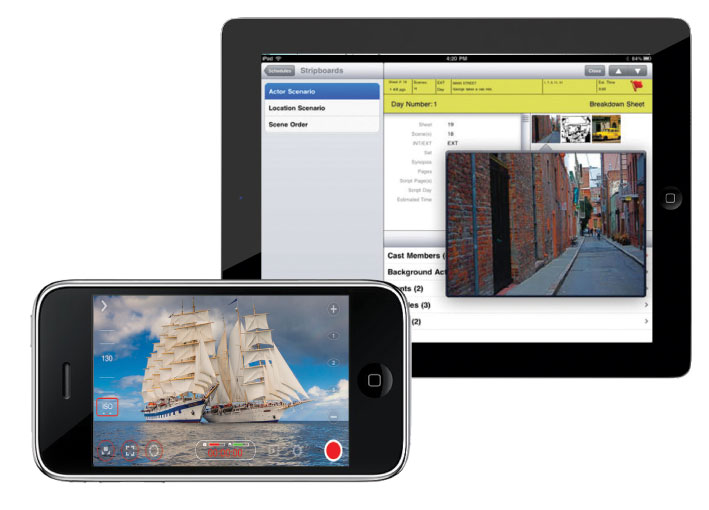
FiLMiC Pro 

  • Publisher: Cinegenix, LLC
  • Compatible devices: iOS
  • Price: US$7.99

How it works: Filmic Pro is the most popular video recording app for iPhone
filmmakers. It features a simple user interface with focus, exposure and white
balance locks as well as an LED light switch. Users are able to set resolution and
FPS as well as activate an audio meter and adjust settings for advanced encoding.
When shooting with a mobile phone it is important to note that filmmakers may
require additional lighting and external audio recording devices.

Why this is awesome: Mobile cinematography is revolutionising content creation in
that it allows filmmakers to produce videos on much lower production budgets and
offers innovative tools with which to do so. For an indie filmmaker, being able to
capture stories on the go without a kit of bulky and expensive film equipment can
even the playing field. A number of accessories have already been developed to
serve this growing production medium including mounts, stabilisers, lens adaptors
and microphones.

Movie Magic Scheduling To Go 

  • Publisher: Entertainment Partners
  • Compatible devices: iPad only
  • Price: Free

How it works: The Movie Magic Scheduling To Go app is complementary to the
Movie Magic Scheduling 5 and 6 desktop applications. The platform allows users to
import, view, create and make changes to a kind of digital strip board while on set.
Users can move strips around or into the Boneyard; adjust daybreaks and banners
as well as detect scheduling conflicts with red flags.

Why this is awesome: The breakdown of a script and its translation as a strip board
offers filmmakers an overall view of all the scene elements. This allows for efficient
and economical scene arrangement and ordering during production – a tough but
vital task that assists in getting the film finished on time and within budget. By
having access to an app which reflects these changes and corrections in real-time,
filmmakers have an advantage in planning their time on locations and the order of
shooting which is most effective.

Using a filmmaking app you think we should know about? Tell us why you think it’s
awesome by emailing: carly@screenafrica.com

- Advertisement -
- Advertisement -
- Advertisement -

Pin It on Pinterest