


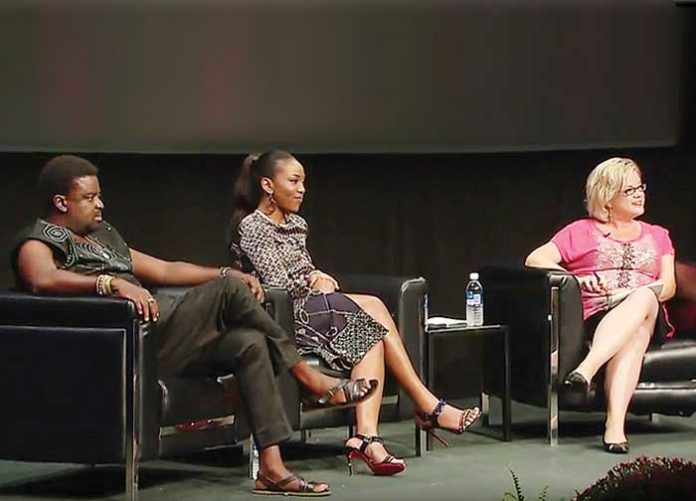
As part of TIFF’s 2016 City to City showcase on Lagos, Nigeria, Nollywood actress, producer and superstar Genevieve Nnaji and New York Times’ ‘Scorcese in Lagos’ Kunle Afolayan sat down with industry watchers for an hour long conversation around Nollywood.
The session, moderated by Wendy Mitchell provided a deeper insight into the current workings of Nollywood and what mainstream contributions can do to make it better. Partly an expression of pride at an industry that has grown into a global phenomenon and in other parts a direct plea for more global investment in the industry, the discussion saw the unlikely duo of Afolayan and Nnaji prove themselves as some of Nollywood’s brightest and best ambassadors.
On the evolution of Nollywood and The New Nollywood
To Kunle Afolayan, Nollywood is still telling the same stories, only in a better way. He credits his first full length feature The Figurine as one of the first movies to challenge the straight-to-DVD model with its clear focus on the cinema. “We tested the cinemas, the available screens and the film did well in the cinemas. It opened up a distribution opportunity, instead of concentrating on the VCD, you first get to the cinema before exploring other distribution channels.” According to him, the cinema option was the major incentive for production values to begin to be raised in Nigeria’s film industry. “After that, a lot of people decided that we cannot compromise on production values. We will still tell our stories, but we will always be considerate about production values.”
To Genevieve, it was first of all a change in mindset and prioritisation. She also commended the industry for making the best of available facilities to grow what has become known as Nollywood. “We worked hard with what we had, with what was dealt us and we did the best with what was available to us,” she explained. “Now, there is a greater focus on improving the quality of film because the attention has changed to cinema. There is a different kind of attention that cinema attracts especially if you are trying to fight issues like piracy. You have to focus on where the money is coming from, where the bigger audience is and the only way you can do all that is through cinema.”
On their styles of storytelling
Storytelling comes naturally to Africans, Kunle Afolayan says, the means to tell it is the challenge. “In 2005, I resigned from banking, I wanted to tell African stories in a different way; it was a mix of the types of movies that were being shot in Nigeria in the 1970s and what was common in Nollywood then.”
He also ascribes a lot of his success to a detailed preproduction process and his team who he has been working with for a while. “As a director, there is nothing as good as working with people who share the same visions as you do.”
Nnaji goes back to her first experience as a child actor at the age of eight in the famed Nigerian soap opera Ripples where she learnt first-hand that acting was more than imaginary playmates but a job with other cast and crew observing “I thought acting was a matter of going on screen and doing something that comes easy to you. I took a lot of directing and I loved to take orders from the director. I still like to be told what to do, she revealed. “These days, people expect you to know everything, you have a lot of experience, just act. However, I still love being told what to do!” Looking forward to more challenges, she added “I’m hoping that things get bigger, the sets get bigger, and we get to work on bigger projects.”
On the evolution of Nollywood – from local markets to pan-African and global audiences
Nnaji explains that she first knew the global impact of Nollywood when she started receiving a lot of fan mail from fans mostly in the Caribbean. “I think my awareness of my success came from outside in. We had travelled far and wide before we even realised it. Nobody was thinking about mainstream or actually crossing outside of Nigeria, much less outside the continent. What has happened has been phenomenal and a breakthrough but we have had to play catch up. It has been a breakthrough that happened really fast and we are trying to adjust and technically catch up. We can’t do it on our own; right now it’s out of our hands. We need the support and backing of people who are used to having their products move this far and we need financing.”
Afolayan clarifies that piracy is an area where he gets really touchy. “The truth is most of these films are a labour of love. Funding is mostly sourced internally. Some of us try to tell stories with universal appeal, we put in the technical knowhow. When internet streaming started, people used to put it straight on YouTube. I’m looking forward to a time when a film will be done; a good film and it gets mainstream distribution.”
“I think the TIFF focus is a great thing, this will be the first time that Nigerian cinema will be celebrated in one of the biggest film festivals in the world,” he continues. “However, I am always bitter when I send films to festivals and they ask for screeners with compliments but they will never tell you what it is. A festival is a platform where films get celebrated and sometimes you get a sales deal, however we always get asked who is in the movie. We decided maybe we should be making the films for our people and concentrating on the immediate market. Since then, we are now being spotlighted now with TIFF but we need distribution.”
Nnaji adds,” investors might not believe there is a market for our kind of movies but there is. This is because, we tell one story; everybody can identify with it. Our stories are quite peculiar to our country, but everyone has experienced heartbreak, everyone has that wicked mother in law, everyone knows what hurt is, everyone knows what pain is. Everybody knows what classism is regardless of where you’re from, regardless of language and colour. That’s what they need to understand. We are trying to say that we are the same, we tell the same kind of stories just in a different way.”
The filmmakers also talked about the entry of Netflix into the Nigerian space and how it has helped distribution globally. “It is welcome because now you are encouraged to take more risks, Nnaji said. Her movie Road to Yesterday is available on Netflix. Afolayan’s 2015 hit October 1, which is on Netflix, exposed him to a wider audience. “I get calls from people in Mexico saying, I saw your film on Netflix,” he said.
By Oma Areh
