


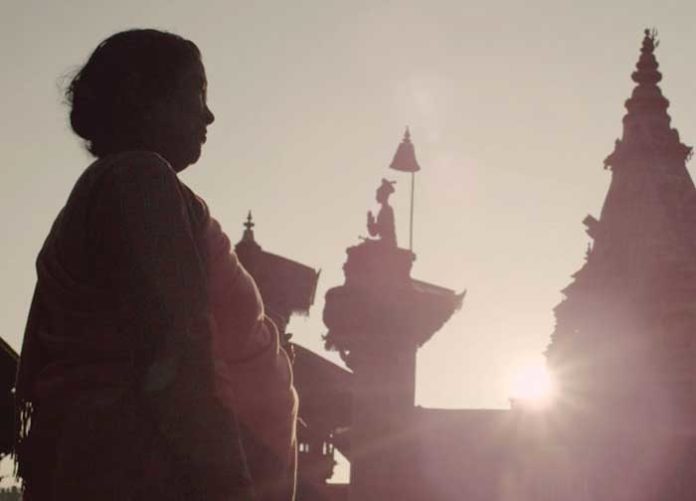
How does one find inspiration while stuck in traffic rushing to get a job that steals the day, how does one seek beauty in a city littered with cynicism? Unwritten: A Visual Journey of Nepal is a graceful documentary of The Fort CEO and Rainmakers Journal founder Shukri Toefy’s journey to Nepal. As told from the pages of his journal, it gently seeks answers to those questions.
Avoiding North Face peppered tourists trailing with K-Way in the Kathmandu Valley as a gateway to conquer Everest, this film explores the cultures of this ancient city and searches for its wisdom beneath the mountain. “Nepal is like a museum without walls,” says Toefy of the choice of Nepal as the destination in his and The Fort CCO Amr Singh’s search for enlightenment. They say it was Nepal’s old world wisdom and mystique that attracted them. A passion project for all involved, it began as a search for adventure, says Singh.
Inspired by the idea that the greatest gift anyone can give is knowledge gained from experience, Unwritten is a journey of self-enlightenment that, despite racking up awards wherever it is screened, will remain as part of an outreach programme to be used to inspire youth to start journaling and to travel and get out of their comfort zones. The film is a visual meditation on the beauty of the world in which we live, no matter where we are.
“We see ourselves as storytellers, but as brand storytellers,” shares Toefy of the build-up to making this film. “This is not what we do every day; this was a creative expression piece that we just wanted to do.” He says the project is an interesting juxtaposition as normal indie filmmakers that come from the commercial ad world. The story starts more than a decade ago when Toefy and Singh were at UCT and started The Fort advertising agency. Toefy at the time worked as a cab driver and started keeping a journal.
“A journal changes the frequency of things, keeping a journal has been one of the most powerful tools for me as an entrepreneur,” says Toefy. “A fascination with the everyday person’s knowledge was the real genesis around this film project,” he adds. This is what started the Rainmakers Journal, a thought leadership platform encouraging people to keep journals. “The seeds of your success lie within you and you must journal and write them down,” says Toefy. They wanted to experience this in a land they had never been to and decided to take a camera and just go.
Armed with a RED MX borrowed from Panavision, together with a set of Zeiss Super Speed lenses and a single LED light, Toefy and Singh got on a plane and went to Nepal at the end of 2014 to document a journal over ten days. Filmed in 4K high definition, all camera equipment was from Panavision, camera, glass, and full kit.
With a few exceptions, Singh chose to shoot using only natural light and also made use of a number of creative innovations, such as shooting through broken glass, to create the film’s look and feel. “We were relying on the time of day and it lent itself well to the aesthetic we wanted,” he says.
“The crew on the ground in Nepal were really good,” says Toefy. “There is this universal film language; no one spoke English. This one guy looked about 12 and he was pulling focus like a genius, no marks but hitting the mark every time,” he adds. On arriving in Kathmandu they had one contact on the ground, and he hooked them up with anyone they needed. “The sound guy was a gamer who burns DVDs. Some interviews had crackling and many issues, but it was an interesting learning process and we will release a behind-the-scenes because it was really funny,” says Toefy.
Despite ten days of less than three hours sleep per night, they say the process was nothing short of fun. “It was a very organic process, and the whole project was a cathartic experience, and the film is an art piece,” says Toefy.
“The final scene was at the holiest place in the world for Hindus and we had to smuggle the camera in there and had to split up,” says Singh. “We tried to make it cinematic and peaceful but filming some of those scenes was really stressful.” He says it is a “Feather in the cap of the old RED MX because we were using all natural light with Zeiss Super Speed lenses, which helped because they are very sensitive to light,” he adds. “Wide landscape using natural light, time of day was vital, but in Kathmandu it is so beautiful, you just point in any direction and it is the most beautiful thing you have ever shot,” says Singh.
After their return home to South Africa the footage of the journey slept for nine months. “Traditionally we can tell a three-act narrative, but after we came back, life is not a three act narrative, it is a fluid poetic accident and that is half reflected in the film,” says Toefy. “So while we tried to create that structure we kept it as loose as possible. It sat for nine months because we knew it would be difficult.” Between work and family they edited between 12h00 and 4h00 each morning. The film was in post for three months offline and two weeks online.
It was edited in Adobe Premier Pro and coloured at Blade/Pudding, while final mix was done at Hey Papa Legend (HPL) with music from Audio Network, outside of the original pieces captured in Nepal. The music was heavily curated, with Toefy and Singh spending more than 100 hours going through music and then mixing it with HPL. “Editor Tshepo Dladla really made this film,” adds Toefy.
“We didn’t make it for a festival piece,” says Singh. “What attracted us to it was the adventure and the process of making it. Part of it was, can we get on a plane and make a film by wandering into Kathmandu?”
They thought they would get there, find knowledge, take it and bring it home. “How privileged am I flying across the world and expecting to get answers? In the edit we realised that was the story we needed to tell,” says Toefy. Unlike MacDonald’s, you can’t just order wisdom, explains the film, in which we see a student crush paint for a whole year as an apprentice before his teacher imparts wisdom, “and then I come along with a camera and want some quick insight.”
“In a quiet Alchemist way, the beauty lies in everyday things all around you and hopefully people will come out of it knowing they don’t have to go all the way to Nepal, they can take time to have a cup of tea and unlock the beauty around you.”
The making of the film has helped The Fort CEO and CCO be less restless, “Two years ago we felt like sell-outs and felt like we needed to use our skills to do something authentic but now we see we employ 40 people and that is our contribution to society,” says Toefy. “Our own lens through which we see ourselves has changed and allows us to feel good about ourselves.”
He adds: “Since then we can now trust our ability to shoot an ad in Ivory Coast with an Alexa on our back and a polyboard. We have shot big budget commercials based on this principle, we know we can achieve this aesthetic with one camera and natural lighting. It has made us better filmmakers.”
Toefy attended the Hollywood International Independent Documentary Awards in September to receive the award for Best Cultural Short Documentary. The film received a standing ovation. It has received Official Selections at the Roma Cinema Doc, Largo Film Awards and the Bali International Film Festival, and won the Van Gogh Award for World Cinema: Documentary Feature at the 2016 Amsterdam Film Festival.
“It is cool to see people appreciate it from all over, saying it felt like a visual poem, and now we realise we can tell an interesting story and ask, what other stories can we tell?”
