


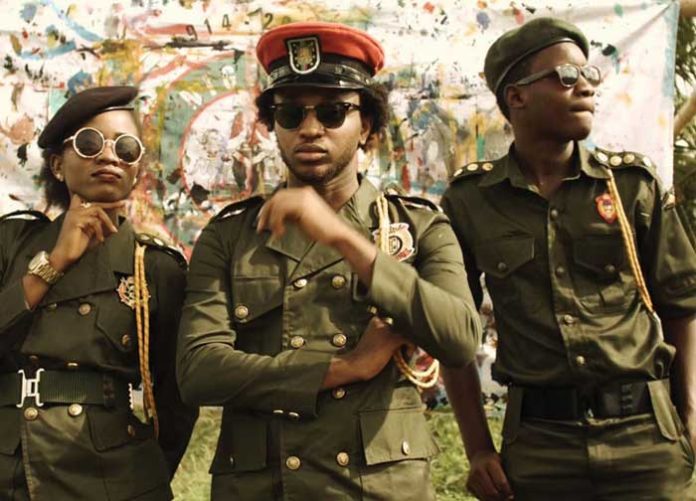
Of all the nine movies that were showcased at the 2016 Toronto International Festival’s Lagos City to City showcase, Green White Green, directed by Abba Makama, was perhaps the most inconspicuous. It did not feature Nigeria’s biggest super stars, it did not even treat a traditional Nigerian story directly as the others did. Yet the low-budget comedy won over the critics at TIFF. Screen Africa spoke to the director Makama, as well as lead actor Ifeanyi Dike JR.
Green White Green tells the story of a young artiste who decides, alongside his friends, to make a movie about Nigeria. The movie explores issues like tribalism abstractly with an almost accidental sense of humour that underlies almost every scene. At TIFF, Green White Green was the shocking bride receiving the best reviews from the biggest industry sources. Screen Daily called it “a rousing celebration and a satire of the phenomenon, with the same no-budget feel.” Now Toronto said “This endearing mosaic of young Nigerian life pulsates with energy and exuberance. Also adding “it may be one of the most accessible City to City titles at TIFF this year”. The movie also got great mentions in Variety and Indie Wire. There are murmurs of big international Hollywood offers but the director and lead actor are keeping silent on this issue.
Screen Africa: What was your experience shooting Green White Green in Nigeria?
Abba Makama: It was very interesting. We shot Green White Green over the course of 12 days but we took out three months to plan. We started scriptwriting around January and did all the recce, pre-production casting, set design between January to April. So we did thorough pre-production considering the nature of Lagos and how chaotic it can be with generators and traffic, we had to go to remote areas of the city. This was something I had in mind because I knew sound was going to be a big problem but it was a great experience. I worked with an awesome crew and cast who hit the ground running. The shoot went fairly smoothly based on our planning, but we still had to do a lot of improv based on unforeseen eventualities.
Green has an indie feel even for a Nigerian film, especially with its satirical tone. Why did you decide to take this route?
AM: I have said this a gazillion times; for some reason, even when I set out to make a drama or a serious film, I end up going the satire route. Maybe it has become my style but I believe with satire, you have a lot to play with. I guess I have come to realise that I am a social critic somewhat. I also find it very interesting just to juxtapose issues; in Nigeria, I have come to realise that we have a huge contrast between the rich and the poor which creates a crazy dynamic for you to play around with in terms of ideas when you approach it from a satirical point of view. So why not satire?
As regards to indie, every Nollywood film is actually an indie and I understand how mine is even more. By virtue of the kind of people we cast, we didn’t cast any major stars, it’s a quirky film. I just did me.
Green got some of the best reviews at TIFF and you were compared to an early Spike Lee in many instances. What was this experience like generally?
AM: I think it did get the best reviews at TIFF and I think it’s because we did something entirely left field. More importantly, it’s a cool film that anybody who is hip will get the essence of. I was being compared to Spike Lee and I didn’t see that coming. Looking at some of his work, I can see the where they draw parallels, it is humbling, yet it makes me feel good.
The audience at Toronto was generally very excited, Cameron Bailey’s words especially meant a lot to me. In the first e-mail I received from him after the submission, he stressed the fact that he had never seen Nigerian youth portrayed in this manner.
Screen Africa: What are your thoughts on this reception? Did you expect this? To what extent do you feel Green actually interprets Nigeria’s reality?
Ifeanyi Dike: This is a loaded question. It’s always a good feeling to be told that something you worked so hard on is good. It’s even better when you are told it’s great. But I think the thing Abba and I are grateful for is that most of the reviews see the film for what it truly is and it really doesn’t get better than that for an artist – for your work to be seen and seen in the way that you intended. And for your work to inspire conversation. I’m quite frankly overwhelmed by the reception. Filming Green White Green a year ago on a goat farm in Nigeria, I didn’t think we’d end up on different continents answering questions and receiving compliments. Did I say I was overwhelmed already? But in a good way and that’s rare for me. I think our film is at least aspirational with what it says Nigeria is and I think that’s a good place to start.
You’re the only African in UCLA’s Masters programme this year and the only Nigerian ever. Can you tell us more about how this happened and what you are bringing to the programme?
ID: I think I might be the only African ever as well. I’m not sure how it happened. There should be more of us accepted to programs like this. I mean, I understand that these programmes are competitive to get into even for Americans with the schools picking eight to 16 students only per year for the acting program but there should be more people like me getting accepted regardless. I planned for a couple years, studied my Shakespeare and went off to the States to audition as soon as I was done filming Top Actor Africa for BET. At first, I didn’t realise UCLA had been trying to contact me after my audition but had the wrong email address. They finally got my email address but said it was too late. I spent about a month in depression, then I returned to Nigeria and began the process of moving on. Three weeks later, I receive an email saying ‘Ifeanyi UCLA calling. The gods and life are sometimes crazy,’ It was apt, I had gotten in. I’m not sure what I’m bringing into the programme because we’ve been instructed to empty ourselves and just come but I look forward to being a thoroughly disciplined actor and person at the end of this journey.
What should we look out for from you project wise?
ID: I’m having a great time earning my Masters in Acting degree at UCLA if that counts as a project. There’s pitching, planning, writing and developing happening – it’s great. I wish I could be exact with projects but unfortunately, a lot of it is still confidential. When I’m at liberty to speak about them however, you’ll be the second to know, after my mom.
Compiled by Oma Areh
