


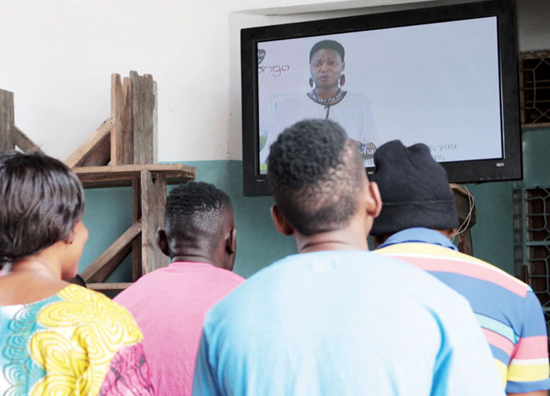
Advertising agency, TBWA\ Khanga Rue has launched a free 12-class series on entrepreneurship for young people in Tanzania called Noa Ubongo or Sharpen Your Brain in Swahili. The programme will be disseminated on social media and eventually aired in thousands of video halls throughout the country.
The initiative follows a highly successful pilot phase conducted in 2016, which saw young people learning job-hunting and other related skills.
Pat Olvera, TBWA\ KRM creative director, says a mere 35 per cent of young people in Tanzania complete secondary schooling. “A number of factors contribute to this, amongst them, economic and cultural pressure. Many girls, in particular, are compelled to leave school early and look for work. The result is a lot of unemployed young people, who lack basic education, work skills and entrepreneurial knowledge.”
Even for those fortunate enough to complete school, there are only 40 000 formal salaried jobs created by the economy each year and 700 000 young people who finish school and are ready to enter the job market.
Deeply immersed in the NGO sector, Olvera and his colleagues at TBWA\ KRM were acutely aware of the issues faced by youth in Tanzania. “We have partnered with Unicef to create programming targeting youth such as Shuga and Sara, and we’ve worked with Restless Development on campaigns encouraging girls to stay in school. We’ve also created many youth-centred campaigns dealing with HIV and other health issues.”
Wanting to get involved in empowering youth directly, the agency came up with an idea to deliver knowledge to young people in a compelling way by harnessing its own knowledge of social media and local trends. “We thought if we couldn’t get the young people to go to school, then maybe there was something we could do to bring learning to them in the places where they spend the most time – in video halls and on social media,” says Olvera.
“All we hear from our clients is talk about engaging youth and it’s usually followed by the well-known statistic about how young people make up such a big proportion of the population. But the reality was that we – as an advertising agency – were mostly only engaging youth when we were trying to sell them stuff – when we’re advertising to them. We as TBWA\ Khanga Rue were a bit troubled by that and thought that it needed to change. We feel it is our responsibility to create media that can make a difference in young people’s lives, that can fill an information and education gap that exists,” comments Nisha Shah Sanghvi, managing partner of Khanga Rue Media
TBWA\ KRM initially applied for funding to get Noa Ubongo off the ground. “We didn’t get the funding, but decided to go ahead with a pilot phase of the project anyway. We got curriculum experts to volunteer their help and created three modules in-house. They covered three areas: how to look for a job if you’ve never had one before; how to get skills and how to write a CV,” says Olvera. One of the greatest challenges was finding a presenter that balanced the peer-to-peer approach of popular YouTubers with an ability to deliver real learning, often on complicated topics. ”We studied a lot of what Maker Studio was doing, even talking to creatives working at Maker, because we wanted that same type of connection with our audience that Michelle Phan or Suzelle DIY has with their audience. However, in this case, we still have to deliver real learning on tough topics,” he explains.
Noa Ubongo launched on Facebook in 2016 and became an immediate success with young people. In addition, it dovetailed well with the recent decision by Omnicom Group to join five of the world’s largest holding companies for a Common Ground initiative aimed at supporting the United Nations’ Sustainable Development Goals (SDGs) where Omnicom specifically committed itself to helping tackle improving education.
Olvera says although the idea for Noa Ubongo preceded the Common Ground initiative, its mission and objective of empowering young people through free education fits with the agenda of Common Ground perfectly and the TBWA\ KRM team felt that its decision to persist with the programme, despite the initial lack of support from the funding community, had been the right one.
“Suddenly, there was much more interest in what we were trying to do. The Financial Sector Deepening Trust (FSDT) came on board and provided us with funding to develop a five-part series – which became a 12-part series – on how to start a business. The greatest challenge here was localising existing content for Tanzanian audiences and turning it into a meaningful learning journey.”
There are 10 000 informal movie theatres or video halls in Tanzania, one of the main channels of media consumption, especially amongst youth. “In addition to using Facebook, our goal is tap into this informal distribution system and disseminate our content to as many young people as possible. We believe this is the first time the halls will be used as classrooms in this way,” says Olvera.
He notes that making learning videos is not necessarily a new idea, nor is trying to teach entrepreneurial skills. “What is unique about our programme – other than it was made by an ad agency – is that it combines these techniques, and localises and adapts them to an audience in a way that is scalable.”
Now there is a clear demand for the programme, with several NGOs expressing interest in using the Noa Ubongo platform to help deliver localised learning content to much bigger audiences. The agency is currently in talks to start piloting classes in refugee camps, where Noa Ubongo can substitute for a lack of teachers and schools.
“The response has been incredible, simply on social media, we engage thousands of followers who ask our hosts for more information, they are asking for the next video, and many simply thank us for giving them this information that they couldn’t get anywhere else. We know that youth are forming Noa Ubongo clubs entirely on their own to watch the classes together. What we’ve also seen, in our focus groups and based on social media, is that Noa Ubongo can change mindsets, it gives youth confidence, it makes them feel more in control of their future. And that psychological impact may ultimately be Noa Ubongo’s most powerful attribute,” adds Shah Sanghvi.
Olvera says the initiative now needs private sector involvement. “We want to add a mobile technology component that will enhance the programme with follow-up quizzes and gamify some of the learning. We want to link students to resources in their area or to companies for internships. “We have a vision for a learning portal where young people can sign up for complete courses, get supplementary learning resources, interact with each other and even submit their ideas and projects for feedback. There are so many ways we can scale this up with the right partnerships,” he says.
“We are currently focused on expanding our reach and curriculum in Tanzania and rolling out our video-hall distribution. We want to turn these video halls into classrooms,” adds Shah Sanghvi. “We are also in talks with other potential partners to enhance our classes through technology, such as SMS follow-up quizzes, peer to peer reviews, and mentorships. What’s great about Noa Ubongo is that it can be scaled up with the right partnerships. It can be transferred to other countries and regions. We want to become a pan-African platform in the coming years.”


