


In June 2016, Unreal Industries and Bladeworks Post Production pulled off a world first when they created a virtual reality live stream for the 22nd South African Music Awards (SAMAs). Never before had a live award show been broadcast for 360-degree VR viewing.
For the 22nd edition of the SAMAs, to be held in Durban, the award committee wanted something different. They called upon Unreal Industries, a production company that specialises in virtual reality, to create and execute a concept that would elevate the 2016 show to a new level. The theme that the committee had chosen
“I had an idea, when we were first talking about it, that I wanted wto do a live VR broadcast,” says Unreal creative director Malcolm Ché. “The committee loved the idea but we were aware that this would be a world first. We have an ongoing relationship with Blade and it’s always been great working with them because they understand what we want creatively and we are capable of pushing what they can do from a creative perspective.”
The project would include a camera rig that would offer full 360-degree coverage, allowing the audience to look around the entire venue during the course of the award show for a truly immersive experience.
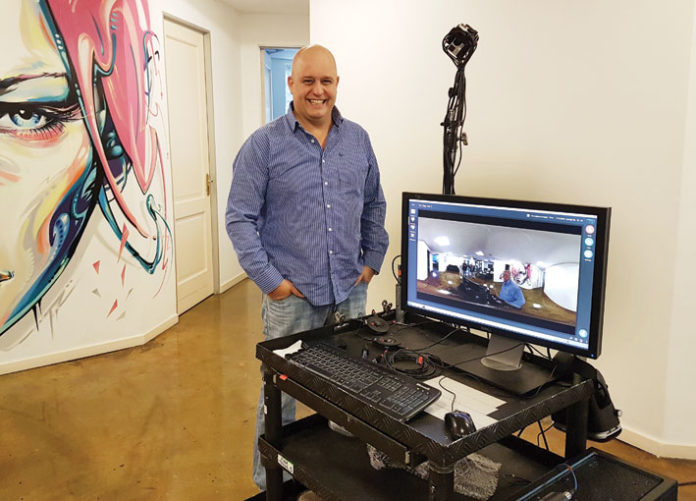
Blade was easily co-opted into the pioneering enterprise, being eager to try something they had never done before. With not much time allocated to the job, general manager Warren Bleksley assembled a team to build a solution mostly from scratch. Chief engineer Peter Hangelbroek and DIT Riaan van der Merwe worked on a portable rig that included six GoPros mounted in a 360-degree rig, connected to a computer complete with Vahana image stitching software.
Flame operator Jaco Kraamwinkel then set about creating a stitching template to allow for the seamless fusing of the images from each of the six cameras, a process that comes with a number of complications involving issues of parallax. To put it simply, if one camera has an image in close-up and the next one a mid- to long shot, stitching is not going to work.
Ché then briefed Blade animators Ryan Lloyd and Warren Jacobs to create a title sequence that would work both with the conventional television broadcast and the VR live stream. Using After Effects and Metal, Jacobs created a space travel-themed sequence that completely embodied the ‘Future is Here’ theme and tied in visually with the VR approach.
During the live TV broadcast, audiences were given the link for the VR stream on YouTube. Viewers were thus provided with a number of options. They could either watch the conventional TV broadcast on SABC or, if equipped with VR headgear, they could watch the live stream, which offered them a complete view of the arena, from the stage to the front and back rows. The effect was to move the broadcast of a live event to a point where the audience had the power to ‘direct’ their own coverage. The team then had the challenge of ensuring that there was something worth looking at wherever the audience looked.
As for the future of the VR medium, it really seems to Ché and Bleksley that the possibilities are endless. Technical capacities are advancing almost daily, which is just as well, since the requirements of the medium are substantial. Bleksley explains that the live stream required an uncontested 100MB pipe – not too tall a requirement for a once-off but if the technology takes off, bandwidth provisions would have to increase exponentially. Cameras and software also require some tweaking, considering the parallax issues that Kraamwinkel worked hard to iron out, as well as the limitations of GoPros and their characteristic ‘bending’ of images. But Hangelbroek and van der Merwe explain that any camera can work in the rig – imagine a night shoot in the bush using six Sony a7S’s.
For Ché, the great value of the SAMAs project is that it brought long-cherished theoretical notions to practical reality. “We now have proof of concept,” he says. “Theoretically we knew there was no reason why we couldn’t put up a live broadcast through YouTube offering a 360-degree view of an award show. Now we have actually done it. That gives us the confidence to move forward with other ideas we’ve been playing with.
“Aside from live broadcast, this will offer enormous potential for creatives in all kinds of other formats. The 30-second commercial, for example, is dead. Now, with virtual reality, you are no longer shouting at someone from a billboard, trying to wrench yourself into people’s lives. Now you are inviting them into your world, you’re offering them a certain amount of control and enabling them to empathise and that wins them over.”
For Bleksley, it’s all about expanding the toolbox that Blade can make available to creatives. “We’ve been talking a lot lately about how post-production is under pressure and how we can find new avenues to create work. This technology offers that. It’s still new and a lot of exciting things are still going to happen in this space. For creatives, it opens up a whole new medium. The playground is getting bigger – it will be interesting to see what people come up with.”
