


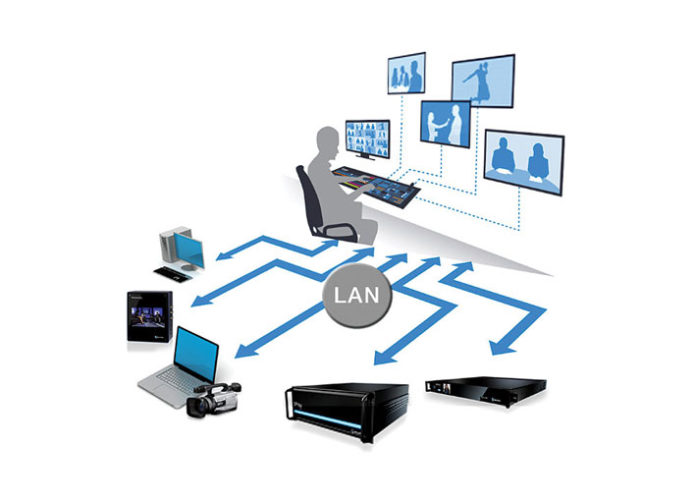
Video over IP (Internet Protocol) comes in many forms and the technology used to stream video over IP has in fact been around for more than 20 years. In the world of broadcast and production, video over IP is an alternative way to transfer file-based media on networked computers. This method of pushing high bit-rate media signals over Ethernet is now a solid replacement for a seemingly dated serial digital interface (SDI). But not all IP standards are equal, it seems. Many industry professionals are joining the debate over which has greater merit.
There are multiple options for utilising video over IP, and one that is increasingly used among content producers and vendors is SMPTE 2022-6, which was ratified in 2012. However, a newer, open source protocol released recently is expected to be the widest adopted IP standard on the market by the end of this year.
Video over IP offers numerous advantages due, in no small part, to the fact that video can be processed on a computer, while on the production side there are countless software-enabled solutions. There are many advantages to IP transmission, including cost savings and greater operational flexibility but the issue of discussion is always on selecting the best path forward. It is no longer a question of whether video over IP will happen but when.
Hundreds of broadcasters and facilities have already switched to a total IP environment while many discuss all the options. The SMPTE 2022 standard was first introduced in 2007 and has expanded to cover more types of IP video transport – positioning video over IP as a replacement for SDI. SMPTE 2022-6 offers a number of advantages as it was designed specifically to handle up to 1080p video, and what makes it so attractive is that it offers the ability to use a single standard for high-bitrate, uncompressed signals.
The main downside to SMPTE 2022-6 is that it isn’t exactly future proof. While it could be seen as a building block that allows video to be sent over Ethernet, the standard is considered to be a transition and can’t handle 4K/UHD raw uncompressed video easily—as SMPTE 2022-6’s pipe supports 10 GB while UHD is about 12 GB. Compression solutions for UHD over 2202 are already in the works however, and one option touted by some in the industry is TICO, a patent-pending, visually lossless, light-weight compression that specifically has been designed for the industry to move 4K content over active 3G-SDI and IP networks. TICO, which is simply an acronym for ‘tiny codec’, is gaining traction, with big names in the industry seeing this as a way for SMPTE 2022 to support 4K/UHD. TICO is just one of several codecs, but these are still essentially stop-gap measures as the industry determines how to best handle UHD video over IP.
In late 2015, there were announcements from two organisations promoting video over IP. One is called AIMS (Alliance for IP Media Solutions) and the other is called ASPEN (Adaptive Sample Picture Encapsulation).While both organisations support the idea that the future of video transport will use IP-like protocols for switching and delivery, they differ in how they manage the important requirement of video synchronisation.
Will these two approaches eventually be interoperable? Clever solutions should evolve that can enable the interchange between AIMS and ASPEN encapsulated video and audio signals without breaking the bank or experimenting with partially deployed competing SMPTE 2022 10GBit protocols like AIMS and ASPEN. But there is uncertainty regarding the use of commercial, off-the-shelf IP switches for transport of live video and audio signals. Which IP switches will support which protocol and more importantly, at what cost?
Another approach, and becoming increasingly popular in the industry, is one developed by NewTek, called NDI (Network Device Interface) technology. NDI makes it easy to send high quality video over any qualifying network, new or existing, and make any video source available to any video destination at an affordable low cost. Of course normal network rules apply – it has to be a fast enough network, and not clogged up by other users, but with a bit of planning, this is easily possible these days. NDI is bidirectional, allowing devices to communicate with one another, but more importantly it makes it easy for a production facility to move into video-over-IP without having to make a large capital investment in a high bandwidth network switches or having to replace SDI devices.
NDI makes the entire video infrastructure virtual. Which means that once you have connected your video source or destination to the network, everything else is software controlled. If you have multiple video devices with an NDI driver, all you have to do is plug it into the network for it to become visible to every other device as a source or your device as a destination for other devices. To get a camera’s output onto the network, you can either plug it into a video interface that is connected to the network (this could be one of many well-known capture cards that are available now – like ones from Blackmagic Designs for example), or any other device with an input that can ‘talk’ NDI. In other words NDI provides a fabric that connects video devices together.
The NDI Software Developer Kit (SDK) provides the tools and resources for developers and manufacturers to integrate NDI into their systems and workflows to enable or accelerate their transition to IP. The SDK supports finding, sending, and receiving any number of video streams over IP, with the encoding algorithm supporting all video resolutions and frame rates up to 4K and beyond, as well as 16 channels of audio and beyond. It also includes tools to implement video access and grouping, bi-directional metadata, and IP commands.
There is no doubt that the broadcast industry hysteria over IP video has rapidly produced remarkable technology and solid building blocks to allow video to be sent over Ethernet, what remains to be seen is how long the entire process will take?
