


In January this year, South African television celebrated its 40th anniversary. Andy Stead was there when that famous test pattern first appeared on black-and-white screens around the country and knew many of the then young, bright-eyed technicians who helped found and develop the South African TV industry.
Where were you when this test pattern was first broadcast by the South African Broadcasting Corporation (SABC) in 1975? This image was the start of it all: television in South Africa – albeit several years after many other countries in Africa had already switched on.
I can tell you where I was. Broadcast television in South Africa was my goal when, in late 1972 and with little experience in the field, I made the decision to travel to England and study television technology in advance of the commencement of broadcasts. Southall College of Technology in London was to be my home for the next three years, and systems technology, studio design; transmission engineering and general principals were studied and learnt on a full-time, no-nonsense basis.
Before completion of the course I was fortunate enough to be accepted by the Independent Broadcasting Authority as a network operations and maintenance (NOM) technician operating from their Brompton Road premises. The function of NOM was to ensure that the standards of all commercial television stations in the United Kingdom met the standards required, as well as to broadcast an engineering programme on a weekly basis from an OB van parked in the basement.
This programme went out live from either a Rank Cintell Mk11 telecine machine or an RCA TR70 Quadruplex VTR machine, and woe betide if there was a fluff on air – I mean after all we were the blokes setting the standards!
On completion of the courses I returned to South Africa full of knowledge and enthusiasm. Did I get a job at the SABC? Afraid not. Lack of Afrikaans was a factor, as well as other reasons – but we won’t get into that. I ventured immediately into the commercial arena.
Breeding ground for talent
The SABC was however the breeding ground of many great technicians and engineers, some of whom remained with the corporation in senior roles up until retirement. Others made their mark on the commercial and production industry. Most have extremely fond memories of the start-up 40 years ago, and also of the introduction of commercial television in 1978 when the first locally produced TV spot the Big T Burger TV aired.
The SABC did in fact commence its own in-house training and most who underwent this course agree that the standards were extremely high. One such trainee was Dave Keet, who went on to make a name in the private facilities business. Keet recalls that the SABC began training technicians for TV at their then brand new premises in Auckland Park.
“I was on the third training course, which started in April 1975,” he says. “Training instructors were brought out from the British Broadcasting Corporation (BBC) to train personnel. For the first three months trainees were trained in all disciplines such as camera, sound, lighting, telecine, editing and even set building. After your initial training you specialised in your particular area of expertise.
“I did studio sound on the first broadcast – 5 January 1976. It was an amazing adrenaline rush after such anticipation and incredible nerves. I think things went pretty much as planned. Commercial TV started about two years later and the whole country sat in front of their TVs at 6pm to see the first TV commercial! The start of commercial TV heralded the beginning of facility companies which provided services to independent film companies for the production of television commercials and indeed programmes – the SABC commissioned a lot of series and one-offs.”
I remember the advent of commercial television well. By this stage I worked for an advertising agency – Van Zijl, Schultz, Lund and Tredoux – that had several large accounts, including SAB, Lever Brothers and Transnet. All their commercials were shot on 35mm film and these had to be transferred to tape for broadcast. While the SABC had telecine machines, they were photo conductive and the quality was deemed not equal to the result one got from a flying spot scanner. There was however a Rank Cintel Mk11 telecine at Lintas advertising on the 11th Floor of Sandton City. An OB van with a 2-inch VTR was hired from the new commercial facility company Video RSA and feeds were laid from the OB van parked in the basement of Sandton City, and the 11th Floor. All Van Zijl and Schultz’s commercials were transferred via this route.
The resulting commercials, when shown on the SABC, certainly showed the superior quality achievable from the flying spot technology – a technology which was to become a bye-word in the industry.
SA’s first post facilities
Video RSA was in fact the first of many commercial facilities companies in South Africa, and became the home to well known industry player Mike Smit. “Kavalier Films started the first video post facility, Video RSA, mainly to finish television adverts for the launch of commercial television in 1978,” explains Smit. “They had a few technical challenges and approached the SABC for help. I was the lucky guy to be seconded to Video RSA by the SABC where I ended up being employed. Although I enjoyed my tenure at the SABC, a significant increase in salary was the main reason for leaving along with the opportunity to be part of the commercials industry. In 1980 I started discussions with Trevor Hill of The Film Editors, who had the backing of Gallo and Argus, to start a new post facility which we called Video Lab. I do however have very fond memories of my time at SABC and it was a privilege to be working in television at the very beginning of this new industry.”
Perfecting outside broadcast
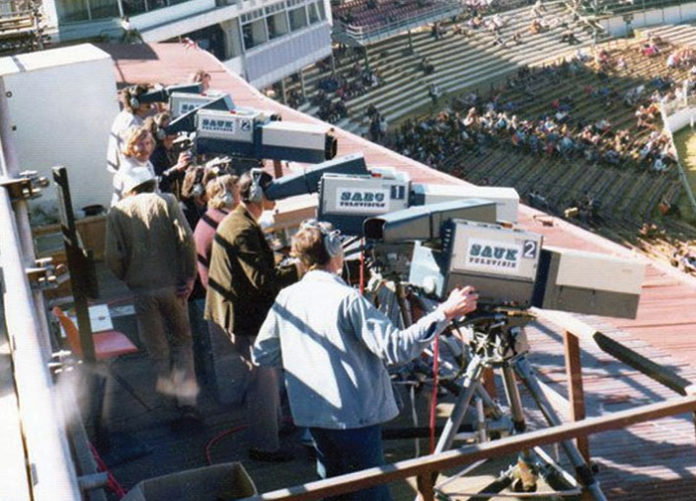
Outside broadcasts (OBs) were an essential part of early television and the SABC was able to meet the challenge. Former head of OBs Nick Bonthuys reminisces: “When I finished my studies I chose to go to OBs and luckily was accepted. I probably would have left if my application was not successful since TV OB was where I saw my future.
“When I arrived at the beginning in 1976 they had just completed a number of training productions. Ex-employees of the BBC were contracted to do the training and they did an excellent job to get the SABC OB teams up to speed. Names like Ron McHardy, Alan Joy, Charles Mickey and Brian Taylor come to mind. Many of them stayed on to play roles in SA broadcast history.
“SABC TV OBs started with three four-camera units and one three-camera unit. The three-camera unit had a handheld camera which was a nightmare to get to work. The OB units had to be running for at least three hours before one could attempt to line them up to produce broadcast standard pictures. Each unit had two Ampex two-inch video tape recorders housed in a separate truck since they were so big and needed special air conditioning and used noisy air compressors to guide the video tape. The equivalent and more of what those tape recorders could do can now could fit on a single USB stick!”
Others who spent time in the OB department included former head of Sony Broadcast South Africa Jess Goedhals. “In 1973 the SABC had advertised, looking for trainee operators for the upcoming television service, so I applied, was accepted and started on 2 January 1974, two years ahead of the commencement of television,” says Goedhals. “Among my listed skills, which I’m sure made me successful, was my passionate Super 8 filming of the motor racing at Kyalami.
“The SABC trained groups of 40 operators over an intensive four-month course using experts from the BBC. My original position was trainee cameraman and after the training course, I moved to the OB department, where we covered many events prior to the launch of TV in 1976. Going live on air was always a thrill and things did usually go wrong but, because the viewers were new, nobody really noticed!
“I left the SABC in 1981 after rising to the position of principal cameraman and not seeing a future by staying on just as an operator. The emerging television facilities company market had started and they were offering substantially better salaries than SABC could pay. I joined Trillion Video in Kramerville where I came across the production of TV commercials for the first time.”
There are countless other people, involved in pioneering South African television, who are still in the industry or have since left and retired – too many unfortunately to list here. Most will, I am sure, agree that the grounding they received at the SABC was the catalyst for long and successful careers during a time when a spirit of bold curiosity and a sense of adventure were probably the best requirement.
Things have changed a lot since those formative years, and the fortunes of the SABC have been overtaken by subscription television services and streaming. Indeed the SABC has missed its deadline for the switch over to digital with this year 2016, being the absolute final deadline. Will they meet it and if not what are the repercussions? Time will tell. But in the meantime, nothing can detract from that historical launch back in 1976 and the keenness and enthusiasm of the dedicated staff that helped to make it happen.


