


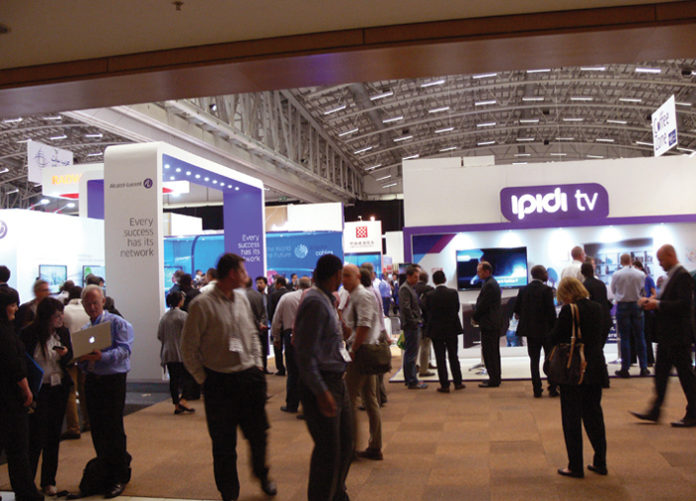
AfricaCom is said to be Africa’s largest communication conference and exhibition and is now in its 18th year. The event took place at the Cape Town International Convention Centre (CTICC) from 17 to 19 of November this year. The conference programme covered the most strategic issues affecting companies in Africa’s digital market – services, efficiency, profitability, customer experience, partnerships, policy and more – and featured four co-located events: VSAT Africa, TV Connect Africa, LTE Africa and Apps World Africa.
Of particular interest was the TV Connect Africa 2015, which is in reality a conference within a conference, and offers exhibition space to targeted suppliers as well as a programme of speakers, discussion groups and workshops. Conference manager for the TV Connect Global Events, Georgina C Wilczek explains: “It’s a series of international events bringing together the television industry around the world, run by the conference and information group Informa, based in London. I have worked as a conference producer within Informa’s Telecoms and Media division since 2006, and before that, I worked at the BBC in London as a Radio Producer for BBC Radios three and four.”
“This was the fourth TV Connect Africa conference, and it has always taken place in the CTICC. The intention is to bring together the television industry from within Africa for three days of case studies, discussions and debates, bringing together content providers, OTTs, IPTV operators, mobile TV operators, broadcasters, regulators, media analysts and app developers”
Topics of interest on the first day included:
- ‘Understanding the inhibitors to digital switchover in Africa’;
- ‘Lessons learnt and strategies for digital switchover’;
- ‘Journey to the digital era: Cost effective routes for Broadcasters in Africa’; and
- ‘Strengthening your pay TV proposition to the consumer by improving the quality of your content.’
Each session was followed by a vigorous discussion and Q and A from the floor. Of particular interest was the ‘Understanding the inhibitors to digital switchover’ discussion, where Christoph Limmer, vice president of video at Eutelsat pointed out that at the beginning of 2015 the population of sub-Saharan Africa (SSA) was about 900 million, and that the number of households will be 161 million by the end of 2015 which shows a 7% growth in three years.
“Africa’s population of consumers with disposable income is booming,” said Limmer, “and is growing from 35% in 2000 to 52% in 2020 (McKinsey). Africa’s population is heavily dispersed still and not concentrated – despite massive urbanisation”. Limmer believes that by 2040 SSA will have a population of 1.4 billion with only 240 million in cities. With 1.16 billion people classed as rural, this will create an environment more favourable to satellite distribution.
Today there are about 37 million digital TV homes in SSA. The number of digital homes is expected to grow to 69 million by 2020, assuming a smooth roll-out of digital migration across the region. Satellite and terrestrial television are the two infrastructures driving digital migration, and cable and IP based television does not play a major role in Africa.
Aldred Dryer, chief technology officer at the Namibian Broadcasting Corporation, pointed out during a panel discussion, the success of Namibia’s switchover. He stated that digital terrestrial television (DTT) launched in Namibia in October 2013. Analogue TV switched off in Windhoek on the 31 January 2015. Decoders are now available for sale to the public at selected retail outlets. There are 16 services on air which cover 67% of the population. A call centre has been established and a consumer campaign is continuously being implemented. Unfortunately the rest of SSA and indeed the southern African region are far behind schedule.
Overall, the show attracted well over 10 000 attendees and this represents a growth of at least 10% on last year. Also TV Connect Africa had at least 300 exhibitors at the event on the main show floor, plus extra exhibitors in the Ericsson A-Hub upstairs and extra companies who took meeting room spaces (overall about 350 companies). This was a record for the show this year – nevertheless the market is still expanding and it is anticipated that this figure will continue to grow in the future.
“TV Connect Africa is a part of the TV Connect Global Events series, which also includes TV Connect Asia, TV Connect MENA and TV Connect London (the annual global event),” adds Wilczek. “The TV Connect London event is a large-scale free-standing event which takes place every April in ExCel, London, attracting well over 7 000 attendees. Many of those who speak and exhibit at TV Connect Africa are also present at our London event.”
“It was great to hear about new content launches across Africa (such as ipiditv in Kenya and OnTapTV.com by PCCW Global in South Africa),” concludes Wilczek, “and to hear about plans for digital switchovers across the continent. The Country Roundtables on the afternoon of day two were also a fascinating insight into the different stages of development in TV operations in a wide range of African markets – the Nigerian case studies attracting a huge level of interest.
“And there was a very interesting debate as to what kind of content African audiences want – Hollywood content works in the main, but there is a large appetite for locally-driven content too. Nollywood content in particular is really taking off.”
