Home Authors Posts by Telemedia PTY Ltd

Telemedia PTY Ltd

19 POSTS 0 JOBS
Telemedia was founded in 1981 with a focus on the supply, installation and service support for radio and television broadcasting equipment. Since then Telemedia has evolved into a broad-­based media broadcast facility providing a sophisticated and versatile product range.

Telemedia (PTY) LTD chooses FileCatalyst for their internal operations

FileCatalyst, an Emmy award-winning pioneer in managed file transfers and a world leading accelerated file transfer solution, has announced that Telemedia (PTY) LTD is now using FileCatalyst as a solution for their internal operations.

Telemedia (PTY) LTD is a leading provider of dynamic media broadcasting services, and they have a strong proven track record for supplying tailor made quality solutions. Telemedia (PTY) LTD is located in South Africa with their head office being in Rivonia, Johannesburg. They have also expand beyond the African marketplace to serve clients in markets worldwide.

Telemedia (PTY) LTD provides the following services to their customers:
• Satellite Telecommunications
• Satellite Teleport Services
• SNG and Flyaway Services
• Provisioning of Broadcast Studios and Facilities
• Broadcast Equipment Hire, and Sales with excellent after sales support

The FileCatalyst product they have chosen to use internally is FileCatalyst Direct, which is a suite of server and client applications that accelerates point-to-point file transfers at speeds of up to 10Gbps. FileCatalyst utilises a patented UDP-based file transfer technology that overcomes the issues of slow file transfers caused by network impairments such as latency and packet loss. They have also implemented the client applications HotFolder and TransferAgent to their internal infrastructure. TransferAgent allows users to send large files via a web browser to any email address and HotFolder is used for scheduling and automating file transfers.

“FileCatalyst is incorporated with company proprietary information on our corporate infrastructure and operates as expected and we’re very happy with it’s performance’ says Charles Bates, network administrator at Telemedia (PTY) LTD. “We are very impressed with how FileCatalyst Direct, and the clients HotFolder and TransferAgent, greatly improve our file transfer times, while at the same time simplifying our workflows.’

“We are happy to announce that Telemedia (PTY) LTD is onboard with FileCatalyst Direct, and we are happy to have another client added to our portfolio of African companies,’ says Alan Atkinson, vice president of Business Development & Marketing for FileCatalyst.

For other interested South African companies, Inala Broadcast will be attending the Mediatech Africa trade show and representing FileCatalyst. Inala Broadcast is a privately owned company registered in South Africa, with operations across all of Africa. As a broadcast system integrator, Inala Broadcast represents a number of leading international manufacturers to the Broadcast markets. Inala has partnered with FileCatalyst to provide the latest in broadcast technology to their clients who are looking to increase the speed of their file transfers without compromising reliability or security.

Mediatech Africa runs from 19 to 21 July at the Ticketpro Dome in in Johannesburg, and Inala Broadcast will representing FileCatalyst in booth C23.
The effects of IP in the television OB environment

For many years the TV and Broadcast industry and IT/Telecommunications industries have been merging. This evolutionary move was inevitable since the invention of digital audio and video.

I have identified two types of internet protocol (IP) transport:

  1. Uncompressed SD/HD-SDI video (with embedded audio) for links within the outside broadcast (OB), e.g.: from camera to OB Van. The current traditional method is to use co-axial cable with BNC connectors on each end, or for HD-SDI over long distances, a fibre optic cable is used, with electrical to optical (then back to electrical) converters being used
  2. Compressed audio and video (encoding) as an MPEG Transport Stream, for contribution links from the OB to the TV Station. Various methods can be used, such as Satellite links, Microwave link or Telecom (3G/DSL line)

In both cases the video signals are packetised and pushed into an IP network.

The case for uncompressed video over Ethernet vs co-axial cable

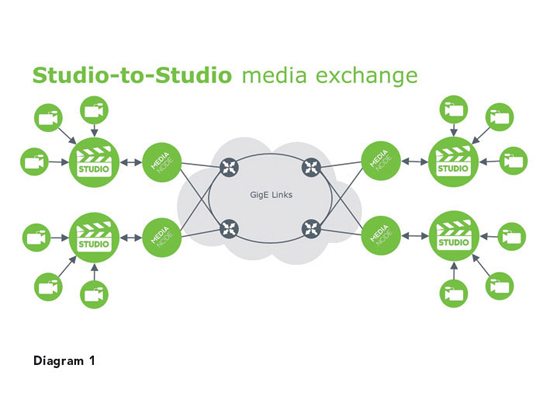
Many broadcast manufacturers have already started implementing an SDI-over-Ethernet (IP) interface for their equipment inputs and outputs. Examples of production equipment include cameras, vision mixers, video servers and editing systems. Once a video signal has been converted to a standard IP Ethernet cable, it can be plugged into a Gigabit Ethernet Network Switch. The video is broadcast throughout the switch and becomes part of a Local Area Network (LAN), very similar to a computer LAN. Below is a schematic of a typical Studio environment, which could easily be implemented in an OB environment. (See diagram 1)

This type of architecture lends itself very well to sharing all the various sources available: collaboration is easy, since all of the content is flooding the network. Redundancy of path and Ethernet switches is handled by networking protocols. This allows the traditional video engineer to leave that to the network/IT engineer. Once the SDI over Ethernet network is established, and enough connections to switches are made, there is very good signal protection.

This is very useful in an OB environment, where cables are temporarily run all over the stadium or outdoor set. With this new type of content movement comes a new level of complexity across the various equipment vendors. The Alliance for IP Media Solutions (AIMS) was created, which includes most of the leading vendors in the industry. AIMS believes it is critical to follow a standards-based approach that outlines a clear roadmap that both meets the needs of implementations today and presents a clear path to greater functionality in the future. AIMS endorses an IP roadmap that includes standards and technical recommendation such as SMPTE (Society of Motion Picture and Television Engineers) 2022-6 and Openflow. The main concept is that the IP technology is not proprietary and standards-based. Most of the well-known manufacturers are already implementing the AIMS-recommended methods, so that maximum compatibility is achieved. It is imperative that the baseband (SDI video/audio) equipment connects seamlessly to any IP network, and that all of the signals can be managed and controlled easily. Added Management Control can be implemented by using a Software Defined Network (SDN). The general idea is that a Management platform controls all of the necessary components in the network, thereby negating any tedious setup of equipment, especially useful for broadcast (and not IT) engineers, responsible for network configuration. Broadcast engineers must be able to provision their own IP circuits, from within a familiar user environment. Key concepts for its success, from the Broadcaster’s point of view:

  • Simple interfaces (web-based User Interface) for connection management, service assurance, and network inventory
  • The transport, management and device control must have built-in redundancy, which makes the solution even more robust and scalable than traditional SDI solutions.
  • Simple hand-over to other IP networks: any router in the network can forward the packets to any other connected network, even if the latter is not SDN based
  • Extendible to remote locations: other locations are effectively extensions of the central studio/campus
  • Cost-effective, incremental transition, through co-existence between baseband and IP
  • Reduced upfront and on-going CAPEX investment, as the architecture is scalable and based on adding rather than replacing
  • Benefit from vendor choice and lower “IT” price-points for network equipment, thanks to compliance to standards
  • Greater flexibility in production by making contribution networks seemless extensions of studios and enabling virtualisation

Nevion’s IP solution, production sites can be treated as extensions of the main production facility. This enables broadcasters to locate the production team in the most suitable location in terms of effectiveness and workflow requirements. For example, the director operates from a compact and lean control environment on location while the sound engineer, EVS operator, graphics and camera shading operators remain at the central broadcast facility. Their system works over standardised WAN (wide area network) connectivity and was designed to operate in mixed mode with uncompressed and JPEG-2000 (J2K) encoded signals. A pioneer in media transport, Nevion provides network and broadcast infrastructure to broadcasters, telecommunication service providers, government agencies and other industries. It enables the transport and management of professional-quality video, audio and data – in real time, reliably and securely – from the camera to the home.

The case for IP delivery from OB to Studio/Station

In many situations the OB production is live, so the final output needs to be transmitted in real time back to the TV station for live broadcast. Distances can vary from a few kilometres to thousands of kilometres, and are rarely perfect connections. Almost all links are bandwidth-constrained, i.e.: over a satellite or wireless link, or fixed-line IP link. The pubic internet is being used more often due to its cost-effectiveness and increasing reliability. However there is no guaranteed Quality of Service (QoS), and it’s anybody’s guess exactly how the data travels from the OB, through various service providers and links that make up the Internet, to the Broadcaster. It is for this reason that SMPTE defined Forward Error Correction (FEC) for the delivery of IP streams.

By Andy Louis, technical director, Telemedia

Telemedia helps broadcast Lesotho elections

In March 2015, Telemedia was again selected to be part of Lesotho Television’s
coverage of the country’s elections. This is the second time that the Rivonia-based
facility has helped cover national elections in the little mountain kingdom.
The election coverage consisted of two major event periods: party rallies the
weekend before the elections and coverage of the elections themselves.

The party rallies aspect involved four different political parties hosting rallies within
Maseru. In order to get coverage from the different venues Telemedia utilised
terrestrial microwave via a temporary repeater within the capital city that enabled
live coverage from all the venues into Lesotho Television. The rally programming
consisted of live speeches from the party candidates, comments from the public
that attended the events and crowd atmosphere.

The election day coverage had the challenges of getting news from the remote
areas of Lesotho; Thaba Tseka; Quthing; Leribe and Qacha’s Nek. These areas are
so remote they have little or no infrastructure. Telemedia used four SNG kits built
on hardy 4×4 vehicles to enable crews to negotiate the rugged Lesotho terrain.
Telemedia has always prided itself on building SNGs onto 4×4 chassis to overcome
these sorts of challenges in Africa.

The satellite used for this event was Gazprom’s Yamal 402 55° East. This satellite
was chosen for two main reasons: firstly, when transmitting from venues that were
located in valleys, the look angles were ideal for some of the remote locations
where the elevation to the satellite cleared the high mountains and the transmission
performance of the satellite allowed the SNGs to transmit and receive
programming. Secondly, the final programming output from Lesotho Television is
also available on Yamal 402; so this was ideal for the journalists in the field to use
as a confidence feed in the remote locations.

On election day, Lesotho Television had available to them six roving news crews;
four using SNG and two using terrestrial microwave. The entire day’s programming
consisted of live news feeds covering the election process around the country with
journalists in the field interacting with presenters and election specialists in studio.

“Special events like these highlight Telemedia’s commitment to providing innovative
solutions to enable clients to capture what they need in order to create an
informative and entertaining product for their viewers,’ says Telemedia’s Quentin
Barkhuizen.

Telemedia set to expand studio facilities

The studio facilities at Telemedia in Rivonia, north of Johannesburg, developed
primarily as an extension of the company’s core business in the supply, installation
and maintenance of broadcast equipment. Yet, what began as more of a side
service has shown impressive growth, prompting continuous expansion.

Founded in 1981, Telemedia divides its business into six focus areas: broadcast
fibre network, projects, sales, SNG microwave services, teleport facilities and
transmission services, which include studios.

The Telemedia campus is well equipped to handle production and broadcast on site,
complete with a sophisticated network of fibre, microwave and teleport facilities, as
well as a range of broadcast equipment from lights to cameras. It seems only
natural therefore, that it would end up playing host to a number of productions.

Its oldest resident is the horseracing channel, Tellytrack, whose set occupies
Telemedia’s first studio space of 100m2. The channel runs for 18 hours a day from
this hub, which is referred to as the Studio Domestic. Alongside the main set, which
includes the presenter desk and a smaller chat show style setup, are fully equipped
control rooms and voice recording booths. The control rooms handle not only the
live studio work, but also the numerous feeds coming in from racing events across
Sub Saharan Africa and abroad. The audio booths enable the provision of fresh
commentary, often in a different language, to accompany the footage being fed into
the studio before it is sent out to the channel’s many dedicated viewers.

The long residency of Tellytrack is consistent with Telemedia’s preferences
regarding its studios. While Telemedia will certainly do its best to accommodate
short-term clients, the company prefers to lease studios on its premises for longer
periods of time. This saves on costs and lightens the logistical load. Telemedia is
therefore a good base for long-running shows, with studio requirements that are
likely to remain relatively constant, which need a permanent or semi-permanent
home. The facilities are also ideally suited to emerging broadcasters for DVB-T
muxes.

Not far from Studio Domestic, also in the original Telelmedia building, is the second
studio, built as its business in this sector began to expand and become more viable.
This space provides seating for an in-studio audience. Telemedia is relatively
flexible in terms of how much is provided for its clients. It can either offer just the
shell or it can fully equip the production with all necessary gear.

Just a short walk down the road from the Telemedia hub is its new studio building,
operational since early 2014. This houses two studios: downstairs is the largest
facility the company has (180 square metres), which currently hosts the SABC chat
show Mzansi Insider. Upstairs is the domain of Gareth Cliff’s operation Cliff Central.
Cliff and his team customised the space they found to their own needs, to the
extent that they turned the original facility completely around.

The space originally intended as the studio is now a large, open-plan space
complete with desks and couches for the company’s creatives and executives. The
actual studio is now situated in the much smaller area that was originally intended
as an equipment room. This is indicative of the kind of flexibility that Telemedia can
offer its long-term clients.

Just next door to Cliff Central is a building containing a number of much smaller
studio spaces which are generally rented out to smaller-scale productions on a
short-term basis. Here Telemedia can offer only the shell or a fully equipped FCC.
In the same building are several playout facilities – many of which are utilised by
churches. Here content is downloaded from locations overseas and packaged for
broadcast to local audiences.

Much of the content is being received or sent using store and forward techniques
over wide band internet fibre connections.

Only a year after the new studio was launched, it seems that further growth is on
the cards. Telemedia’s facilities are currently around 90 percent occupied, meaning
that more space will soon be needed.

Plans are currently underway to add more facilities on the seemingly ever
expanding Telemedia campus.

Telemedia offers top range Hitachi broadcast cameras

Based in Johannesburg, Telemedia is a broad-based media broadcast facility
that offers studio space, transmission services, outside broadcast equipment
and studios, and a sales department that offers various products in the fields of
production and broadcast. Among its offerings in the cameras field are Hitachi’s
range of broadcast cameras.

The Hitachi range of professional broadcast cameras has a solution for every
application. Whether there is a studio or EFP requirement, the Hitachi cameras
offer a solution to meet technical requirements and budget.

Hitachi’s top of the range cameras, SK-HD2200 and SK-HD1200 (hand held
version of the SK-HD2200) offer 3 x 2/3 inch, 2.3 million pixel 1 080 line
progressive IT-CCD’s with 16 bit A/D convertors. It also offers 3G HD-SDI signal
handling from end-to-end and switchable between progressive and interlaced
formats. There is also a range of control panels to choose from depending on
functionality needed, CCU to camera connection is done via SMPTE-311M Hybrid
Optical Fibre cable.

Part of Hitachi’s high-end offering is their HD1500 High Speed HD production
camera; used for super slow motion applications. The HD1500 offers superior
signal to noise performance when compared to rival cameras at normal and 3 x
speed.

One feature that is unique with this product is that it uses 6Gbps data
transmission instead of 10Gbps; this allows an additional 400m cable length
between the camera and CCU.

The Hitachi HD1000 and HD5000 range of cameras focuses on HD-TV studio and
field production applications.

This range of cameras offers 1080i and 720p HD formats. Due to the multi-
application role of these cameras the specifications can be customised
depending on technical and budget requirements.

Some decision-making points include the following:
• Imaging Device: 2.3 M Pixel or 1 M Pixel CCDs
• A/D Convertors: 14 – or 16-bit
• Viewfinders: CRT ENG CRT Studio and LCD Studio
• Camera control units
• Studio adaptors
• Single camera body dockable units: Fibre or Triax camera adaptors; HDTV
COFDM wireless camera back transmitter with camera control or P2 HD recording
adaptor.

Telemedia – pilot of the airwaves

Telemedia is a proudly South African company and a leading provider of a range of
dynamic media broadcasting services with a proven track record in supplying tailor made
quality products. Its portfolio of services, among others, includes satellite
telecommunications and teleport services, SNG and flyaway kits, broadcast equipment
sales and the provisioning of broadcast studios and facilities.

The company has been involved in a number of system integration (SI) projects of late,
including a studio telephone hybrid system for Radio Botswana based in the capital city,
Gaborone.

Telemedia also recently established an outside broadcast (OB) contribution microwave
system for Lesotho Television.

An interesting collaboration with Cassidian Optronics saw Telemedia installing airborne
microwave video downlinks for the Malaysia Fire Department, Airwing.

“SI usually refers to a solution that involves more than just “plug n play’,’ explains
Telemedia’s national sales manager Quentin Barkhuizen. “Some of the major aspects
that we take into consideration when having to design an SI solution include a simple
and cost effective answer to meet the requirements / specifications, as well as upgrade
path considerations. In Africa this always has to be considered because not everybody is
HD, so SD is still required, yet most equipment will do both whether it’s a flick of a
switch or the purchasing of a licence key to enable a feature. The cost implications have
to be considered especially if the client is cash strapped.’

Barkhuizen notes that if you are integrating into an existing system, you need to ensure
that the solution complements the existing workflow and ascertain if there is a trade-off
from one problem to a new one.

“Really complex and difficult to understand systems require that the operators have to
be sufficiently trained on the system for it to be successful,’ continues Barkhuizen.
“After sales service is a very important aspect for any system that has components
which were manufactured outside of South Africa. This requires that the solution
provider stock spares or has sufficiently trained personnel to service / fault find any
problem which may arise.’

With over two decades experience in the radio and television broadcasting industry,
Telemedia’s consistency in quality, attention to detail and pro-active approach has seen
its services being retained by all of their clients around the African continent.

Telemedia (Pty) Ltd

Telemedia, a specialist provider of a range dynamic media broadcasting services
and tailor-made solutions, will highlight a number of state-of-the-art
technologies at Mediatech Africa.

“We are planning to display all the SNG (satellite news gathering) FlyAway
equipment from Vislink, a world leader in microwave, satellite and wireless
communications systems. In addition we will showcase the latest encoders and
receivers from Ericsson,’ explains Quentin Barkhuizen, Telemedia’s national
sales manager.

He notes that Michael Hall, an expert from Crystal Vision – a designer and
manufacturer of distinctive modular products for the professional broadcast
industry – will be a guest on the Telemedia stand at Mediatech Africa.
Other experts available to talk to Telemedia customers will be Stefano Finessi
and Spencer Newbury of the Vitec Group.

Barkhuizen continues: “Telemedia is an official distributor for the Vitec Group,
which incorporates a number of top brands such as Sachtler camera support
systems, Anton/Bauer batteries and chargers, Petrol Bags camera protection
equipment, Litepanels LED lighting products, and Camera Corps remote camera
systems.

“On our stand we will also display Reflecmedia green screen technology, which
is used in TV production, film and digital content creation around the world.’
Visitors to the Telemedia stand will be exposed to two new Hitachi cameras –
the Hitachi SK-HD1000, a high-performance, multi-standard, multi-format studio
and field HDTV production camera, and the SK-HD5000, Hitachi’s top-of-the-line
HDTV studio and EFP camera.

Also to be highlighted on Telemedia’s stand are Nevion optical fibre distribution
and signal processing solutions; Wohler in-rack audio and video monitors;
Kroma video monitors and Comrex IP audio transmission technology.
Barkhuizen reports that Telemedia has just completed a digital telephone hybrid
system for three studios at Botswana Radio, using the Comrex STAC 6.
“We’ve also installed an OB (outside broadcast) contribution link for LTV
(Lesotho TV), utilising Vislink Gigawave equipment. This project involved
equipping a repeater station at Berea Plateau,’ he concludes.
Telemedia (Pty) Ltd – Stand Numbers D38 + D40

Visual Unity / Telemedia Africa joint venture

Leading international system integrator and multiscreen platform provider Visual Unity has entered into a joint venture with Telemedia Africa to establish Visual Unity Africa. The company, based in Nairobi, Kenya, offers system integration and professional services to the local broadcast, IT and telecommunications industries, along with specialist R&D capabilities to develop innovative Mobile Applications for the triple play space.

Visual Unity Africa is headed by partners Baiju Shah, Ali Hussein and Ken Kariuki, all of whom have extensive management experience in the broadcast and technology sectors. Hussein and Kariuki will be permanently based at Visual Unity Africa’s Nairobi offices from where they will initially develop the East and Central African market, with a view to expanding into other areas in the future.

With a population of 200 million plus, a growing middle class and a rise in GDP from $400 million to $800 million in the last decade, it is clear that the African market offers enormous potential for growth. The region is already being recognised as a hub of innovation in the broadcast and mobile application space thanks to a very high penetration of mobile devices and the advent of cheap tablets coming onto the market. Many areas are now making the switch from analogue to digital broadcasting and it is anticipated that a price war between main providers will result in a drop in the cost of internet bandwidth.

Tomas Petru, Managing Director of Visual Unity, says: “In terms of broadcast and content delivery, Africa is an area that is ripe for expansion and there have already been significant changes with a proliferation of new TV stations coming on line to quench demand for local content. However, one thing the market lacks are specialist systems integration and professional services organisations that can assist broadcasters with their equipment choices as they make the switch to digital television and enable them to monetising content as they embrace the burgeoning multiscreen environment. With our rich set of video and broadcast products, our extensive R&D expertise and our knowledge of the linear and multiscreen systems integration, Visual Unity Africa is ideally placed to bridge this gap by providing high quality services and products to the emerging triple market.’

Ali Hussein adds that Visual Unity Africa’s combination of local connections and business development expertise will give the company an enviable lead in the market.

“Visual Unity Africa’s 360˚ view of integration, along with its acquired mobile applications capability, will enable us to sell products and services to media, telco and broadcaster organisations. Visual Unity Africa also has an important role to play in influencing regulatory issues and setting new regional standards. It is our intention to be a hub of best practice that will serve as a benchmark for the rest of Africa.’

Telemedia displays visual feast

As in previous years Telemedia, a leading provider of a range of dynamic media broadcasting services with a proven track record in supplying tailor made quality products, will be present at Mediatech Africa with a wide variety of products on display, including well known brand names.

“We will be showcasing Vislink Communications, Nevion Fibre Products, Ericsson Television, Kroma Monitors, ReflecMedia, Sachtler Lighting and Camera Support, LitePanels, Hitachi Cameras, Advantech Communications, Crystal Vision, Wohler and SNG Van and Flyaway Setups,’ says Telemedia’s Quentin Barkhuizen.

Present on the Telemedia stand will be specialists Stefano Finessi from Vitec / Sachtler, Ebby John from Nevion, Michael Hall from Crystal Vision and Spencer Newbury from LitePanels.

Telemedia recently won the tender to supply all ATM equipment for public service broadcaster SABC for the South African local government elections.

Barkhuizen continues: “We also set up the streaming of two Lesotho radio stations — Radio Lesotho and Ultimate FM — on the Internet. Currently we are setting up a FTP system for field reporters within Lesotho to send their footage back to Lesotho TV studios in Maseru. So we have had a very busy period of late.’

Telemedia stand number: H9

- Advertisement -
- Advertisement -
- Advertisement -

Pin It on Pinterest