


For many years the TV and Broadcast industry and IT/Telecommunications industries have been merging. This evolutionary move was inevitable since the invention of digital audio and video.
I have identified two types of internet protocol (IP) transport:
- Uncompressed SD/HD-SDI video (with embedded audio) for links within the outside broadcast (OB), e.g.: from camera to OB Van. The current traditional method is to use co-axial cable with BNC connectors on each end, or for HD-SDI over long distances, a fibre optic cable is used, with electrical to optical (then back to electrical) converters being used
- Compressed audio and video (encoding) as an MPEG Transport Stream, for contribution links from the OB to the TV Station. Various methods can be used, such as Satellite links, Microwave link or Telecom (3G/DSL line)
In both cases the video signals are packetised and pushed into an IP network.
The case for uncompressed video over Ethernet vs co-axial cable
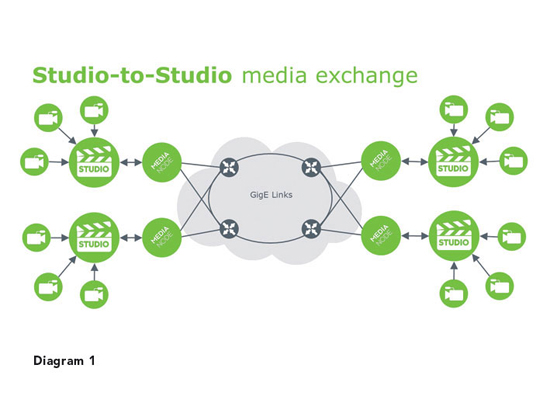
Many broadcast manufacturers have already started implementing an SDI-over-Ethernet (IP) interface for their equipment inputs and outputs. Examples of production equipment include cameras, vision mixers, video servers and editing systems. Once a video signal has been converted to a standard IP Ethernet cable, it can be plugged into a Gigabit Ethernet Network Switch. The video is broadcast throughout the switch and becomes part of a Local Area Network (LAN), very similar to a computer LAN. Below is a schematic of a typical Studio environment, which could easily be implemented in an OB environment. (See diagram 1)
This type of architecture lends itself very well to sharing all the various sources available: collaboration is easy, since all of the content is flooding the network. Redundancy of path and Ethernet switches is handled by networking protocols. This allows the traditional video engineer to leave that to the network/IT engineer. Once the SDI over Ethernet network is established, and enough connections to switches are made, there is very good signal protection.
This is very useful in an OB environment, where cables are temporarily run all over the stadium or outdoor set. With this new type of content movement comes a new level of complexity across the various equipment vendors. The Alliance for IP Media Solutions (AIMS) was created, which includes most of the leading vendors in the industry. AIMS believes it is critical to follow a standards-based approach that outlines a clear roadmap that both meets the needs of implementations today and presents a clear path to greater functionality in the future. AIMS endorses an IP roadmap that includes standards and technical recommendation such as SMPTE (Society of Motion Picture and Television Engineers) 2022-6 and Openflow. The main concept is that the IP technology is not proprietary and standards-based. Most of the well-known manufacturers are already implementing the AIMS-recommended methods, so that maximum compatibility is achieved. It is imperative that the baseband (SDI video/audio) equipment connects seamlessly to any IP network, and that all of the signals can be managed and controlled easily. Added Management Control can be implemented by using a Software Defined Network (SDN). The general idea is that a Management platform controls all of the necessary components in the network, thereby negating any tedious setup of equipment, especially useful for broadcast (and not IT) engineers, responsible for network configuration. Broadcast engineers must be able to provision their own IP circuits, from within a familiar user environment. Key concepts for its success, from the Broadcaster’s point of view:
- Simple interfaces (web-based User Interface) for connection management, service assurance, and network inventory
- The transport, management and device control must have built-in redundancy, which makes the solution even more robust and scalable than traditional SDI solutions.
- Simple hand-over to other IP networks: any router in the network can forward the packets to any other connected network, even if the latter is not SDN based
- Extendible to remote locations: other locations are effectively extensions of the central studio/campus
- Cost-effective, incremental transition, through co-existence between baseband and IP
- Reduced upfront and on-going CAPEX investment, as the architecture is scalable and based on adding rather than replacing
- Benefit from vendor choice and lower “IT” price-points for network equipment, thanks to compliance to standards
- Greater flexibility in production by making contribution networks seemless extensions of studios and enabling virtualisation
Nevion’s IP solution, production sites can be treated as extensions of the main production facility. This enables broadcasters to locate the production team in the most suitable location in terms of effectiveness and workflow requirements. For example, the director operates from a compact and lean control environment on location while the sound engineer, EVS operator, graphics and camera shading operators remain at the central broadcast facility. Their system works over standardised WAN (wide area network) connectivity and was designed to operate in mixed mode with uncompressed and JPEG-2000 (J2K) encoded signals. A pioneer in media transport, Nevion provides network and broadcast infrastructure to broadcasters, telecommunication service providers, government agencies and other industries. It enables the transport and management of professional-quality video, audio and data – in real time, reliably and securely – from the camera to the home.
The case for IP delivery from OB to Studio/Station
In many situations the OB production is live, so the final output needs to be transmitted in real time back to the TV station for live broadcast. Distances can vary from a few kilometres to thousands of kilometres, and are rarely perfect connections. Almost all links are bandwidth-constrained, i.e.: over a satellite or wireless link, or fixed-line IP link. The pubic internet is being used more often due to its cost-effectiveness and increasing reliability. However there is no guaranteed Quality of Service (QoS), and it’s anybody’s guess exactly how the data travels from the OB, through various service providers and links that make up the Internet, to the Broadcaster. It is for this reason that SMPTE defined Forward Error Correction (FEC) for the delivery of IP streams.
By Andy Louis, technical director, Telemedia
