Home Authors Posts by Grass Valley Press

Grass Valley Press

18 POSTS 0 JOBS
Grass Valley is a trusted partner completely focused on empowering customers to create, control and connect content wherever, however and whenever it is consumed.

Grass Valley opens up powerful content management capability to smaller media operations

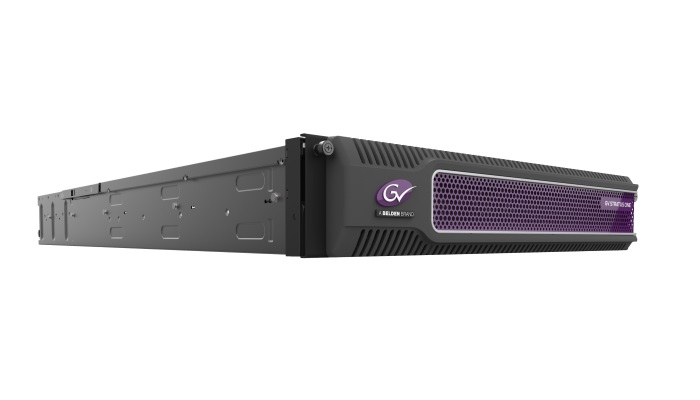
Grass Valley debuted GV STRATUS One on its NAB Show 2019 booth, delivering unmatched content management capability in a compact 2 RU footprint. GV STRATUS One deploys in a matter of hours and empowers a resource constrained operational staff to handle every aspect of the media workflow, from the moment content is captured to final delivery via any platform – all from a single unit.

GV STRATUS One combines the next generation technology of GV STRATUS software with applications from GVRE transcoding, GV I/O servers, and EDIUS editing into a comprehensive, all-in-one platform. The solution streamlines collaborative workflows to expand content creation without adding headcount, allowing content to move quickly and efficiently through the content workflow process. GV STRATUS One manages ingest, playout, recording, transcoding, asset management and supports streaming to the web client. Content can also be edited through the high-resolution EDIUS editor with multiple licenses for proxy editing and HTML5 streaming. This combination of functionalities in an integrated platform simplifies purchase and deployment and reduces costs, making it an ideal solution for small broadcast operations, regional and satellite stations, venues and house of worship environments.

Pete Semerak, vice president of production, Grass Valley, said: “GV STRATUS One opens up high-end production opportunities to smaller broadcast environments, making it easier to manage multiple distribution channels from a single box. This solution reduces the complexity with affordable turnkey simplicity that empowers smaller production operations to meet the demand for first class content.”

An integrated hardware-software solution, GV STRATUS One delivers 300 hours of usable storage at 100Mbps, eliminating the need for additional equipment. The solution is powered with a range of time-saving collaborative features, including:

  • Automated Rules Engine: simplifies the organisation and delivery of content.
  • Growing File Workflows: allows media to be edited during ingesting for rapid deployment, enhanced collaboration.
  • Social Media & CMS Management.

Delivering even greater creative freedom, this versatile solution overcomes resource constraints to allow production staff to get content to viewers quickly.

Grass Valley demonstrates powerful content and media solutions at CABSAT 2019

Grass Valley, a Belden Brand, will be at CABSAT 2019 (12–14 March) to showcase a wide range of products and solutions, leveraging the best innovation and expertise to give customers the ultimate selection and service.

Featured solutions will include:

IP:

IQUCP Universal Compute Processor: The high-speed IP I/O with optional functionality at 4K UHD/3G/HD/SD rates that can be re-programmed as required. IQUCP allows users to deploy a single, high-density hardware unit that supports up to 16X 3G SDI BNC I/O ports, of which four can be 12 Gb/s direct ports. It can be reprogrammed for alternative use, requiring only a software change to reconfigure the system and eliminating the need for new hardware.

MV-820-IP multiviewer: The only product on the market that delivers 48 IP inputs and 12 IP outputs in a 2 RU chassis. This high density I/O makes it ideal for a range of IP monitoring applications.

Grass Valley IP control and monitoring: Delivers comprehensive configuration, control and monitoring of any media installation. The system can be customized to provide a high degree of automation and seamlessly integrates with other Grass Valley solutions, as well as associated third-party devices.

News:

GV STRATUS video production and content management: Offering a suite of tools with access from anywhere on any supported device, capturing content from a wide range of sources. GV STRATUS also places a premium on user generated content, integrating with popular social media and CMS platforms to manage, track and analyze the performance of social channels from within the application.

Switchers:

Kula Production Switcher: Designed for the professional broadcast and AV markets, Kula offers a powerful feature set in a compact system for easy installation and operation. Available in several models: as a 1, 2 or 3 M/E switcher, with the capability of operating in SD, HD, 3G/1080p and 4K UHD, as well as a dedicated 1 M/E 12G-SDI or IP version.

GV Korona K-Frame V-series: This system is designed for small to mid-range broadcast and media applications, where compromising on performance is not an option. GV Korona K-Frame V-series is available in three system packages, with 1, 2 or 3 M/Es and a complement of licenses, providing exceptional value and incredible power.

Cameras:

LDX 86N RF head: The only wireless, shoulder-mounted 4K UHD RF head in the industry. It provides the freedom to get the shots you need while offering a single solution for transmitting HD, 4K UHD and HiSpeed HD over the same link — even simultaneously transmitting high-speed phases (up to 3X 1080p) with a separate 3G video channel.

The LDX 82 Series: Consists of four models offering varying levels of operational flexibility to match every production need, with the ability to upgrade as production and business needs change. This includes extended color gamut supporting ITU-R BT.2020 and HDR operation with full 15 F-stops or >800% of regular cameras.

The LDX C86N WorldCam: offers all the production formats of the LDX 86NWorldCam (HD/PsF/3G) plus a seamless upgrade path via GV-eLicense to native 4K (LDX C86N 4K). With the addition of BT.2020 wide color gamut support and optional HDR support, this versatile camera provides an outstanding solution for all HD/3G applications.

Replay: 

LiveTouch replay and highlights: A complete replay and slow-motion system for studio and sports applications. It’s fast and easy to use, yet offers sophisticated highlight capabilities including integrated editing as standard. LiveTouch systems can scale to meet HD, 3G and 4K UHD productions of any size.


HDR holds the key to better images

SCREEN AFRICA EXCLUSIVE: Consumers have long judged video content by the visible quality of the image they see on a screen. With newer high-resolution formats now available on standard consumer-grade devices, viewers have naturally developed a hunger for first-class quality, which explains why they have such high expectations for better and better images.

Over the years, we’ve witnessed the shift from black-and-white to colour, from SD to HD, from analogue to digital, and now we are seeing simultaneous interest in both 4K UHD and HDR. Looking for a superior viewing experience, consumers are investing in new displays that can support these latest formats. Initial reactions to 4K UHD and HDR content indicate that consumers are impressed with the noticeable difference they see in the quality of programming; the colours pop and the details stand out more in a wider variety of scenes. This demand on the part of consumers – and the advertisers trying to reach them – is pushing content producers to adopt 4K UHD and HDR technologies.

4K UHD increases the number of pixels, resulting in a larger field of view for long shots or increased detail in close-ups. However, while consumers undoubtedly enjoy a much richer viewing experience in 4K UHD, the additional resolution alone is not enough – particularly when you consider the screen size that most of them are accessing content on. More pixels in an image requires a much larger screen at the same viewing distance to see a noticeable difference in the content. This is where HDR comes in.

HDR is generally recognised as the next big thing in content delivery, delivering an immediate – and perceivable – benefit to the consumer. Thanks to its contrast ratio, which is closer to the conditions found in real life, HDR allows image reproduction that is much closer to reality.

Consumer trends indicate that HDR is a good bet for content producers. Shipments of HDR TV sets are forecast to surpass HD units by 2020 and reach 245 million units in 2022, representing a market that will be worth around 36.82 billion by that same year. By combining 4K UHD and HDR, broadcasters can deliver the best images possible in the industry today that create truly immersive and lifelike experiences for viewers.

HDR also benefits content creators in that the format enables more dependable results under difficult shooting conditions. Its wide contrast range is better able to capture much more detail in the brighter areas of the picture in environments with irregular lighting or partial shade, found at many outside broadcast productions.

It’s not just in the context of 4K UHD that HDR can make a difference. HDR is fully format independent and does not need any specialised viewing conditions – such as the minimum screen size and proper viewing distances required for 4K UHD – to show its advantages. The ability to produce HDR content in HD removes the significant bandwidth requirements needed for HDR in 4K UHD and can be more quickly deployed. For many broadcasters, adding HDR to 1080p HD footage is an attractive, cost-effective strategy. From a viewer perspective, there is still a stunning improvement in image quality, and disruption to existing workflows is minimal.

Bringing HDR into the workflow

For broadcasters and content creators, embracing an HDR workflow process raises a number of questions and poses some challenges. Most notable is the need for a parallel SDR/HDR production workflow – one where the signal can be adapted with up/down mapping as required to mix and match incoming content formats and output signals, without sacrificing any quality. For example, operators may need to integrate existing SDR content into new HDR productions or may need to send HDR content to SDR multiviewing screens in a studio. Many broadcasters reserve HDR for their premium channels but don’t want the expense of a separate production chain for generally broadcast SDR assets. In any case, the producer’s intent for each individual signal must be maintained.

One of the big hurdles to widespread deployment – as it always is with any new technology – is standards. ITU-R, the radiocommunication sector of the international telecommunication union, have specified in their Recommendation ITU-R BT.2100 “Image parameter values for high dynamic range television for use in production and international programme exchange” two different standards for HDR – Hybrid-Log Gamma (HLG) and Perceptual Quantisation (PQ) or Dolby Vision.

Grass Valley, a Belden Brand, offers a portfolio of HDR-enabled Live production solutions that includes cameras, production switchers, servers, routers, up/down mapping cards and multiviewers. To provide the best possible picture quality, either HD or 4K UHD images are captured and used across the production chain in their native PQ or HLG format. That content is simultaneously delivered in HD or 4K UHD, SDR or HDR through a best-in-class down-scaling/down-mapping conversion at the end of the production chain. Using not only the most, but also the best pixels throughout the production and a single conversion ensures the best quality picture possible. An added benefit for many content producers who must rapidly adapt to new production environments at each event, Grass Valley supports all of those formats from the same hardware, preserving the producer’s investment and skill sets from program to program.

An upward trend ahead

Looking forward, we are expecting a rise in 4K UHD and HDR uptake across sports and entertainment production. In recent months, we have seen significant investment coming from broadcasters as well as production companies, outside broadcasting and rental houses globally – and we expect this trend to continue in the months ahead.

Written by Chris Merrill (director of Product Marketing) and Klaus Weber (principal, Camera Solutions and Technology) at Grass Valley

Mediability announces strategic partnership with Grass Valley

Mediability has announced that a Diamond Partner agreement with Grass Valley has been signed for Mediabiliy’s Nordics operations. The agreement secures Mediability’s customers, across the Nordics, access to the full products portfolio of Grass Valley, including the former Snell Advanced Media (SAM) product lines.

With the long term relationship with SAM, the Mediability team have built key competence on SAM’s playout and production solutions, that are now integrated into the Grass Valley product offering. The partnership with Grass Valley opens new possibilities for our customers to explore the Grass Valley market leading content and media technology solutions.

“Our long term relationship with SAM has been a driving factor in Mediabiity’s success in the Nordics and we are very happy to secure our position with Grass Valley, as their selected partner in the Nordics, says Håvard Myklebust, CEO, Mediability Group. “We can now offer the best of breed products and solutions to our customers for live production, news, playout, and networking, in collaboration with one of the media industry most renowned vendor.”

“We at Grass Valley are proud to have a partner such as Mediability with such technical capability and professionalism in customer service. In a time of industry flux and technology transition, where our customers are looking for a trusted advisor, SAM’s long-term partnership with Mediability in the Nordics has showed us that they are there to help guide their customers through their decision process. We look forward to a great future working with Mediability and our Nordic customers,” says Greg de Bressac, head of Global Channel Sales – Grass Valley.

Grass Valley EDIUS 9 wins Product Innovation Award

EDIUS 9 Nonlinear Editing Software from Grass Valley, a Belden Brand, has been recognised by TV Technology, part of NewBay’s Broadcast/Video Group, with a 2017 Product Innovation Award. First introduced in November, EDIUS 9 added a number of significant performance enhancements that made it even easier for users to edit anything in real time in almost any format or resolution.

“Our team works really hard to learn from users and add the new features that make EDIUS more powerful and user-friendly with each version,” noted Katsushi Takeuchi, vice president and general manager, Editing Systems, Grass Valley. “Recognition like this from such a respected source means a lot to us. It’s even further validation that the platform is exactly what the industry needs and is on the right path to remain an indispensable tool in the nonlinear editing process.”

Some of the many new features in EDIUS 9 include native editing and full export of HDR material from any source, the ability to mix SDR and HDR material in the same project, workflow and format updates, a major upgrade of the user interface, additional third-party hardware support, and the inclusion of Mync media management software.

Soon, EDIUS 9 also will feature a new “Cloud Ready” floating license package that is designed for large facilities such as broadcast stations or educational environments, allowing users to install EDIUS across multiple systems and then run a set number simultaneously at any given time, adding more licenses as needed. This feature will enable the use of EDIUS 9 on virtual workstations with major cloud platforms.

Celebrating its fifth anniversary, NewBay’s Product Innovation Award recognises excellence in manufacturing of products to serve the TV/pro video and radio/online audio industries. Winners are selected by a panel of professional users and evaluation criteria include innovation of concept and design, creative use of technology, price value, and suitability for use in a broadcast TV/pro video or broadcast/online radio environment.

LDX 82 Series HDR-capable advanced imaging camera platform

For increased flexibility and a wider range of choice when it comes to HD cameras, Grass Valley recently debuted the LDX 82 Series, which includes four upgradable camera models, offering varying levels of operational flexibility to match every production need. Each model of the LDX 82 Series offers the best sensitivity in all HD formats—including 1080p—a wide colour gamut, and Grass Valley’s XDR (Extended Dynamic Range) operation with a full 15 F-stops (available by GV-eLicense only).

The LDX 82 Series cameras are built around Xensium-FT imagers, a new generation of camera imagers that combine all the advantages of CMOS imaging technology such as high sensitivity in all video modes, high dynamic range and low power consumption. They also include global shutter behaviour, which before was possible only with CCD imagers. Xensium-FT imagers deliver unmatched sensitivity and picture quality even in the most demanding applications.

Understanding that productions need freedom and adaptability, Grass Valley enables users to choose the right solution to fit their specific requirements. Thanks to the unique GV-eLicense program, LDX 82 Series users have the choice of upgrading their cameras to the functionality of any higher level in the family though a perpetual or 7-day license.

The LDX 82 Series also is available in compact versions, providing even more workflow and creative flexibility. The compact format enables the highest quality native HD capture in camera positions that are difficult to reach, or are impractical for camera operators.

Visit Grass Valley at Mediatech 2017 on the Protea Electronics stand (D17). 

Grass Valley helps broadcasters transition to IP

Long a proven networking technology for many industries, Internet Protocol (IP) technology is quickly gaining traction across the broadcast television ecosystem as broadcasters look to make their operations more efficient on every level. Understanding exactly how and when IP technology will impact a given business model depends on a broadcaster’s individual situation, but developing an understanding of the technology and how it fits different workflows is critical.

The need to manage a growing volume of content continues in the broadcast world (i.e., multiple formats, VOD, OTT, etc.) as the market jockeys to identify the best way to accommodate viewer tastes. Higher quality content (4K/UHD and beyond) requires more horsepower to distribute throughout and between broadcast plants. To remain efficient while satisfying these demands, broadcasters need to choose the technology that has already demonstrated its ability to support the bandwidth that broadcasters require. In the long term, IP provides the most affordable and sustainable solution.

IP technology is well established and is already delivering benefits in a number of other vertical industry applications, including IT data centers. The broadcast industry can benefit from a model like this, one that relies on the same scalability, load balancing, use of commodity hardware and redundancy that make IT data centers so ubiquitous and successful. The Broadcast Data Center approach from Grass Valley, a Belden Brand, brings all of those benefits to the broadcast space.

With the agility of IP, broadcasters are set up to handle the growing needs of their broadcast plant today and, perhaps even more importantly, to ensure their ability to continue expanding easily in the future. It’s this agility through technology that makes IP so appealing: high data rates, wide bandwidth and a system that’s both format agnostic and scalable for whatever the future brings. An IP infrastructure based on open standards provides broadcasters with maximum agility and flexibility to adjust business models, capitalise on new revenue opportunities, and add new capabilities and services without having to constantly rebuild their infrastructure.

The reason for common standards is obvious: interoperable solutions based on widely accepted, open standards have driven the industry’s growth and success for decades by accommodating broadcasters’ current needs and ensuring they’re ready for future advancements. Just as the industry did with SDI, broadcasters must maintain this approach with IP—utilising a single, standardised interface for transmission of video to ensure that widespread signal transport interoperability continues.

As a founding member of the Alliance for IP Media Solutions (AIMS), an independent trade association founded to ensure that all IP solutions brought to market offer complete interoperability, Grass Valley is dedicated to open standards that will integrate seamlessly into current workflow environments. The association’s initial focus is on promoting the awareness, adoption and refinement of open protocols for media over IP.

Broadcast television operations are the factories that drive the medium and IP technology improves productivity. Going forward, IP technology is changing the way video is produced. IP data transport not only provides a way to move media from point to point, but also enables carriage of additional, time-varying data related to the media itself.

For example, a camera has a fixed location measured with GPS and lens type, based on configuration. As the video is recorded, F-stop and focus are varied. Additional dynamic information related to the recording can be included in the metadata such as time of day, event type, people, places or things, and other keywords associated with the media. This data can then be used to generate and render real-time graphic enhancements, such as first down lines for American football games or other event-specific graphics. As a result, follow-on productions are richer, and offer more value by including additional clips, sound-bites or text references based on context.

This is one of the real values of IP. It can be argued that metadata has become at least as valuable, if not more valuable, than the actual video being captured. And, the way that dynamic metadata is handled by IP technologies powers creativity, through time-aware, data-rich applications that can’t be handled in SDI.

In many customer environments around the world, Grass Valley’s Broadcast Data Center enables a broadcast-centric IP plant designed with the affordability and efficiency of today’s IP networks and COTS switches, while leveraging the reliability, extensibility, functionality and familiarity of the SDI broadcast world. GV Convergent control system controls and manages traffic through both IP switches and SDI routers, while controlling edge switching and orchestrating bandwidth with a design for the needs of broadcasters. The GV Node Real-Time IP Processing and Routing Platform provides vertically-accurate switching. Controlled by GV Convergent, GV Node’s real time, distributed routing and IP processing supports both IP and SDI workflows. Additionally, GV Convergent and GV Node provide other broadcast-centric benefits so that an IP infrastructure mimics traditional SDI workflow and processes.

With the right solutions provided by a supplier that is committed to interoperability and leveraging the benefits of technology from adjacent markets, broadcasters are realising the benefits of IP and are discovering new opportunities for improved efficiency and profitability.

Visit Grass Valley at Mediatech 2017 on the Protea Electronics stand (D17). 

Grass Valley introduces the new GV Korona K-Frame V-series systems

The new GV Korona K-Frame V-series systems from Grass Valley, a Belden Brand, are specifically designed for low- and mid-range broadcast and media applications, where compromising on performance is not an option. GV Korona K-Frame V-series systems are available in two system packages, with 1 or 2 M/Es and a compliment of licenses, for exceptional value and incredible power.

The small footprint of the GV Korona K-Frame V-series is ideal for smaller stations, sub-studios, mobile environments, corporate, sports venues, educational, government and houses of worship production facilities. With its modular design for simple scalability and serviceability to its handling SD/HD and the ability to produce in 3G/1080p with no loss of functionality and 4K UHD with a simple license upgrade, it is ready for anything.

Out of the box, GV Korona K-Frame V-series provides you with 3G/1080p and 4K UHD (quad-split and 2SI) support capabilities, up to 3 M/Es plus two additional and powerful Video Processing Engines (VPEs) for all the no compromise mixing and keying power you will ever need. Its native 10-bit 4:2:2 processing even supports High Dynamic Range (HDR). This is real big switcher performance in a small form factor with a lower CAPEX cost than previously available.

As part of the K-Frame family of Video Production Centers, the V-series works with any Grass Valley switcher control panel, just as any control panel works with any K-Frame. This gives you the power to build a show on one panel, with the confidence to know that it will play back on any other panel.

- Advertisement -
- Advertisement -
- Advertisement -

Pin It on Pinterest