Home Authors Posts by Cera-Jane Catton

Cera-Jane Catton

316 POSTS 0 JOBS
Cera-Jane Catton is a writer and journalist with years of experience in community newspapers, blogging and freelance journalism. She has worked in a cache of capacities, often finding herself behind or in front of the cameras, intentionally and less so. She has been a stunt double in two Bollywood movies, has worked in various capacities on a number of natural history documentaries, and other international productions shot in South Africa. Cera is a former Screen Africa journalist.

Insights from the world’s film festival circuit

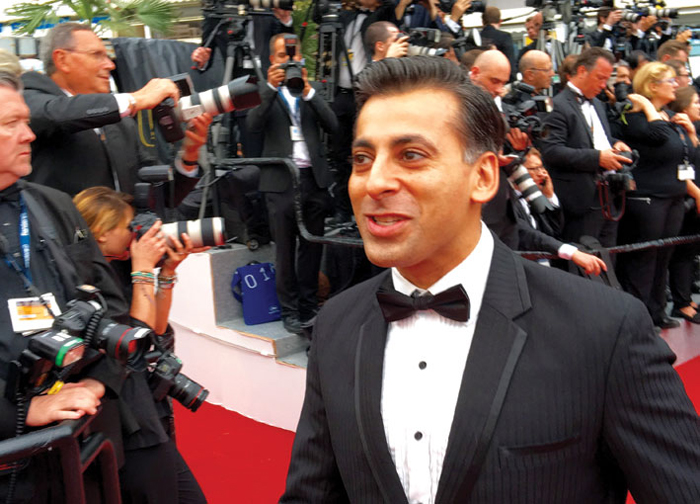
After the completion of the Cannes Film Festival and prior to the start of the Durban International Film Festival, Screen Africa caught up with AB Moosa, the managing director of the Avalon Group, to talk about what it takes to make an impact at film festivals.

It was Moosa’s twelfth trip to Cannes, which is considered the most important film festival in the world. Each year at the festival and Marché du Film more than 30 000 professionals are accredited. This year marked its 69th anniversary, and the event continues to strengthen its role as a pioneering platform in world cinema. “This includes the unearthing and promotion of films and artists to the implementation of new activities to support film creativity and growth,” says Moosa. Cannes includes a series of cultural and artistic activities such as masterclasses, workshops, panel discussions, symposia, and a prestigious competition, the highpoint of which is the Palme d’Or Award.

According to Moosa: “It is therefore crucial for South Africa to make its presence felt at this incredible market and festival to showcase its film offerings and talent to the international film fraternity.”

Moosa observed at the festival that, despite the rapid rate at which technology continues to revolutionise and reinvigorate the film industry with streaming becoming more relevant, cinema-going and the big screen experience continues to be an integral part of filmmaking.

“For me personally Cannes is always exciting because I get to meet key international industry players in one place and the conversations we have around film are sometimes the most enriching part of the experience,” adds Moosa. He attends the festival to service relationships with studio executives and to negotiate new content for South Africa. “Attending keeps me up to date with international filmic trends.”

The thriving South African cinema industry certainly stood out at Cannes this year. Moosa says that the SA film Happiness is a Four-Letter Word was a great local film to showcase to a global audience. “Other strong films included Kalushi, Free State and Mrs. Right Guy.” Unable to view any of the films in Cannes, Moosa views any home grown offerings in SA. “From what I hear, the viewings of these films were very well received by international buyers,” he says.

Advising filmmakers, Moosa says that Cannes is a very competitive market with global industry talent convening in the French Riviera to network and showcase their films. He says: “It can be overwhelming for many first time players and my advice is to persevere even at times when it may seem impossible to break into such a competitive space and to aspire to make films that are proudly South African with a global appeal.”

Back on home ground, Avalon, South Africa’s largest and oldest independent cinema exhibition and entertainment company, were co-founders of DIFF and have been co-sponsors since its inception in 1979. The group have also supported the Durban FilmMart since it commenced seven years ago.

“DIFF has and continues to be an important and invaluable platform of both showcasing and supporting new talent,” says Moosa. “New talent gets recognition and with this comes further benefits, allowing the filmmaker to leap to the next level. Many filmmakers have also told me that both DIFF and DFM are the best platforms for film networking in Africa. It has led to many mutually beneficial relationships and other collaborative possibilities. For me one of the greatest benefits of DIFF is the educational opportunities it presents; both to filmmakers and the general audience.”

DIFF is a part of the Avalon legacy, says Moosa. “The festival started at a time in our country when we were the only cinema group willing to screen festival films, many were politically sensitive as they were critical of apartheid or had scenes of black and white interactions which were not acceptable to the apartheid government.”

Thirty-seven years later it has certainly grown in stature and is among the most significant film festivals on the continent, which Moosa says the group is humbly proud to have been a part of for all these decades.

DIFF certainly has the potential to grow and become more internationally respected and regarded, like Cannes and other international film festivals. Moosa says: “This however would require a revised and refreshed approach for it to be revitalised and developed.” He says that DIFF has the potential to show the world that there is infinite skill, ability and talent both in South Africa and Africa and it is an important platform to showcase this.

A pioneer and entrepreneur himself, Moosa says that DIFF has reached a stage where a new approach needs to be considered and adopted. “As with many things in this dynamic and fast-paced industry and world, in order to stay relevant reinventing oneself is required,” he says.

Each year Moosa attends film festivals in Berlin, Cannes, Toronto and Dubai, and others sporadically. “Each one has something unique to offer and sometimes it depends on the timing, completion and release of different films that helps make a particular festival more relevant than others in a given year.”

While the famed film festivals such as Cannes, Sundance, Berlin, Venice, Rotterdam, Toronto, all have at least some element of subjectivity, Moosa says not to forget the niche and genre festivals that may be best suited to screen your film.

Considering the possibility that it is the films that make a festival Moosa says the two co-exist and are equally important. “Festivals create opportunities for the film to be seen by a wider and international audience and promote the talent of the film to aspire to possibly better works in the future,” he adds.

Moosa says that if the film is well received by audiences then it gains a life of its own. “Plus the bonus of having the international press and respected trade mags to promote the film is invaluable.”

He says that positive word of mouth is most often what helps to create the impact.

After DIFF Moosa is off to CineEurope in Spain, which is an annual cine exhibitor’s conference and trade show. “There I will meet with studio execs and then up-to-date insights, trends and technological developments in cinema are showcased and discussed.”

The ancient art of existing as one

Taking a group of San people from their home in the desert to the bustling city centre of Frankfurt was just a small fragment of the course in the making of Ghostland. The German documentary is about the earth’s oldest existing culture, who have existed sans clothes for  20 000 years – the Ju/’Hoansi of the Namibian Kalahari.

The production team decided to juxtapose the Ju/’Hoansi culture with their own in order to better understand the two.

“We show the reality and values of the Ju/’Hoansi and how these are reflected in their view of foreign ways of living,” says co-director Catenia Lermer. “It is not sufficient to simply examine our own culture if we are to develop universally valid statements on human behaviour. It is only possible to see and understand human behaviour if it is observed in the contrast of many different cultures.”

It was on a chance accompanying trip to support the traditional tribes of Namibia that Ghostland was born. “We had an idea of what the story could be, but we knew that results would depend on the characters and the culture of our protagonists,” says Lermer.

Joined by unit manager, Sven Methling, and director Simon Stadler, who was also cinematographer. Both Methling and Stadler conceptualised Ghostland. It is one thing to want to film an ancient and remote culture, quite another to make such an idea conceivable. It involved long periods spent in the village prior to the filming that made it possible for this European trio to establish an empathetic, respectful and gregarious relationship with the Ju/’Hoansi. “We were integrated into the day-to-day life of the village with and without the camera,” says Lermer, speaking of the bond that still remains after the film’s completion.

Documenting without influencing, the journey began in 2010. Ghostland follows a group of San people from the Kalahari to civilised Namibia and Europe. “A journey to the world of the ghosts with the tables turned. The Ju/’Hoansi are no longer the research specimen but the researcher, not the beggar but the teacher,” explains Lermer. The film explores an ancient existence, and then allows it to view the modern world.

The rich reality and values of the Ju/’Hoansi is reflected in their perception of our world. This context of the film came about after a German foundation invited four members of the Ju/’Hoansi to go to a workshop in Europe. “That was an unexpected chance for our project to get deeper in the view of them,” says Lermer. “It allowed us to look at ourselves through the eyes of the Ju/’Hoansi.”

Released in March 2016 the film premiered at the Thessaloniki Film Festival in Greece, and is having its South African premiere at DIFF. In April this year the filmmakers presented it to the Jo/’Hoansi. “It was a technical challenge, but we managed to show it with a bed sheet, our laptop and a video projector. The school supported us with electricity from their solar panels.” This was the final step in the process of making the feature. “We were excited how our protagonists would react and very happy that they laughed a lot, were impressed and entertained.”

While travelling with the Ju/’Hoansi to Himba Village the filmmakers realised that it was the first time that these tribes had ever met or interacted with each other. “It was an impressive moment to share this first contact,” says Lermer. She explains that the biggest challenge was to get close enough to capture their emotions and sentiments without intervening in their lives.

It was in 1990 that the law changed for the Ju/’Hoansi; these nomads were forbidden from hunting and forced to stay in one place. This meant they were unable to support themselves. While supported sporadically by the government, they were forced to sell devil’s claw at the side of the street or to leave the group to make money.

“The Ju/’Hoansi of Grashoek, our protagonist, got the idea from a Namibian NGO of a self-dependent Living Museum, which is now working passably successfully after a couple of years.” Implementing the same concept, they are able to exhibit their traditions without fear of losing their knowledge the way it happened with the traditional knowledge of many other San groups.

Despite these challenges their life remains fixed between two worlds. “The fact is that the circumstances destroyed their traditional society, which was unprecedented, tolerant, peaceful and formed by equality,” adds Lermer.

Ghostland shows that much can still be learned from Ju/’Hoansi knowledge and behaviour. The film exemplifies that life in the Kalahari, and life as it once was, is only possible by sharing everything. “There are no individual possessions, and no individual destiny, simply the destiny of the group,” she says. The unity is characterised by equality and respect.

Filmed in Namibia, Germany (Frankfurt, Main, Göttingen, Hamburg), Italy (Rimini), and Denmark (Lejre). Using 720/25PN recording technology with Panasonic HVX 201, as Lermer explains that without electricity, this allowed them to limit the data volume on hard disks, which was then colour corrected and scaled up to 1080p.

“We decided not to use clip-on or radio microphones as it did not seem appropriate for us to cable the Bushmen,” says Lermer. The sound was recorded entirely using boom mikes. The film was edited in Final Cut Pro Studio. World Distribution was done by the Austrian agency Autlook Filmsale.

Electricity was a major challenge as every week or so the crew had to travel 120km to charge equipment. Ghostland was made to show a neutral and observational perspective, so to come that close without disturbing the atmosphere they kept a small, flexible team. “That was the advantage,” says Lermer. “But at the same time it made a lot of work for only three people.”

Key crew list:

  • Production and equipment: Cameleon Film / Simon Stadler
  • Director, camera and idea: Simon Stadler
  • Co-director and sound: Catenia Lermer
  • Idea and unit manager: Sven Methling
  • Editing: Simon Stadler and Andre Broecher
  • Colour correction and technical post-production support: Magna Mana Production GmbH / Frankfurt am Main /
  • Music composing, sound engineering and mixing: Matthias Raue / Tanit Studio GmbH / Frankfurt am Main

FILM DIRECTOR SPEAK: Mandla W. Dube

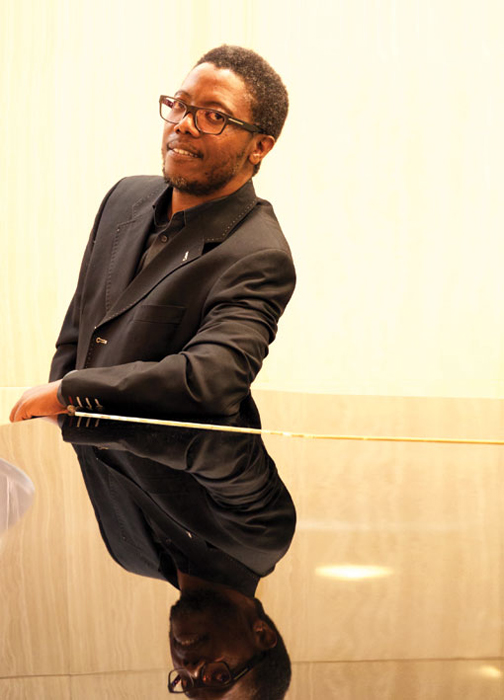
Talking to us from Cannes, South African director Mandla Dube has a broad and international foundation. From an American alma mater to teaching camera technique at Wits University, camera technician to cinematographer. Dube is a father, film maker and flag-waver, who recently honoured the heroism of Solomon Mahlangu in the feature film, Kalushi.

HOW WOULD YOU DESCRIBE YOURSELF AS A DIRECTOR?

Dedicated, meticulous and ready to learn. While hard working, I love the creative and collaborative process with actors and crew.

DESCRIBE THE MOMENT YOU DECIDED YOU WANTED TO BE A DIRECTOR?

I had no choice, no one wanted to direct my script and project. So a friend of mine, Teddy Mattera, a director himself said: “When it’s your turn you better step up and direct.” So I did. Now I enjoy it and wish I had overcome the fear sooner. However it’s never too late. I did direct my cinematography thesis film Imagine That while at the American Film Institute (AFI), where a directing fellow encouraged me to direct as opposed to getting someone else to convey my vision.

WHAT IS YOUR BACKGROUND AND HOW HAS IT SHAPED YOU AS A DIRECTOR?

I am a cinematographer first and foremost. I’ve loved cinema for many moons, since I was seven years old or so. When I did my undergraduate studies at Clark Atlanta University (CAU) I was hungry to tell stories, so I minored in African history. That opened a whole universe of African stories in the diaspora which I was willing to learn and embrace. At that time Spike Lee was my inspiration. When I left home after the new democracy for graduate school I went to AFI in Hollywood, I already knew the African voice was part of my responsibility as a filmmaker. In Los Angeles my visual storytelling style was sharpened as a cinematographer working for some of the great studio cinematographers.

HOW HAS YOUR CAMERA EXPERIENCE SUPPORTED YOU AS A DIRECTOR?

I started working in camera as a prep technician at an equipment facility in Atlanta, Georgia in 1992, while studying at CAU. So lenses, cameras and light equipment were part of my vocabulary and tools at a very early stage. I know what a 75mm lens will do emotionally at a given distance on a particular format as well as an aspect ratio used. And continue to discover more and more by immersing myself in the new technology as it comes out. It also helps to surround yourself with great assistants that know the gear. But I must give credit to my instructors and classmates as well at AFI who shared their knowledge. I was fortunate to work and be mentored by Bill Dill, Henry Adebonojo, Wally Pfister, Bob Richardson, Allen Daviau, Janusz Kaminski, Greg Gardiner, Bob Elswit, Amy Vincent and recently on Money Monster directed by Jodie Foster where I did second camera for Matthew Labatique.

WHAT IS YOUR FAVOURITE POSITION TO BE IN ON A FILM SET?

Cinematographer and director, and to be ahead of schedule. Nothing pisses me off like the AD coming to me saying we are running out of time. Once time is gone you can’t scoop it up from the floor and voila it’s back.

WHERE DO YOU FIND INSPIRATION?

I walk a lot and I talk to my sons about everything. I read and watch documentaries, the stories of people passed that have not yet been told inspire me. Obviously the universe conspires with me when those ideas come. I learned from Stanley Kubrick to write every idea that comes to mind, no matter how insignificant you think it might be.

DO YOU HAVE ANY MENTORS?

I would spiritually die if I didn’t. My late parents, my wife, my brothers and sisters. My co-producer Walter Ayres and Paul Raleigh at Hollard. My directing coach Adrienne Weiss who teaches at Columbia University. And actors on set are such great mentors when they know who their characters are.

WHAT HAS BEEN YOUR PROUDEST MOMENT AS A DIRECTOR?

Overcoming the fear of directing and sitting in the cinema witnessing audience members go through an emotional ride with my work. That is just fantastic.

WHICH PROJECTS ARE YOU CURRENTLY INVOLVED IN?

Right now I am doing a documentary series on Mapungubwe while developing a dark comedy and a heist film. It is 5.30am at the Cannes Film Festival, while I answer these questions I have been sending notes to my co-writer Leon Otto on some scripts we are developing. I am mentoring a few filmmakers on their projects. I’m also heavily involved in KZN to make a presence felt. Then of course my kids, and I am a farmer too.

WHAT ARE YOUR PERSONAL CAREER MILESTONES?

Making Sobukwe – A Great Soul with Mickey Dube as my cinematographer. Fulfilling the promise to Martha Mahlangu to tell her son’s story, Kalushi. Meeting the late director Djibril Diop Mabety at Cannes in 1997 – he taught me Zen. Being directed by the great Haile Gerrima and Jodie Foster. Working on huge studio films observing directors command their craft and looking back on where I come from, Mabopane outside of Pretoria, I feel really blessed.

WHAT IS YOUR FAVOURITE ONE-LINER FROM A FILM?

“I’m walkin’ here.”

IF YOU COULD SHOOT A FILM ANYWHERE IN THE WORLD, WHERE WOULD IT BE?

Peru. Machu Picchu. Egypt.

IF YOU COULD PRODUCE AN AFRICAN VERSION OF A HOLLYWOOD CLASSIC, WHAT WOULD IT BE?

Cleopatra.

WHICH FIVE FILM CHARACTERS WOULD YOU INVITE TO A DINNER PARTY?

Tituba from The Crucible, Nino Brown from New Jack City, Brenda from Kalushi, Mandingo from Mandingo, Django from Django Unchained, Miss Cilly from the Color Purple and Catherine Trumell from Basic Instinct.

Usain Bolt speeds up ‘next generation of fast’ campaign

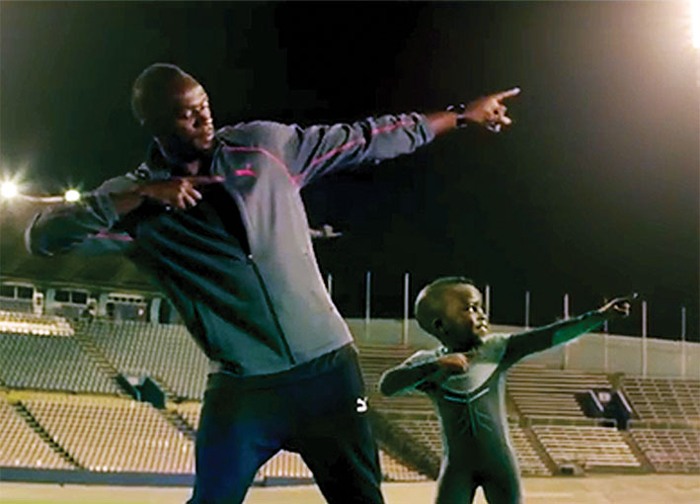
When Telkom launched its Boltspeed fibre network across South Africa at the start of February 2016, they claimed it was the fastest fibre optic internet available. Therefore, Telkom wanted an icon of speed to embody the connection. Who better to personify the brand than Usain Bolt, the fastest man ever timed? True to his form, Bolt’s role was shot in three hours. Due to the athlete’s Olympic training schedule, filming was structured around it, taking place on Bolt’s home turf in Kingston, Jamaica.

Bolt’s management worked closely with Telkom and their advertising agency, DDB Johannesburg, to develop the concept. The ad features Bolt training a real talent, a toddler track prodigy in the making.

“A TVC on this level would usually take up to four months to produce, with an entire week set aside for filming,” says Matthew Berge, executive creative director at DDB. “We had to trust our director, Robin Goode, and time our shoot to the second, with very little room for error.” It took a total of five days shooting with just half a day for stills and the CG shoot.

Goode, who founded Figment Films in October 2015 with executive producer Di du Toit embraced the three hour challenge for Figment’s first TVC. The Jamaican leg of the shoot was shot over two days in November 2015. “We took two crew with us to Jamaica, the DOP Tim Pike and the AD, Dale Butler,” says Du Toit. The rest of the crew were from Walters Productions in Kingston.

“We had to use them as they do all Usain’s work and, despite concerns, it worked out superbly, they delivered 100 per cent.  It was just like working at home,” says Du Toit.

The Kingston shoot was done at the National Stadium. “We started with Bolt’s interview sequence and then used a quad bike and steady cam to get the running footage,” explains Du Toit. “We also had to capture a lot of stadium background plates to comp our running baby in.” With only three hours of Bolt they had to use a body double to get some of the shots. Bolt’s tight schedule meant they had to meticulously plan their time.

A sprinter in a fat-suit was filmed against a green screen at Panalux Cape Island Studio in Milnerton, Cape Town. Children have proportionately bigger heads, feet, hands and knees compared to adults, and so fat-suit technology was used to allow an adult athlete to be filmed in the sporting sequences. This allowed seamless filming while maintaining the correct proportions of a two-year-old boy.

“Goode used this technique to get the right proportions for a toddler and recreate the lifelike action for the running baby,” says Du Toit. Lastly they filmed the toddler, newcomer Michee Kabongo from SA, this was his first shoot, and it was also against the green screen to capture his face. Filming was done using the Red Dragon in both Jamaica and SA.

“Once all the live action was shot we went to Black Ginger for the photogrammetry shoot,” explains Du Toit. Kabongo and the man in the fat-suit stood in one place and 50 cameras took 360 degree stills in an arc around them. These images were used to create a CG model of them to place in to the wide shots of the stadium.

“This is a very common technique used in feature films today and it creates a very lifelike 3D object that can perform and do things you wouldn’t think they could normally do,” says Du Toit. Goode used these various techniques for producing the commercial to ensure the shots appeared authentic. “He needed to have total control of the action he was getting and it is always better to see the images in camera than to try and recreate them in post. This way the emotion and performance is real and there is only a small part that had to be enhanced in CG,” Du Toit confirms.

The capturing of Kabongo was supported by Tracy Lund, the Baby Wrangler. “She not only cast him but managed and worked with him throughout,” says Du Toit. Edited by Ricky Boyd at Deliverance: “he did an amazing job offline so that everyone had a very clear idea from early on as to how the commercial was going to turn out when the post was created,” adds Du Toit.

The music was created by Markus Wormstorm, South African musician and composer, the song has since turned into a talking point of the commercial.

Get Active given the go-ahead to get SA off its ass

At the start of the New Year, Virgin Active kicked off its ‘Get off your ass’ campaign to tie in with the banal resolutions that come with January.

The commercial conveys the message to South Africans to get up and get active in a series of scenes contrasting the lazy against the fit. In the background is a swing song with lyrics that highlight a tendency to let procrastination and lethargy ruin those annual resolutions. The song however, did not sit well with some viewers who claimed that it contained an expletive.

Lines from the jingle that was composed by Ogilvy & Mather for this TVC include, “If you’re feeling kind of bummed that you’re not having all the fun, get off your ass,” and “If you think the world’s against ya, cos your nice pants they don’t fit ya, get off your ass.”

The South African Advertising Standards Authority (ASA) handed down its ruling on the case in May 2016. Representing Virgin Active on the matter was ENSafrica, their head of intellectual property, director Gaelyn Scott talks us through the judgement.

“The ASA ruling deals with two separate provisions of the ASA Code,” explains Scott. “The first of these is clause 14 of section II, which deals with advertising and children. This clause says, among other things, that an advertisement should not cause children mental, physical, emotional or moral harm, nor should it leave children with the impression that undesirable behaviour is acceptable.

“The second provision, clause 1 of section II, deals with offensive advertising,” Scott continues. According to the ASA Code, “no advertising may offend against good taste or decency or be offensive to public or sectoral values and sensitivities, unless the advertising is reasonable and justifiable in an open and democratic society based on human dignity, equality and freedom.”

Virgin Active responded to the complaint with a number of arguments. It said that the advertisement is motivational, in that it exhorts people to exercise. It said that the expression “Get off your ass” is colloquial, and isn’t out of line with society’s values. It argued that the expression was appropriate, given the light-hearted and fun tone of the advertisement and that there was no visual connection with any body part. It further said that it is generally adults who go to gyms, so the advertisement wasn’t aimed at children. It added that most children know the word ass anyway, because it is often heard on TV.

Scott also referred to earlier ASA decisions that have dealt with the word. In particular, a case involving Renault, in which the ASA held that the phrase “I came, I saw, I kicked ass” was not offensive. The ASA directorate on this occasion made the point that the word ‘ass’ is less offensive than the word ‘arse’. Then a case involving Art Lab, in which the ASA held that the term “kick-ass digital printing” was in line with society’s values. Lastly the Groet die Grotman (Defending the Caveman) case, in which the ASA held that the Afrikaans word for ‘arseholes’ (‘poepholle’) would not harm children, and would not encourage them to use it indiscriminately.

Dealing with the issue of advertising and children, the ASA directorate first referred to the earlier decisions and said, “As is evident from the above, the directorate accepts that the word ass, while not necessarily preferable to parents, would not likely cause mental, emotional or moral harm to children.”

It then discussed the advert’s flighting schedule, and noted that it generally appeared with shows aimed at adults. Finally, explains Scott, it dealt with the argument that the word ass was used excessively, five times in a 42-second commercial. The directorate had no problem with this, saying that it was contextualised and was used to encourage a healthy lifestyle.

Moving on to the offensiveness objection, Scott says the directorate noted that it needed to consider the matter from the viewpoint of the “hypothetical reasonable person.” It added that “this approach adopts neither an oversensitive nor a hypercritical perspective, and takes into consideration relevant factors such as the context and likely audience for the commercial.”

Therefore the directorate concluded that it was satisfied that in the context of a humorous and blithe commercial, the word ‘ass’ would not cause offence.

Following a zest for adventure

The chart-topping single ‘Addy (Never Growing Up)’, by the South African indie rock band The December Streets, was brought to life in this music video. The concept was born in the brainstorming process between the band and the creatives, Run Jump Fly Creations. The song is about never losing touch with your young mind that had no limitations and a hunger for adventure.

It was written by Tristan Coetzee in one evening. Addy is the name of his late childhood friend, and ‘Never Growing Up’ is a reference to living with the passion you had when you were a kid.

The story follows a young boy who begins drawing on a sticky note, the character he draws comes to life, jumping off the note and goes on adventures around the room. Ending with an old man looking back on his life, still drawing and doing what he loves.

“As most creatives dream of for projects, we were given pretty much free reign regarding the brief,” said director Lourens Smit at Run Jump Fly. The constant movement in the video, filled with life’s trials and tribulations, essentially relates back to the idea of growing up. “This tied into the overarching concept, pictured in the stop motion character on the sticky notes,” explained Smit.

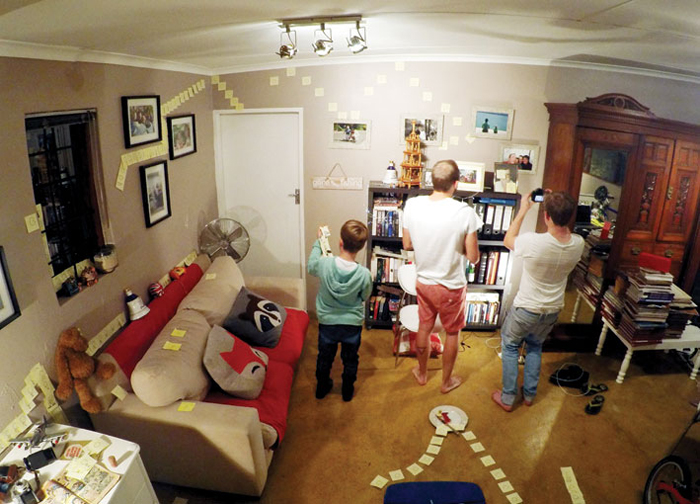
Tristan Coetzee and Zayn Opperman co-directed the video. Planning began by finding a suitable space; they chose the home of a friend of theirs in Rietondale, Pretoria. “He could tolerate his home being filled with sticky notes and loads of coffee for three days,” added Smit.

They didn’t want the narrative to be limited by technical animation ability. “We decided to create a stop motion which interacts with the real world,” he said. They decided on sticky notes so that they could essentially have a deconstructed flip-book animation react in a real space.

Every single frame of the video was hand drawn on a sticky note by Zayn Opperman. “In pre-production we drew out each note according to the scene, then stuck them up chronologically on a wall to make sure we did not miss a single frame, and then filled in the blanks, often adjusting and improvising on site,” said Smit. The character moulds and interacts with his surroundings. “This gave us freedom to play around creatively in the space,” said Smit.

They ended up using 3000 sticky notes, shooting the entire video chronologically. “This made the editing much easier as we could essentially import all the images in timelapse fashion and adjust the frames to fit with the music,” explained Smit. “In saying that, we did improvise and illustrate a few scenes that presented themselves while shooting on site.”

Shooting on a Sony a7s with a Zeiss 50mm lens, they stuck down each sticky note and meticulously took a still. This process was repeated 3000 times. “We used guides on the a7s to line up the sticky notes within the frame so that less re-framing would need to be done after the fact, which really helped,” added Smit. “This is the kind of project that lives or dies in the planning process and by doing these little things, it saved us lots of headaches in post.”

Opperman spent around three days creating these illustrations which took more than 14 hours to place around the room. Once these images were compiled, animation and colour was added by Run Jump Fly before everything synced up.

Smit says that, while the video required painstaking attention to detail, it was a lot of fun to make. The only difficulty they faced was trying to control lighting. “With the time it took to photograph each sticky note and the fact that they moved, getting a consistent level of light became quite difficult and a hassle in post.”

The song is driven by the band’s fresh sound, and the video embodies the message that passion never dies.

TB tackled in edutaining feature film

The Lucky Specials is a feature film that blends fiction and non-fiction to educate audiences about tuberculosis (TB).

Opening in the dark, dusty and dangerous work environment of the mine, the film introduces the protagonist, Mandla. Played by South African actor Oros Mampofu, Mandla is a gold miner by day, and musician by night.

The Lucky Specials are a small mining-town cover band, fronted by Mandla, who contracts a drug resistant strain of the disease from his mentor. Caring more about his music than his health, he fails to get the help he needs. Using advanced 3D animation, the film dispels misconceptions about TB. It interposes action with animation to show what’s going on inside Mandla’s body.

Produced by Discovery Learning Alliance and Quizzical Pictures, the film aims to help audiences across the African continent understand and respond to TB.

“While South Africans are more aware about TB than 30 years ago, knowing about it, and taking the appropriate measures towards guarding yourself against it are two different things, and this is what we attempt to challenge in this film,” says the film’s director, Rea Rangaka, a South African born into a family of doctors.

“TB is one of the biggest killers in southern Africa but it doesn’t have to be. It is curable. It is important for us to tell people this. It has a very simple message: get tested, finish your treatment and you will be okay,” says the film’s producer Harriet Gavshon.

The film is aimed at a broad southern African audience, with citizens in all of the region’s states being vulnerable to TB. “We are all at risk, and it is important for all southern Africans to learn about the symptoms and what TB is,” confirms Gavshon.

The film employs an unusual mix of storytelling styles to get its message across. Gavshon says: “If you are trying to change the world, the work has to be extremely compelling and entertaining and have very high production values.” A serious subject matter is lightened with music. “The non-fiction takes the form of extremely sophisticated computer generated graphics as we journey into the protagonist’s body and literally witness a life and death struggle as he deals with TB.”

There were a number of different locations involved in this production. “We filmed in Maputo, Mamelodi, Kliptown and KZN,” says Gavshon. “The biggest challenge was to mount a huge concert on the Salt Rock beach. We were also very lucky to film in TB hospitals and TB labs to ensure that the film is authentic and resonant at all times,” he adds.

Rangeka had always wanted to shoot on the Arri Alexa, and The Lucky Specials’ budget enabled him to do so. The film will be distributed around Africa on free-to-air television, cinemas as well as on mines and in schools and community groups.

“I hope people are talking about The Lucky Specials five to 10 years from now as a film that made an impact on them and their lives, however large or small,” said Rangaka.“We are privileged to play a role in the battle to contain TB,” said Gavshon.

All cast and crew got behind the cause. “Even the art department got PhDs in microbiology. They were so focussed on telling the story in as authentic a way as possible and insisted on educating themselves about the absolute minute details of TB,” said Gavshon.

The animation is currently being built and they are working with Masters and Savant, “who have the herculean task of understanding the exact details of how to visualise TB and how to communicate it to a broad audience,” says Gavshon.

NFVF announces Q4 funding and plans for 2016

This is a year of historically significant landmarks in South Africa, according to the National Film and Video Foundation (NFVF).

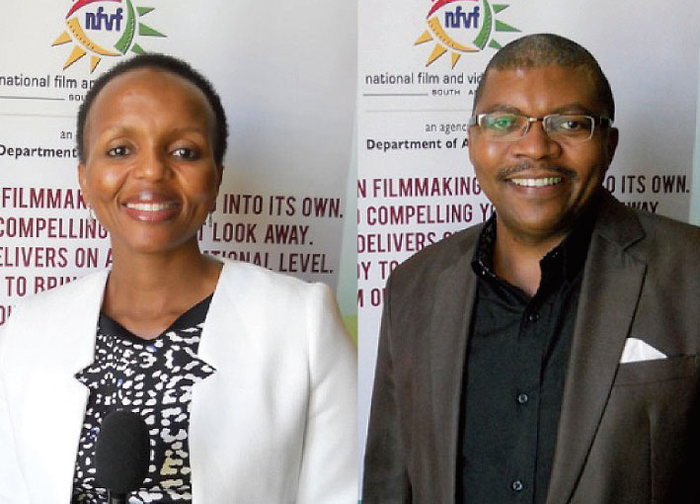
In light of these, the NFVF plans to “promote social cohesion and correct imbalances of the past,” says Zama Mkosi, CEO of the NFVF. Plans include audience development and a study to assess the economic impact of the film industry in South Africa.

Speaking at the NFVF head offices in Johannesburg, on 4 May 2016, Mkosi gave feedback on the funding approvals from the last year and shared the annual performance plan as had been presented to the portfolio committee in Parliament the week before. As of April 2016, the NFVF changed its funding cycle from a four-month to a three-month annual cycle.

“In this financial year the NFVF will fund the development and production of films of historical significance: two documentaries featuring the 40th anniversary of the Soweto Uprising. And two documentaries featuring the 60th anniversary of the women’s march to the Union Building in protest of the Pass Laws in 1956.” She said a call had been issued to fund these documentary films.

“To address the issue of transformation within the film sector the NFVF has reallocated its budget to ensure increased funding for emerging black filmmakers in partnership with the IDC,” says Mkosi. More resources will be directed towards new entrants into the industry. “This intervention is geared towards first time filmmakers to give them a calling card into the film industry,” she adds.

Mkosi explained that the NFVF will embark on a nationwide public screening campaign during the months of June (Youth month), August (Women’s month) and December.

In the last quarter, three production companies received funding for three years and during this financial year the NFVF will support four black-owned production companies over a three-year period as part of the Enterprise Development Programme. This programme saw the NFVF enabling the making of the hit films Ayanda, Happiness, Hard to Get and Mrs Right Guy.

The NFVF hopes that the film industry will move beyond project-to-project funding and position South Africa as the premier film producer of the continent. The foundation is pursuing new partnerships with BRICS countries and co-production opportunities to expand the industry.

“In the 2016/17 financial year, we will continue to play a leading role in the growth of our industry, addressing the needs of the stakeholders and broader film community. The NFVF has committed itself to enabling the industry, doing so through production and development, policy and research, funding and governance. We would like to assure the industry that we will continue to implement our strategic priorities with integrity, and are working towards improving the quality of life for ordinary South Africans,” says Mkosi.

She confirmed that the NFVF will continue its support of women and youth filmmakers, a project which, during the past two years, has seen the production of 20 films by young filmmakers and 20 films by female filmmakers. The NFVF has also concluded a deal with the SABC to screen these films during youth and women’s months.

Peter Kwele, head of marketing and communications at the NFVF, explained how their national internship programme worked and introduced 15 interns from the Johannesburg office. Partnering with the Department of Arts and Culture in regard to school programmes, the annual bursary exceeded 100 students and they have more than 80 interns nationally.

“The NFVF will continue its partnership with the MICT Seta,” he says. These interns have been placed at various broadcasters, film commissions and production houses across the country.

WGSA seeks out international flair for SA screenwriting

In 2015 the Writers’ Guild of South Africa (WGSA) declared it was the first and only guild in the world to send its delegation to an international film market. They went to Natpe, Miami in January 2015.

In June the WGSA took a delegation of writers to Natpe, Prague and Story Expo in Los Angeles in September. There were 110 speakers at Story Expo, including Linda Seger, John Vogler, Steve Kaplan and Peter Russell.

Returning from Story Expo delegates were asked to pick the top ten speakers they would like to be brought to SA. From those 10, they voted for the ideal one. Peter Russell was that person. He presented a workshop on the Secret Patterns of Writing for Different Genres in May 2016. A topic that was most relevant to the members of the WGSA.

Delegates from the WGSA will be attending the London Screenwriters Festival in September 2016 and the WGSA intends to follow the same process to choose its 2017 speaker.

Russell spoke to a full house in Johannesburg, Cape Town and Durban, where he engaged with the audience on what they would most like to learn from him, Hollywood’s story doctor who has read more than 7 000 screenplays. Sharing his secrets and tips he emphasised that Africa is hot around the world, and: “When you get real you get interesting.”

Before the talk the WGSA handed out certificates for its skills laboratory. Initiated with the Soweto Workshop where 20 graduates had completed phases one and two and were now attending Russell’s workshop. These 20 attendees were given their completion certificates.

The WGSA designed its skills lab in 2011 and ran a pilot in Johannesburg that year without any funding. “It was a great success, however, we found that most of the writers who actually needed to attend, could not afford it, so we needed funding,” says Thea Aboud from the WGSA. Since then the WGSA has been trying to raise funding for this project, and in 2016 the Gauteng Film Commission was the first to fund its skills lab. “We do hope that other organisations in the film industry will follow suit,” adds Aboud.

The Skills Laboratory has three phases:

  1. Phase one is an intensive workshop for beginner writers, who cannot afford to enrol at a formal film school or are not yet ready to be accepted by certain programmes. Writers can work on scripts in peer groups or one-on-one with a story editor. Scripts can be read out loud as a live pitch to producers.
  2. Phase two focuses on skills enhancement for the professional writer and industry professionals. It offers courses ranging from script evaluation to introducing writers to fresh opportunities within new media, from writing blogs to the creation of online stories and games and courses, with international trainers and experts.
  3. Phase three introduces the WGSA’s Short Film Course. This course will include participants in the greater Gauteng area and will be conducted in each of the five Gauteng regions.

“If we can secure funding this will be a new group to the ones certified for completing phase one and two,” says Aboud. The WGSA is currently looking for funding for this phase.

SABC becoming 90 per cent local

The decision to introduce a 90 per cent local content quota at the South African Broadcasting Corporation (SABC) is here to stay, and to be rolled out across all its broadcasting platforms. In the beginning of May, the SABC’s 18 radio stations began implementing a 90 per cent quotient in their respective music programming. Has this local quota thrown light on a number of grey areas in the industry?

This was a welcome decision, increasing regulations on radio for public broadcasting from 40 per cent and commercial broadcasting from 25 per cent. Arts and culture minister, Nathi Mthethwa expressed his support of the increase, “Local content develops, protects and promotes our national identity, culture and character. Local content broadcasting is an important element in the economy, as it determines market share. The more local content is used by broadcasters and other users the more the owners of the content receive financial benefit.”

The SABC stated that as a public service broadcaster it has a mandate to reflect the country’s heritage and culture to the South African public. Another key mandate for the broadcaster is to ensure that it develops and nurtures South African talent, through the broadcasting of local content. “The SABC took this conscious decision to raise local music content up to 90 per cent of its airplay, as the public service broadcaster believes it has a responsibility to contribute to South Africans who take pride in their music and stories,” says SABC spokesperson Kaizer Kganyago. “The corporation is not apologetic about this stance, as for many years artists in these respective industries have complained about being marginalised,” he adds.

Kganyago says that the SABC has not faced any challenges in implementing this decision and that they had received positive responses from government, music and television industry stakeholders and the public at large around the decision. “We are further encouraged by the positive response from some of our investors,” he confirms.

The SABC agreed that through focussing 90 per cent of airwaves on local music content, artists in both television and radio would reap the benefits of royalties more than ever before. “The SABC takes the restoration of human dignity very seriously as it is one of the organisation’s core values and we believe that this move will contribute to achieving that,” said Kganyago. “This decision will also assist in the creation of job opportunities.”

At the end of May SABC COO Hlaudi Motsoeneng, addressing content producers at the corporation’s offices in Johannesburg, confirmed that its 90 per cent local content quota will be adopted by the broadcaster’s TV channels.

As of July 2016 there will be an increase in local content offering on television aiming at 90 per cent. Motsoeneng said that the broadcaster’s commercial television channel, SABC3, would have an 80 per cent local content policy and other channels would increase to 90 per cent. Previous local content on SABC1 was at 75 per cent, SABC2 was at 65 per cent and SABC3 at 40 per cent. Motsoeneng did not state how this increase would happen. “We have given instructions, the how is not my business. From 1 July we should see a different SABC. I think it’s achievable, we are going to get rid of content that is no longer working for SABC,” he adds.

At the announcement Motsoeneng spoke of plans to revamp its television channels and to source more local content. He says, “This is the opportunity for South Africans. If we don’t have good quality content and good music, this is the time for people to grab this opportunity to produce that quality that we’re talking about.”

The SABC awarded more than 60 content producers and new talent contracts. The new talent is expected to produce content for the corporations’ television channels. Motsoeneng says this move will help empower young people and create jobs.

The SABC says it has put aside R600 million to boost its 90 per cent quota increase. This figure is based on the public broadcaster’s decision to go into business with local producers and celebrities including Khanyi Mbau, Somizi Mhlongo, and Arthur Mafokate, to assist in the success of this local content rise. A large part of this plan hinges on entertainment personalities. The SABC has vowed to continue to unleash new talent and broadcast more local content.

Motsoeneng adds that this local content facelift further ensures that billions of Rands won’t escape the country. “I can tell you, the bulk of money goes outside instead of staying here and we have created that opportunity within the SABC.”

As for its announcement of new language based channels, the SABC will launch Nguni, Afrikaans, English and Sesotho channels when DTT is launched. The SABC is planning on bringing in over 32 producers and 27 up-and-coming producers who will be the force behind the revamp.

Motsoeneng reaffirms: “You need to give us quality content, you need to give us the content that will be able to attract the audience and if you don’t attract the audience there is no reason why the SABC will keep such content in our platform.” He adds that it is also important for Venda and other language soapies to be created.

The SABC does include Africa in its local content. “As South Africans we cannot isolate ourselves from our fellow African countries. Many of our artists have collaborations with other African artists and for us that is local,” confirms Kganyago.

So, from now onwards, the SABC is nearly 90 per cent local. This could mean positive growth for the industry, an opportunity for digital platforms to increase traffic, and an opportunity to creatively promote international acts performing in SA.

Will it, however, see SABC viewership increase or decline as viewers switch to other channels that are focussed on giving viewers what they want, irrespective of who produces it? Only time will tell as we see how the SABC implements this increase.

- Advertisement -
- Advertisement -
- Advertisement -

Pin It on Pinterest