


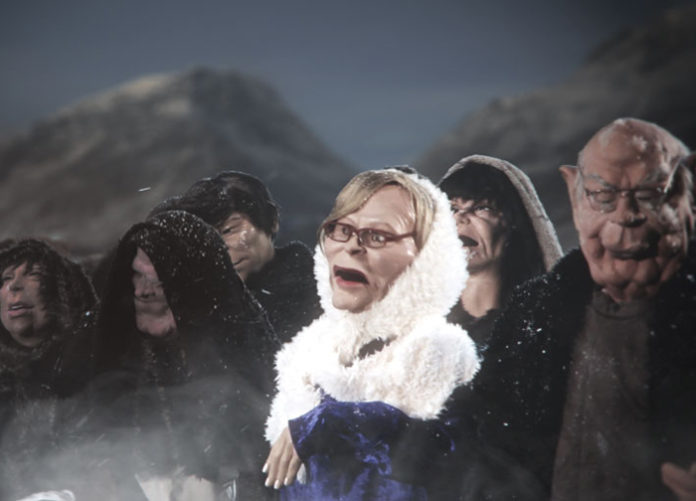
Puppet Nation ZA is an Emmy-nominated South African satirical puppet show produced by Both Worlds. The show requires a hard working crew which works at lightning speed to produce well-researched, believable, side-splitting characters. The team discusses the work involved in making this skit ‘Game of Cronies’ – a spoof of the popular TV series Game of Thrones – come alive.
Karen Jeynes on writing:
I think Puppet Nation resonates so well with audiences because it allows us to laugh at things that might otherwise seem taboo, or make us angry or sad. By satirising politicians, we give people a way to laugh at them – but also to imagine that things could be different. The fact that our characters are puppets allows for an extra layer of safety – you’re not really laughing at the president himself – or Vladimir Putin – you’re laughing at a representation of them.
Each puppet is unique; some talk slower so their dialogue needs to be shorter or punchier. Our voice artists are remarkably talented, and you learn which actors will relish in a certain kind of dialogue, and which characters are better singers or better at delivering one liners – it’s a wonderful challenge.
Alex Fynn on directing:
In our latex world, created in our tiny studio with our small crew, attention to detail in all departments is key to allow for complete suspension of disbelief. Timing in all aspects is vital. Between one and five puppeteers per character are needed for manipulation on set, depending on their size and the complexity of their performance. About 90 percent of what we do is on green screen, so I have to take into consideration how the choices I make will heavily affect the rest of my team while still ensuring the original intent of the satire comes through.
In this scene I focussed on ensuring that the correct, zombie-like performance was achieved with all characters in all of the plates so that they could be composited together to create the effect of hundreds of zombies walking in the snow. I referenced a shot from Game of Thrones which gave the team a good indication of what the final picture should look like.
San-Mari Calaca on wardrobe design:
With a show like this all clothes bought have to be tailored to fit the puppet’s body correctly and sometimes need to be made specifically. I always have to be aware of current trends, hairstyles and the personal style every character possesses. Politicians’ and celebrities’ styles change in real life all the time, so current references of all characters are very important to keep the show current.
For this scene I had to research the Game of Thrones wardrobe thoroughly to recreate the exact style needed. I then personalised Helen Zille so she is highlighted and still true to her blue DA colours.
Adriaan Hellenberg on sound design:
Keeping the sound design as realistic as possible is key to making the Puppet Nation world a believable one. Subtlety, detail and timing are important but because we are working with these amazing puppets, I can get cheeky and playful with the sound design at times. Sometimes when I’m working on a news interview scene I will spontaneously add small bursts of music for comedic effect, so in this regard the medium does allow me to be a bit more off the wall at times.
All the voice recordings are done in studio before going on set. Tassyn Munro directs the voice artists in studio and I chime in here and there. The only voice artist who does not come into studio is Ben Campbell who sends his clips via internet from America. Once I have all the voice clips, I compile the scenes together while following the script. Once checked and approved by Alex, the sound is played on a speaker on set and the crew shoot the scenes syncing mouth movements with the sound.
Tonga Isango on cinematography and lighting:
My aim is to keep evocative compositions while framing out the mechanical aspects of the show and guaranteeing a certain level of comfortable posture for the performers. To spare the puppeteers from physical strain I design the lighting and mark the blocking points with similar size ‘dummies’ prior to the shoot. While it is commonplace to use soft flattering light on human subjects I use relatively directional light to have the puppets’ features and texture ‘pop’ because a substantial part of the comedy lies there.
To convey its sombre tone and the overall low key lighting of this scene, I placed a full CTB and ND filter on a 1k Tungsten as low level cold key light and back light with a double CTB converted 1K Tungsten with no diffusion for shape defining, subject rimming light. I placed an additional 650W CTB converted tungsten 180 degrees left pointed at the foreground to backlight the Styrofoam snow. The same light was then bounced back at the subjects as a fill light.
I shot this scene with a Canon DSLR 5D MkIII coupled with assorted 24-105mm and 85mm 1.4 Zeiss lenses. Out of my gear options this kit allowed the right balance between maximum mobility (just a day to complete the entire sequence) and a slightly higher technical image quality.
Aurora Drummer on editing:
Due to the fast turnaround of Puppet Nation, all of our edits need to be locked down before they go to VFX for compositing. The majority of our footage is shot on green screen and so in a particularly complex skit like ‘Game of Cronies’, one needs to use a fair amount of imagination to determine the feasibility of a cut. One needs to imagine how a scene will look once it has been composited and had effects added, and pace the edit accordingly. One also needs to pay special attention to how believable the puppets are from certain angles, and cut the scenes to make the puppets seem realistic.
Occasionally puppeteers will be visible on screen or the puppets’ necks will pop out of their bodies, so we need to edit around this. Usually we shoot each scene with a multi-camera set-up and so this is usually possible. However, I usually discuss these mistakes with the director and the VFX artist to determine the best course of action.
Nikolai Groudev on VFX:
The biggest challenge in working on a show like this is speed – I have four days to complete a 25-minute show which is shot entirely on green screen. How much is practical and how much is fake depends from shot to shot. There have been some shots that are nearly all practical and shots that are entirely a puppet surrounded by green screen fakery. My goal in each shot is to blend them together in such a way that the viewer might suspect it’s a green screen but be unable to tell at what point the practical set ends and the CG set begins.
In this particular skit, making the shot come alive involves layering multiple plates of individual puppet performances shot on green screen in order to create the illusion of an endless horde. Adding elements like the snowflakes and subtle gusts of wind as well as depth of field, motion blur and chromatic aberration is what makes the shot look less clinical and fake as well as the addition of a slow camera move in post which also helps to add depth to the crowd as well as make it less obvious that they are standing in front of a static green screen.


