


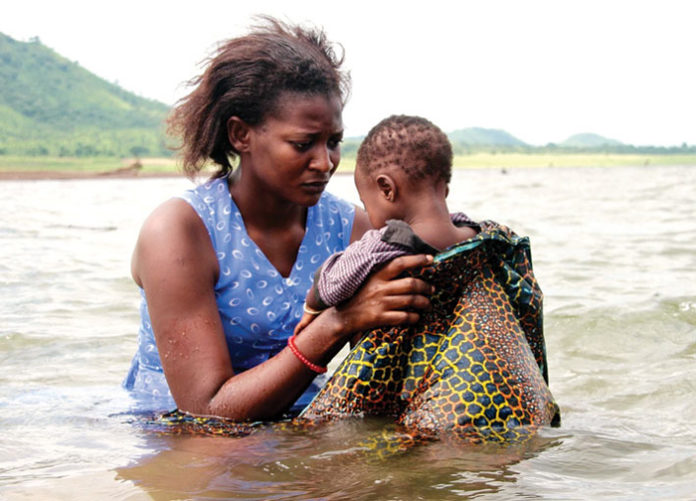
Premiered at the 2016 Tribeca Film Festival, Children of the Mountain is a poignant and visually transcendent debut feature by Ghanaian native Priscilla Anany.
Anany, who moved to the United States in 2003 and has lived there since, started out writing poems and short stories at a very early age. Inspired by Michael Jackson’s early music videos, Anany became eager to see her stories come to life on screen.
In Children of the Mountain, she has combined her love for filmmaking with her intrinsic interest in women’s issues and unique African stories. “My overall goal is to make films that portray people of African descent in a positive light, and to tell stories that explore the unique and undiscovered rich cultures of Africa and Africans,” says Anany.
Following an affair with her neighbour’s spouse, Essuman (Rukiyat Masud) falls pregnant and gives birth to baby Nuku (Jessica Dablo) who is born with a cleft lip, cerebral palsy, and Down syndrome. Essuman is led to believe that Nuku was born this way because she has a ‘dirty womb’ – as is widely believed in rural West Africa when one bears a child with such birth defects. Her future as a wife and mother unravels as her lover disowns her and Nuku, and the community, fashioned by old wives’ tales and superstition, turns its back on her.
This lead’s Essuman on a desperate search for a cure to her son’s illness, where she encounters futility at hospitals and is conned by religious leaders, shamans and medicine men. In these trying times, Essuman’s faith wavers at times causing her to shift between having the utmost dedication to her son and controversial attempts at self-preservation that involve getting rid of her child. Set against the breathtaking backdrop that is Ghana, Children of the Mountain is a story about a mother embracing her warrior spirit when faced with extreme adversity.
Anany says that she was inspired to make this film due to an aunt she had who died when she was very young. Her mother told her stories about how her grandparents struggled to find a cure for her young aunt, going from hospital to hospital, one medicine man to another, to pastors and shamans, and just about anybody who claimed they could cure her. “That was my first inspiration, to write a story about a mother who will do anything for her child’s health,” she comments.
Further inspired by a prose a friend of hers had written which expressed her rationale regarding why her daughter was born with Down syndrome – as she felt that it may have been her fault – Anany set about the making of Children of the Mountain in 2014.
“My goal is to let mothers all over the world know it isn’t their fault their babies are sometimes born with health issues or with deformities. There’s no such thing as a perfect child or human, all children are a great gift, and they should be loved and accepted no matter how they come,” Anany states.
“In many African cultures, women are often blamed for various things, some of which they have no control over. As a women’s empowerment advocate, I like to tell female stories that encourage, change and challenge cultural norms. I like stories that exonerate women from blame. Children of the Mountain is one such story.”
To establish the desired realism of the film, Anany wanted to cast a child with the real life conditions projected in the story to play the part of Nuku. “Besides, this was a low budget indie and I knew I wouldn’t be able to afford CGI,” she offers earnestly.
During the casting process, Anany and her team, made up of crew from her own Ghanaian and New York-based production company i60 Productions, visited a few hospitals in search of a fit for the character of Nuku, but faced some upheaval as the families of these children were uncomfortable with featuring them in a film. “Many were ashamed of the condition,” Anany explains.
That’s when she came into contact with the Graft Foundation, a Ghanaian-based and funded non-governmental, non-profit making organisation which seeks to help deformed children in Ghana and in neighboring West African countries by providing free reconstructive plastic surgery. “Once they read the script, they were willing to assist. They had a list of kids who were awaiting surgeries but then the next challenge was to find a family that would agree to have us work with their child…Fortunately, Jessica’s parents were willing to allow me to work with her.”
Made on location in Ghana, Children of the Mountain took just 19 days to shoot, but the development, funding and post-production took another two years. Filmed by cinematographer Eli Wallace Johansson using a RED Epic, in a style that distinctly emphasises the realism of the story and highlights the beauty of West Africa, Children of the Mountain is cinematically as emotive as its narrative.
Anany says that she chose to shoot on the RED Epic as she wanted to use a camera that could shoot beyond 4K. “Both for the quality and the ability to have more freedom in post-production should we need to make an adjustment to the images. The RED enabled us to shoot in 5K,” she explains.
A total of 101 minutes in length, Children of the Mountain, written, directed and produced by Anany, was funded in part by her company i60 Productions. That, combined with some money from her family and friends, and a grant from the Jerome Foundation as well as the Women in Film Finishing Fund, comprised the budget on which this ‘Afro-indie’ gem was made.
Children of the Mountain deals with questions of culture and tradition, stigma and superstitions, in a delicate and yet direct manner. Anany hopes that the film will not only be seen by audiences far and wide, but also used as an educational piece. “I’d like for them to know there’s hope and there’s help out there,” she says. “This message is extremely important in African countries where the stigma against such conditions is very high. I absolutely think the story will resonate with Africans and international audiences.”
