


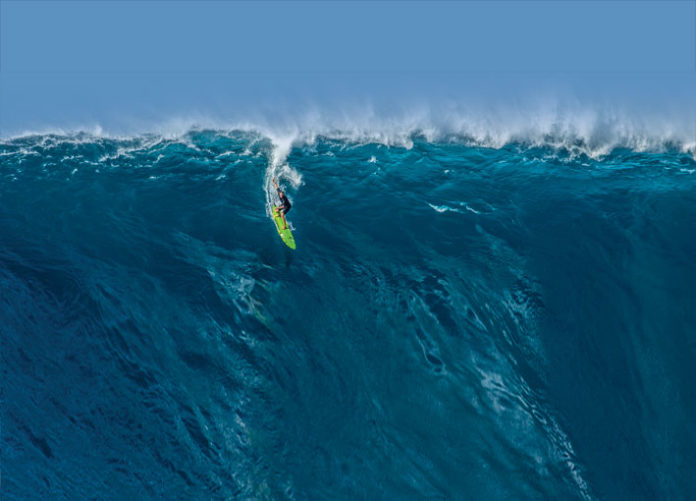
South Africa’s surf film festival, Wavescape, saw thousands attend free screenings on Durban’s Golden Mile. A full moon and engaging line-up concluded the June screenings. This epic festival has been touring the country since 2004, arising from a love of surfing and spreading through a love of sharing surf stories.
It was in 1998 when Steve Pike, known colloquially as Spike, started the website wavescape.co.za while travelling overseas. “It grew into a pre-Cambrian iteration of something resembling a website,” gibes Spike. “I used to send out a text-only HTML surf report via email, with whacky language and slang. It was the time of the prehistoric web.”
In 2003 Spike’s book Surfing in South Africa was published and while having coffee with his publisher, Ross Frylinck, he said: “We should start a surf film festival. It would be such a cool thing to do.” The pair researched it to discover that there were only two surf film festivals in the world, one in San Sebastian, Spain, and the other in Kona, Hawaii. They held Africa’s first festival in Cape Town in 2004. Frylinck quit his day job, by selling his publishing company and the Wavescape International Film Festival was born.
The first film festival included a surf board art exhibition and charity auction, and Spike says it was an immediate success. “Some big movies had come out in the early years, including Riding Giants, Dog Town, Z Boys and Step into Liquid.” The inaugural screening was outdoors at Clifton fourth beach, and more than a thousand people came to the first screening. “Because the website had a database, and people still used to read newspapers, we could get the word out easily,” says Spike.
In 2005 Peter Rorvik at the Durban International Film Festival (DIFF) contacted them to explore a collaboration since Durban was after all nicknamed Surf City, and they were keen to add a component to DIFF that tied the city to the ocean. “We have been coming to Durban every year since, and for the past 11 years, we get around 2000 or so folks who come out for the Bay of Plenty open air screening as well as another 1000 or so who come to five nights of indoor screenings.”
Wavescape has steadily grown into an institution, according to Spike, with the help of partners such as the Save Our Seas Foundation and Pick ‘n Pay. “Cape Town comprises several events, including a beach screening, indoor screenings, the art board exhibition and auction, a Slide Night comprising top ocean speakers in a format that’s like a cross between Tedex and PechaKucha, and a Fish Fry, comprising sustainable fish braais and a cultural exchange among the surf craft community,” explains Spike.
Wavescape’s intention has been to foster the development of adventure film making in South Africa, and they are working with Wesgro in Cape Town and Red Bull South Africa to attract entries to their Shortcuts Film Competition as well as workshops where the best extreme sports filmmakers impart their wisdom. “As surfers who have seen first-hand the threats to our oceans, we have slowly evolved into a deep awareness of issues around sustainability and conservation, and are keen to explore projects that have a real impact on saving our oceans,” says Spike. “Surfers are at the coalface of these issues. As custodians of the oceans, in a sense, we could have a powerful role in educating the world about the shocking statistics around plastic pollution and ocean acidification,” he adds.
For 11 years Durban has made Wavescape proud by presenting its famous warm winters. Gear there is supplied by Black Coffee. “We have a potent projector and a scaffolded screen, with fibre cables running the video from the van,” explains Spike. “Because the weather is so mild, it is generally not necessary to take lots of precautions for keeping the electronics dry and the screen free from wind.” This is not the case in Cape Town, they have come a long way since their beginning. “In the early days of our Cape Town festival, we had this inflatable screen that needed a constant stream of air via an electric pump on the side. My partner Ross and I often reminisce about the good-ol’ bad days when we would stand on each side of the screen, watching a gust of wind catch the screen, causing it to bulge horrendously and threaten to split it from end to end, or worse, to snap the nylon straps anchoring it into the sand and send a stainless ratchet into the audience. It was like playing chicken, to see who would last the longest before we abort the show by pulling two giant zips on each side that would instantly collapse the screen. A couple of times, we tried to continue, but had to call it off,” explains Spike.
DIFF has never posed such problems and their current screen is a lot sturdier. Spike says DIFF 2016 was the best evening yet for their first screening, with a perfect balmy night, cranking surf along the piers nearby and not a breath of wind. “We had sell-out shows and busy screenings,” says Spike of the indoor screenings at Rivertown Beerhall. “Durban is an awesome city, and we’re so proud to come up from Cape Town and be part of the vibrant growth of a truly African city. If we can help in even a small way to build Durban into a tourism and cultural destination, then we feel we have fulfilled our role at DIFF.”
Wavescape does screenings in Cape Town, at the Labia in town, and on Clifton fourth beach, and have previously done tours of the Garden Route, as well as shows in Jeffreys Bay, and in Reunion. Filmmakers can submit their films for consideration via the website www.wavescapefestival.com and they keep an eye out for new projects that are in the mix around the world.
“We have good relationships with many of the top surf filmmakers, and of course with the rise of social media and the ubiquitous YouTube, it’s hard to miss most of the films. However, we’re always looking for edgy narratives that fly in the face of the ‘surf porn’ convention, and sometimes those films take a little bit of digging to find,” adds Spike.
