


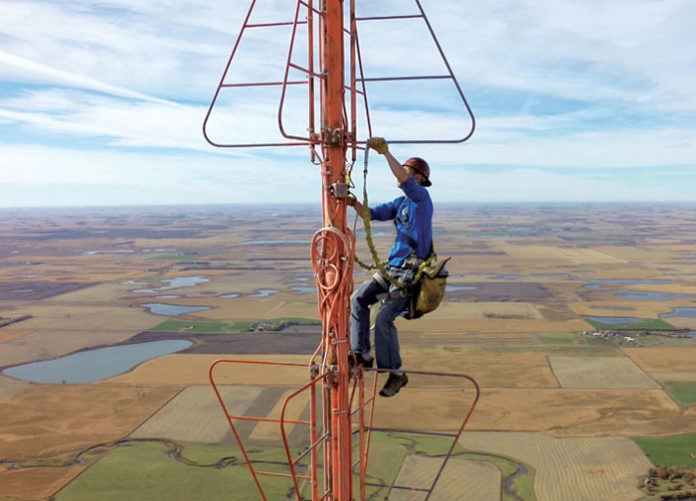
If you are up to watching something really different, do yourself a favour and get onto YouTube and check out 1500 Feet TV Tower. It’s a short two-minute viral piece showing an engineer changing a light bulb at the top of an immensely tall steel structure in the prairies of the USA – subject matter that most might think is incredibly boring but visually this is stunning and beautifully executed.
The film is a classic illustration of how the field of aerial videography has changed dramatically over the past few years, encompassing three main points I see as major factors affecting the industry today: Increased safety, significantly reduced costs, and the scope for innovation… all thanks to the drone.
The film industry is undoubtedly the best place to nurture innovation in new technology, it combines two opposite elements: the technical sector and a community of creatives. Drones are the latest proof of the fast-moving and ever-evolving industry as production companies begin to recognise the vast creative opportunities presented by pilotless aerial cameras. Traditionally, helicopters have been used for wide landscape and pretty aerial shots. However, they have always had high risks in terms of safety. In the US market it is estimated that up to 40 people are killed or seriously injured every year during film productions – most of which are attributed to aerial accidents involving helicopters. A helicopter has a typically limited – expensive – flight time, whereas a tag-team of a couple of drones will enable shorter between-shot delays and no hideous fuel costs. The same shot can be taken over and over again without additional air clearance, saving time and money. Drones are also particularly handy for their size: a helicopter can’t drop into canyons for that adrenaline-boosting sweeping shot. The shadow footprint of a drone is of course also far smaller, so there’s less need for crafty shots or post-production edits to remove a helicopter shadow in the background.
You can’t fit a helicopter indoors. Drones are flexible, can fly high or low, and all the levels in-between. Being able to operate indoors and outdoors means it’s completely possible for complex indoor/outdoor shots to be executed – ideas which until recently haven’t been feasible for any production company no matter their budget. And of course, let’s not forget the environment, the drone is much friendlier to mother Earth. Using fast-charge batteries, there is no burning of fossil fuels in the flight process, making the carbon footprint tiny in comparison.
The growing use of drones is changing the way that movies and TV shows are made, giving consumers a new perspective on the action. Film industry experts say they will open up new possibilities of filmmaking in much the same way that lightweight cameras did in the 1960s and the Steadicam did in the 1970s. In February this year BBC announced that Sir David Attenborough would host the upcoming new factual natural history blue chip production of Planet Earth II. It’s being shot in UHD and the epic scale of this series is said to be second to none and the BBC production team report that this is going to be a visual treat of note thanks to the latest camera stabilisation, remote recording and aerial drone technology that has transformed the way that they do their filming.
Until recently in the US, the Federal Aviation Administration (FAA) allowed only public agencies such as fire departments to use drones for such things as tracking wildfires. The agency effectively banned their use for commercial purposes because they were viewed as potential aviation safety hazards and threats to national security. Prodded by the Motion Picture Association of America, the FAA took the first step toward allowing Hollywood to use drones when it granted a waiver requested last year by seven aerial photography companies. Drone proponents hailed the decision, saying it would put the U.S. on a more even footing with other countries where they are legal and used on films such as the James Bond movie Skyfall and Transformers: Age of Extinction. Filmmakers contend that drones create more distinctive shots because they can go where manned aircraft can’t – dropping down into narrow spaces such as alleyways and even flying through windows. Under the new FAA rules, drones can be used only on sets that are closed to the public and cannot be operated at night, unlike in South Africa, where Drone Crew have approval for such film operations.
Operators in SA must hold a Remote Pilots Licence, Air Services Licence and a Remote Operator Certificate; keep the drones within an unobstructed line of sight and below an altitude of 400 feet. At least two people are required to operate the drones: one to pilot the craft with a controller and a second who operates the camera and acts as spotter to watch the drone in flight.
Out of interest, the vertigo inducing footage, mentioned earlier, of the engineer changing the light bulb, was filmed by Prairie Aerial videography, using a DJI Phantom 2 modified for higher performance with Antigravity motors and balanced carbon-fibre props. The camera was a GoPro 3+Black also modified with a 5.4mm rectilinear flat lens with IR filter. The gimbal was a Zenmuse H3-3D and piloted by Joseph and Todd Thorin. I asked Todd how he got away with the FAA 400 feet altitude rule with this project: “Yes, at the time there was an altitude limit, although I was not fully aware of it. I work as a safety officer for a tower construction and maintenance company and we were actually testing the possibility of using drones for tower safety and inspection,” said Thorin. “I consulted with a licensed fixed wing pilot to see what his no-fly zone around a tower is and then I claimed that space for my drone flight. As the video gained views I was contacted by the FAA and instructed that this was not allowed. With the new FAA Drone regulations taking effect from 1 September here in the US it will now be allowable for a commercial drone to fly to any altitude if within 500’ of a structure” Thorin concluded, “I’m a bit of a rebel. I say, if the regulations are ambiguous or there is a common sense avenue to operate on the frontier go for it and see what happens. I was not too far off on this one because the new regulations now allow what I did. Somebody has to break the trail. I am now a member of a very small group of citizens who has actually received written notice from the FAA to cease commercial operations. They did admit that the video was really cool though!”
At the time of writing the film had racked up 6 952 606 views on YouTube and was a finalist in the inaugural Drone Up International Film Festival in Plovdiv, Bulgaria held in late August 2016.


