


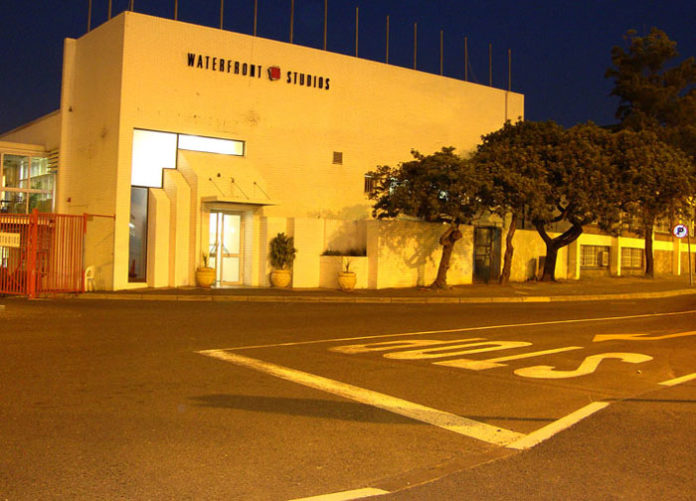
With the recent announcement by Silverline 360 that they have purchased Waterfront Film Studios at the V and A Waterfront in Cape Town, a look back at the history of this studio complex which has changed hands several times may well be of interest as it tells a rather fascinating tale…
Now a studio landmark at the V and A the complex was not always so and in fact started life as a bus depot serving the Cape Town area. The transformation into what it is now shows a somewhat beleaguered and sometimes very profitable history. It started as far back as 1997.
Well known facilities company The Video Lab – based in Blairgowrie, Randburg – decided on an expansion strategy and set up a small facility in Gardens, Cape Town. Having outgrown these premises and seeing growth potential the decision was made to move to new premises at the V and A Waterfront directly next to the historic Time Bell Tower, built in 1894, and just off Portswood Road. Initially the facility consisted of a Radio Studio, but expanded into a Betacam editing facility with a Rank Cintel Telecine and a Quantel – state of the art for the time!
It was the only major post production company in Cape Town and garnered much business including the increasing number of overseas filmmakers. “We had been in this locale for about two years,” recounts Mike Smit, MD of Video Lab at the time, “when it became apparent that we needed more space and since there was now a demand to provide studios as well as post-production.
“During a drive around I noticed a large building at the entrance to the Waterfront with a ‘To Let’ sign outside. The building had been used by KIC, who manufactured washing machines there. I phoned the letting agent and started negotiations”.
The building itself had originally been used by a bus company and all the floors were sloping in order to facilitate drainage after washing. The interior dimensions were however ideal for studios. In order to secure a lease a presentation had to be made to the Waterfront Company and there were other contenders…
“During a visit to look at studios in Australia I met a studio expert named Veronica Sive,” says Smit. “I brought her out to South Africa and together we prepared a pitch which was accepted and we secured a long term lease.
“The building was very derelict and had not been occupied for many years. There was also a homeless community living in the locale under the highway and part of the lease agreement was that we would re-house them – which was done.
“We renovated the entire structure of some 9000 square metres” says Smith “We installed a double roof, air conditioning and leveled the floor. We created three studios – two to very high specifications – and one a shooting stage. We also built very comprehensive post production suites capable of handling anything, even that which the overseas market could throw at us. We had a front end film laboratory and we opened our doors as Sasani Studios.”
As time progressed, and through several mergers and acquisitions (including the establishment of Condor Cape in 2003) the facility was re-branded as Waterfront Studios. At this time, the facility still benefitted from a booming industry.
In 2010 one of the major Waterfront shareholders, MFP, went bust and although there were several options on the table, in 2011 Waterfront Film Studios (WFS) as it was then known went into liquidation.
The good news for 2012 was that a purchasing entity came to the table. As of January 2012, Autumn Star Trading 905 (Pty) Ltd trading as Collective Dream purchased the assets of WFS and continued trading much as before. Collective Dream was part of a large family business comprising a group of some 24 companies headed by Sean Else, managing director of Creative Dream.
At the time, Else commented: “In our view the traditional post-production facility business model is becoming outdated and unlikely to succeed in the longer term. Our goal is to become a one-stop shop, taking the journey with our clients from conceptualisation, through pre-production, production, post-production, broadcast and distribution.
“The conflict between the previous shareholders of WFS really distracted focus from the core business. The sound stages, studios and facilities were a mess. We immediately started a major clean-up and upgrade of all facilities.”
Sadly the dream was not to last. In late 2013 a new joint venture partnership between The BladeWorks, LaserNet, Hilton Treves and Alun Richards acquired the assets of Collective Dream Studios and the partnerships began the process of putting together a specialist services company which would not follow the traditional facilities model.
“The reality” says Steve Harris of BladeWorks, “is that when involved in the studio-only business, one becomes entirely dependent upon income from a single source. While my experience with some of the service companies like Film Afrika and Out of Africa was great, my experience of the international companies using their services was not great at all.
“The result of contracts being terminated at the last possible moment, or even worse a major international company not arriving at all for a long term contract, was to clarify our view of cash input versus cash output. Each of the partners involved in Waterfront Film Studios have established core businesses that are owned-operated – none of the partners were prepared to invest further time or money into a business that is dependent upon most of its income being derived from a single source, ie. studio revenues.
“I must say that we were blessed in the sense that we became involved in a number of local film and television productions. That aspect of the business was very exciting for me. I can only thank all the local production companies that entrusted us to provide post-production services. Other wonderful experiences included working on international television series like Wallander and Tutankhamun.”
Late last year discussions commenced regarding a joint venture in the VFX business with Silverline. Whilst this side of the initial discussions came to nought, it became apparent that Waterfront Film Studios would be an ideal addition to the Silverline stable, mostly because of the extent of the services that Silverline could offer to support and grow the studio revenues
On 1 July 2016, Silverline 360 advised that they had purchased Waterfront Film Studios and thereby added it to the existing stable of companies that include Media Film Service, Searle St Post and Refinery amongst others.
“This is the first step in consolidating all the Silverline 360 Cape Town operations to the new premises, including Media Film Service, Searle Street and Movie Mart. Media Film Service is predicted to take occupation of the old Arena building mid-next year,” advises a Silverline 360 spokesman.
“Personally” adds Harris, “I will focus mostly on The BladeWorks in Johannesburg. The BladeWorks specialises in post-production of television commercials; under the guidance of Warren Bleksley.”
So – another spoke in the wheel of the somewhat chequered history of Waterfront Film Studios. Whilst the acquisition by Silverline 360 is seen as a good thing in the industry – one wonders – what next?
