


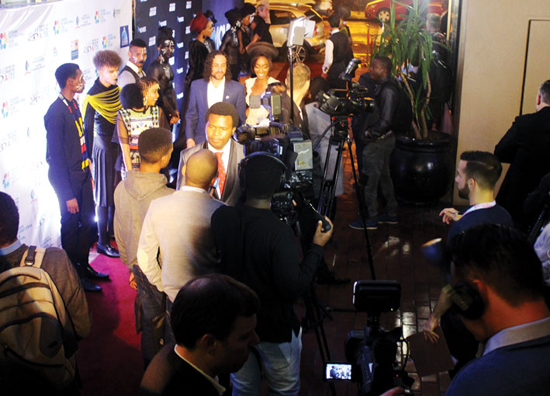
Having successfully launched at an exclusive A-list event in partnership with the IDC in Johannesburg, the 38th annual Durban International Film Festival (DIFF) not only assured to sizzle but delivered on this promise. The aptly themed Film Meets Fashion red carpet Opening Night event, hosted by M-Net, saw celebrities and industry practitioners don their tuxedos and ball gowns to party the night away. The opening film Serpent, by female director Amanda Evans, was well received and went on to win the African Film Critic Award at the festival.
This year, the festival’s social events calendar was packed, and accredited guests had a range of events to choose from. Opening and Awards events were over-subscribed, a testament to the accomplishment of the edition. The festival closing was held at Gateway Theatre of Shopping and the closing night film – Dr Mbongeni Ngema’s Asinamali – had audiences thoroughly engaged. The film makes its commercial South African run this September.
The German focus had a gala screening for the film Goodbye Berlin by Fatih Akin. The young leads, Tristan Gobel and Anand Batbileg attended the festival from Germany and said that they enjoyed their South African experience, which included a trip to Max’s Lifestyle in Umlazi to watch the critically acclaimed film Vaya.
Canada was celebrating 150 years of independence and 20 years of co-production with South Africa. To aptly celebrate this, the Canadian delegation at the festival held a big party as well as screenings of selected films spread across five days.
Potato Patahto, by Shirley Frimpong-Manso, a Ghanaian film selected as part of the Women-led Film focus was a big hit, attracting a full house to its screenings. The award-winning documentary Liyana by Amanda and Aaron Kopp, featuring Gcina Mhlope and produced by Thandi Newton, was also a major success with jurors and audiences alike.
The 2017 outreach programme was by far the biggest yet in the history of the festival. Highlights include several firsts for DIFF, like the popular screenings at Max’s Lifestyle in Umlazi where audiences could chill, enjoy the shisanyama and watch good films. Akin Omotoso’s award-winning Vaya opened the screenings at this venue and was a firm crowd favourite. Another first saw a screening of short packages at the Westville Prison.
Wavescapes, for the surf lover’s, was moved to Ushaka Marine World – a free outdoor venue next to the ocean – and it was an instant hit with audiences, who, despite the sometimes chilly and slightly wet weather made their way to the big screen every evening.
Some new additions, that will be permanent features in future editions, included the Women-led Film focus which saw the launch of SWIFT at the Durban FilmMart (DFM), and the micro-budget film programme, which seeks to redress the past inequalities. The objective of the latter is to expose micro-budget filmmakers to the broader platform that was previously inaccessible to them. The day-to-day screenings of micro-budget films attracted large audiences which left the filmmakers excited about the road ahead for them and their projects. Six of the chosen films, including student films, were exhibited over a period of six long days at the Old Court Museum. Micro-budget filmmakers had an opportunity to interact with the experts within the film schools programme. The idea of an enabling environment to allow dialogue between industry practitioners and aspirant filmmakers was alive and realised.
Talents Durban celebrated ten years of existence and as part of the anniversary festivities, alumni sent through projects for a Talents Durban Alumni screening opportunity which took place on the Opening Night of the programme. After sifting through more than 30 submissions, the panel selected Sink by 2011 alumni, Anel Alexander. Sink has since been awarded the Golden Horn Award for Best Feature Film at the 2017 South African Film and Television Awards. 2011 alumni Tiny Mungwe’s project, Womxn: Working was selected as one of this year’s DFM projects. The Hangman, which won the Best South African Short award at this year’s DIFF is a Talents Durban alumni project directed by Zwelethu Radebe (2013 alumni). Skulls Of My People, co- produced by Lodi Matsetela (2009 alumni), was one of the documentary films in competition at DIFF this year. Cut Loose, part of the short film package, is directed and written by Shanelle Jewnarain (2012 alumni). The success of Talents Durban alumni speaks to the relevance of the programme in the industry and we look forward to its continued growth.
Festival manager Chipo Zhou had this to say about her first DIFF: “To come in with three months left to the festival meant a lot of sleepless nights and they paid off. I’m quite happy with the edition but looking forward to a calmer 2018. The Centre for Creative Arts (CCA) team worked tirelessly, each and every one of them was amazing and the festival could not have taken place without their efforts. Our funders and stakeholders were very involved in the planning of the festival as well as its implementation on the ground, showing how invested they are in the industry and its growth. This also took quite a load off the team and we are very grateful. We had a few controversial films, some of which won awards, which was great. I love that audiences were engaged and interrogated the narratives, it showed that the stories struck a chord emotionally, which in my opinion are the markings of distinguished artists.”
DIFF award winners 2017
Best Feature Film
A Father’s Will
Directed by Bakyt Mukul & Dastan Zhapar uulu
Best South African Feature Film
Vaya
Directed by Akin Omotoso
Best Director for a South African Film
Inxeba (The Wound)
Directed by John Trengrove
Best South African Documentary
Strike a Rock
Directed by Aliki Saragas
Best International Documentary
Dusk Chorus
Directed by Nika Šaravanja & Alessandro D’Emilia.
Best Actor
Inxeba (The Wound)
Nakhane Touré
Best actress
Beauty and the Dogs
Mariam Al Ferjani
Best Screenplay
La Soledad
Directed by Jorge Thielen Armand.
Best Editing
La Soledad
by Jorge Thielen Armand
Best International Short
Witnesses
Directed by David Koch.
Best African Short
All of Us
Directed by Tobias Rosen.
Best South African Short.
The Hangman
Directed by Zwelethu Radebe
Best Direction (in the international competition)
A Father’s Will
Directed by Bakyt Mukul & Dastan Zhapar Uulu
Best Cinematography
A Father’s Will
Akjol Bekbolotov
Artistic Bravery
Liyana
Amanda Kopp and Aaron Kopp.
The Amnesty International Durban Human Rights Award
Strike a Rock and Mama Colonel.
The African Critic Award
Serpent
Directed by Amanda Evans
DIFF 2018 will run from 19 to 29 July next year and online submissions for the 39th edition will open on 2 October 2017.
The Centre for Creative Arts (CCA) within the College Of Humanities of the University of KwaZulu-Natal, together with the eThekwini Municipality, the KwaZulu-Natal Film Commission, the National Film and Video Foundation, the German Embassy and the Goethe Institute among others, made the 38th Durban International Film Festival possible.
The festival is the longest running of its kind in Africa, bringing together filmmakers and industry experts from around the world and providing opportunities for emerging talent to join the mainstream media through the Durban FilmMart and Durban Talent Campus.
