


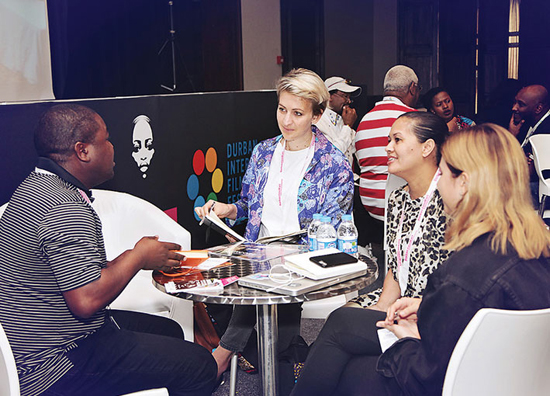
The Durban FilmMart (DFM) is one of the most important film finance platforms and industry events on the African continent, and this year’s eighth edition was certainly the biggest since it began eight years ago in the coastal city of Durban, South Africa.
“It was a very busy few days at this year’s Durban FilmMart with an estimated 900 meetings taking place between projects and potential investors, and the results have been very positive,” enthuses Toni Monty, head of the Durban Film Office, the eThekwini Municipality’s film industry unit that partners with the Durban International Film Festival to present the DFM which took place from 14 to 17 July this year.
“Our eighth edition was amazing and we are very pleased with how the market has grown from strength to strength in fulfilling its vision to develop African content and network African filmmakers. We had over 600 delegates from over 30 countries participating, including 17 African countries, and we have received very positive feedback from them about how our pan-African profile has grown.”
Central to the Durban FilmMart were the networking sessions and meetings held over four days between delegates comprising filmmakers, producers, distributors, agents, broadcasters, film funders and government agencies.
The DFM, hosted a co-production finance forum with ten documentaries and 12 fiction feature films being pitched by producers and directors to broadcasters, financiers, investors, distributors and sales agents.
“We received really wonderful feedback about the projects that were pitched during these co-production sessions,” says Monty. “What is really exciting is that African filmmakers attending the market are presenting at a much higher level in comparison to when Durban FilmMart first opened its doors eight years ago – and the competition is tough. We had 22 official DFM projects in the forum supported by Cinemart, Rotterdam, and IDFA, Netherlands, as well as an additional 20 projects associated with partner programmes Hotdocs, Realness, Berlin Talents programme, Caribbean Tales and Produire au Sud, plus others with a record number of 70 projects presenting at this year’s finance forum.”
Another welcome addition, was the support from the Industrial Development Corporation for an insightful ‘Film Finance: State of the Industry’ session – a useful session to help filmmakers understand the business of film.
“Of particular interest from this year’s DFM was the introduction of CineFAM-Africa Incubator Accelerator Programme – in which six serialised television projects by women of colour were rigorously mentored by Nicole Brookes and Lisa Wickam of Caribbean Tales, Canada,” says Monty. “We have received the most astonishing feedback from these participants, who found the tough process a springboard to launch their projects into the pitching process.”
Participant Mary-Ann Mandishona from Zimbabwe received an invitation to participate in the CineFam Caribbean Tales Incubator Programme with her project Mamba Kazi – African Warrior Queens, specifically for ‘marginalised’ women of colour which is held during the Toronto International Film Festival (TIFF).
“I thought the programme was educational, challenging, entertaining and inspiring,” says Mandishona. “I learnt how to concisely communicate my pitch with confidence and I gained much insight from my fellow participants of remarkable, talented women.”
“Nicole was brilliant and forceful and pushed us to represent our ‘truth’ as Africans or ‘women of colour’ within the story spectrum ‘unapologetically.’ Lisa provided us with an advantageous balance, by providing insightful business-oriented aspects of the film industry. This ‘tug of war’ that happens in our creative minds is always tricky to navigate, so the ‘yin-yang balance’ of the mentors was helpful. Both nurtured and listened to each CineFam participant with genuine interest and passion. For me personally this has been the most soul-rejuvenating ‘film’ workshop I’ve participated in to date. There was such a positive energy of creative excellence being shared amongst us, our diverse group of super talented ‘women of colour’ shall be forever connected. Nicole stimulated that creative energy with her enthusiastic approach to teaching and sharing.”
“I feel renewed and empowered to continue the hard work ahead with ‘clenched teeth determination’ and look forward to pitching at the TIFF,” she says.
“With this kind of feedback from all the participants, we hope to continue developing the relationship with Caribbean Tales, in a concerted effort to grow this forum for the DFM,” affirms Monty.
This year a Women-led Film Focus together with the DIFF, was enabled through the support of main sponsor M-Net and the National Film and Video Foundation (NFVF), and many workshops, seminars and discussion focused on industry transformation.
Feeding into this narrative, a new edition to the DFM was the presence of Tilane Jones, executive director of ARRAY, the film distribution collaborative founded by Oscar-winner Ava DuVernay which is focused on women filmmakers and filmmakers of colour. Jones presented a session entitled Women-led Film, which was also the thematic approach to this year’s DIFF and DFM. She was also able to take numerous meetings at the DFM, and was very encouraged to see the level of passion and interest there is in Africa to drive women into significant positions within the industry.
Alongside the Women-led Film theme, SWIFT (Sisters Working in Film and Television) held a hard-hitting workshop around the role of women in the film industry, looking at practical and tangible ways in which the industry could be transformed into a more inclusive one for women.
“The industry lounge was also abuzz with formal and informal meetings, and we were pleased to have VR technology showcased there by Ingrid Kopp’s Electric South, together with the Goethe-Institut screening four VR shorts from Africa.”
“On a country-to-country engagement level, together with partner, NFVF, KZN Film Commission, and he Department of Trade and Industry, we hosted three co-production delegations from Canada, Germany and Kenya, and we extend grateful thanks to the Canadian High Commission, the German Embassy and Kenya Film Commission for supporting these programmes with vision and enthusiasm.”
“The journey of growing the Durban FilmMart over the past eight years has been remarkable. What started as an idea to create a business networking hub for African filmmakers all those years ago, has grown into a well-established platform for African projects in development, and the progress is palpable. Through Durban FilmMart we have seen filmmakers who were previously fairly unknown to the global filmmaking community, develop strong global networks and partnerships, multi-tasking a number of projects. We have witnessed the development of Durban FilmMart alumni: the writing is stronger and the collaborations well thought out, with filmmakers who in earlier years were unsure of which direction to take, now governing their own paths. Many alumni have catapulted themselves into the hearts and minds of global audiences and filmmaking communities. This is what we intended all those years ago. We just had no idea it would evolve so quickly.”
Some of the projects that have recently hit the news, to come out of the DFM include Inxeba (The Wound) (DFM 2014) by John Trengove, produced by Urucu Media, which premiered at DIFF this year and will have its theatrical release in 2018, and is the SA hopeful for an Oscar nomination. And two DFM alumni projects have recently been selected for this year’s Toronto International Film Festival: the South African western Five Fingers for Marseilles (DFM 2013) by Michael Matthews, produced by Sean Drummond, and Khalo Matabane’s The Number (DFM 2012) which was filmed in KZN last year.
“These are but three of many many projects that were incubated at the DFM, and went on to develop into fully fledge films” says Monty. “It is really encouraging to see this model working for the industry. The City of Durban has indeed become an important platform for African filmmakers to connect with the global market place.”
“The Durban FilmMart was made possible by our principal funder, the eThekwini Municipality, and we are privileged to have the on-going support of a city government that recognises, supports and promotes the value of our industry, and understands the importance of providing African filmmakers a platform to connect with the world, and, importantly, to connect with African filmmakers throughout the continent.”
