


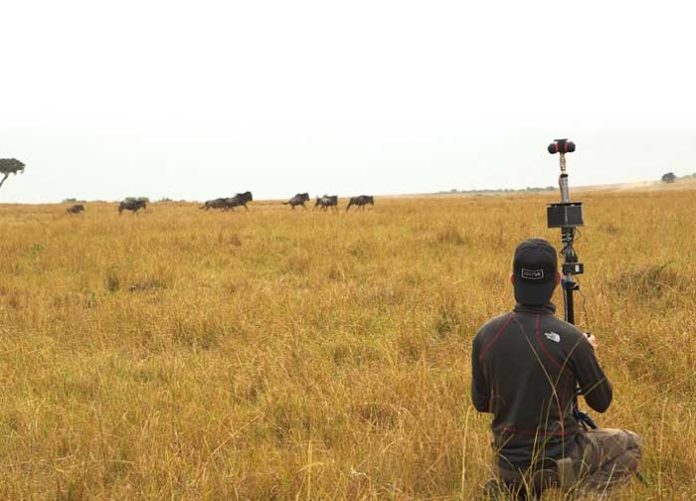
While VR is gradually taking off, the team at Deep VR have promptly produced the first documentary in virtual reality. Exodus: The Great Wildebeest Migration was an unsuccessfully subsidised plot in August 2016 but in October, after its obstacle rich conception, Wildscreen Film Festival in Bristol asked to premiere an early edition. It received rave reviews, and the documentary will now become a series: the Exodus series. Deep VR will produce a further five short immersive documentaries each with a different animal.
I’m getting ahead of myself; let’s go back to the making of Exodus, the first one about Wildebeest, pronounced in whichever accent you carry. Screen Africa caught up with Ulrico Grech-Cumbo: producer, co-director and DOP on Exodus, and CEO of Deep VR. “We tried to find funding for the project from various places. I flew to National Geographic twice to discuss the project with them. The crowdfunding was always going to be the cherry-on-top part of the funding strategy. In the end, nobody was willing to fund the project upfront because nobody had ever filmed a truly immersive narrated wildlife documentary in VR,” he explains.
They had a six week crowdfunding campaign with a flexible target of $25 000 and they raised seven per cent of that goal with $1 861, which paid for international and local flights for one crew member. “We decided in the end to self-fund the entire trip, because in VR if you’re going to do it at all, you’d better do it now,” says Ulrico. “We wanted to beat bigger, better-funded companies to the punch, and being agile and ambitious and well-schooled in VR allowed us to do that.”
The lack of funding or backup did not deter the team from the dream of immersing the viewer in the wild and forever changing the way wildlife documentaries are experienced. “Wildlife documentaries separate the viewer from the subject matter. VR, our speciality, would allow a never-seen-before perspective,” explains Ulrico. “So we chose the most epic wildlife phenomenon to immerse people in: the great wildebeest migration in East Africa. The idea was to create a 10-minute short-form documentary detailing the struggle, danger, and eventual triumph of these massive herds as they chase the rains.”
Filming took place over 11 days in August 2016. The final documentary came out of post in December 2016 and as of going to print, Deep VR is still finalising distribution. They simultaneously produced a behind-the-scenes documentary which details the novice unique journey, and the entertaining struggles and gratifying victories.
The short was filmed using custom GoPro-based rigs. Lacking most of the necessary equipment, the Deep VR team built a lot of it from scratch. “The primary reason is that we wanted to use sensor-extenders to keep the recorders safe while the lenses were the only part exposed in the event of a trampling. This would let us safeguard our footage. The cameras were modified to replace almost all plastic parts with custom aluminium to withstand the heat; we used special lenses from Japan that allowed us to dramatically reduce our nodal distances between different lenses on the rigs. We had a custom micro-processor board allowing us to trigger cameras using RF signal. And we had a custom gen-locking kit which allowed us to synchronise multiple cameras at once,” explains Ulrico, adding: “We used god’s lighting kit, the sun and only the sun.”
They used a Tetramic spatial microphone to capture 360 degree audio. “This allows us to spatially map audio in the final VR experience so that it’s recreated exactly the way you’d hear it in the wild,” Ulrico explains. They used a DJI Matrice 600 as a primary drone and a DJI Phantom 3 as a back-up. Despite this their primary drone malfunctioned a number of times and they lost it before they could use it. “We also crashed our second drone due to battery issues,” he adds.
They faced battery charging issues throughout the trip, relying solely on solar and generator power. The only time they had full batteries was on arrival. “We had to build our own VR cameras for the shoot to ensure they’d withstand trampling, heat and dust,” says Ulrico. “As the shoot progressed, there was a massive attrition rate of gear. We were field-testing at the same time as we were having to capture the project, which means we were constantly in trouble-shooting mode and never left it.”
The documentary was filmed in the Maasai Mara National Reserve in Kenya. It was no easy road for these pioneering filmmakers. They needed permission from the local authorities to run around the Maasai Mara. “The park does have a well-developed commercial filming policy but our challenge was that we needed to rig cameras, essentially walking around the Big Five plains and hippo-infested rivers every single day,” says Ulrico. They needed to do this in a park that does not allow walking safaris. They were badly hit by the doccie maker’s greatest challenger – unpredictable nature and wildlife. “The nature of filming in VR meant the cameras would need to be autonomous, i.e. free-standing. The animals were super sensitive to human presence so we had to predict where they’d go, in order to try rig cameras. We had completed 70 per cent of our shoot without really capturing anything of value. It put immense pressure on the team,” says Ulrico. Along with that pressure, everyone on the team was hit with a virus that had them bed-ridden for ten per cent of the shoot. When fit and out in the field they were in one of the most sought after game viewing territories and therefore “A huge amount of tourists watching the migration constantly interfered with our logistics and clean wildlife-only shot goals,” he adds.
The piece was edited using Photoshop for rotomasking, After Effects, Premiere, Autopano Kolor and Giga, Nuke, and DaVinci Resolve for grading. The small team that pulled off a great feat included Telmo dos Reis as co-director, editor and DOP; Jared Reid as wildlife specialist and DOP; Josh Miller as drone pilot and DOP; and Amy Montalvo as behind-the-scenes videographer.
Ulrico concludes: “Deep VR is putting a stake in the ground with the vision of being the world’s best VR wildlife documentary production company.”
