


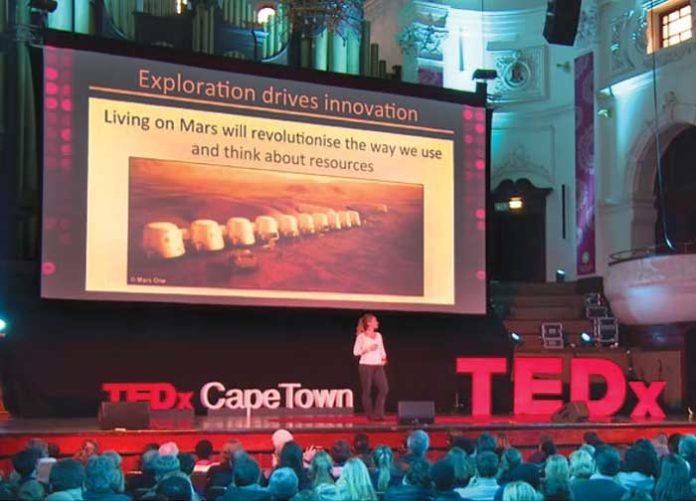
Within 20 years, man will be living on Mars. This is the bold conclusion given by Dr Adriana Marais in Johannesburg at the November launch of the National Geographic series, Mars.
Before the premiere screening of the first episode of Mars, Marais, a theoretical physicist currently doing research in the area of quantum biology, explained her mission to get there. She’s made it onto a shortlist of 100 people vying for a front row seat on the Mars One expedition.
The Mars One organisation proposes to land the first humans on Mars and establish a permanent human colony there by 2026, aiming to send four at a time. Of the 100 candidates seven are from Africa. Marais not only explained the process and the purpose of the project but she brought it to life with her pioneering spirit and passionate excitement for the possibilities that she is a part of. She opened the audience’s eyes to the new era of innovation and space travel we are entering, and enlightened them to feel as excited for the mission and her willingness to give up her life on earth to pave the way for the future of humanity.
“Billions of years of evolution of life on Earth have culminated in the possibility of us calling another planet home for the very first time,” says Marais. She set the tone for the series that is partly factual and partly speculative, as we are taken into a world of the unknown and given a taste of what is in development and almost possible, while also being shown what is imminent and unfolding before our eyes.
The series premiered on Nat Geo in 171 countries and 45 languages during November 2016. The Mars production team took every effort to base the scripted narrative on accurate science. The series writing team worked with an extensive group of experts, both in the public and private sectors, to understand how the science could serve the story. The series also forms a collection of interviews with the top scientific minds currently working to overcome the many obstacles that stand in the way of an eventual inaugural launch, including exclusive interviews with Elon Musk and his team at SpaceX mission control as they successfully landed their Falcon 9 reusable rocket on a drone ship off the East Coast of the US in April 2016.
“The future of humanity is fundamentally going to bifurcate along one of two directions: either we’re going to become a multi-planet species and a spacefaring civilisation, or we’re going to be stuck on one planet until some eventual extinction event. In order for me to be excited and inspired about the future, it’s got to be the first option,” says Musk in the series.
The six part series brings this exciting phase of human exploration home, despite it taking us to Mars. “Showing that life is sustainable on Mars, or furthermore finding evidence of life on Mars, would be one of the most important possible discoveries for humanity. A giant leap in terms of understanding who we are, where we come from and what the future may hold, the Mars One Project, one of the most ambitious ever proposed, makes this dream realisable,” concludes Marais.
