


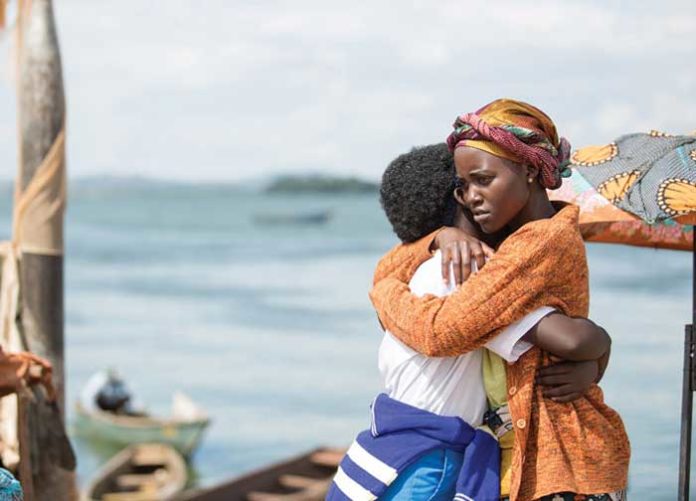
Disney has made its first African story, Queen of Katwe. It flows like a fairy tale yet it’s the true life story of Phiona Mutesi, a Ugandan chess prodigy from Katwe who, with loving guidance, defies the borders of the slums to follow her dreams.
Mutesi’s life story was the subject of Tim Crothers’ book The Queen of Katwe: A Story of Life, Chess, and One Extraordinary Girl’s Dream of Becoming a Grandmaster. Published by ESPN in 2012, it was optioned that same year by Walt Disney Pictures. “It’s a classic underdog story,” says Crothers, who first went to Katwe in 2010. “For Phiona to have done what she has done is against the grain in so many ways. I think that’s what makes her story so extraordinary. She has no business being an elite chess player, and there’s no word for chess in her native language,” he says. “At nine, when she discovered the chess programme, she could not read or write and was basically homeless. She turned her life around from that to becoming a really good chess player and an incredible person, a leader of the women’s movement in her own country.”
It was the article by Crothers in ESPN Magazine that first introduced producer John Carls to the work of Sports Outreach and its cinematic potential. Carls was especially interested in the work of Robert Katende. Mutesi’s chess coach, who began as a soccer coach for Sports Outreach in Katwe. Katende was a civil engineer searching for a job that would financially support his wife and two children when his compassion led him to the development of his chess programme. It was there that he met Mutesi, a girl whom he took to when he saw the fight in her. She ended up making one of the greatest moves in chess, where the pawn becomes the queen. “That is one of the most powerful messages in the film,” says Carls. “That, no matter where you start from, you can still accomplish the greatest of things.”
Presented in association with ESPN Films, Queen of Katwe stars Golden Globe® nominee David Oyelowo, Oscar® winner Lupita Nyong’o and introduces Madina Nalwanga az Mutesi. The remarkable biography was made into a screenplay by William Wheeler.
While developing the project, Tendo Nagenda, Disney’s executive vice president of production and of Ugandan descent, immediately thought of Mira Nair. An Oscar® nominated director and the founder of Maisha Film Lab, a film school for East Africans, and a production company Mirabai Films in New York.
“It was quite ironic,” Nair remembers, “As one of my mantras is that if we don’t tell our stories, no one else will, and here was a story that was so local yet came from Hollywood.”
Nair says she had Nyong’o in mind for the role of Harriet, Mutesi’s mother who had her first child at 14. “I called it the Lupita draft,” she says.
Nyong’o won an Academy Award for Best Supporting Actress in 2014, concluding her acceptance speech by saying, “May it remind me and every little child that no matter where you are from, your dreams are valid.” This is a seemly statement for this story, which demonstrates how any dream can change the world.
A child of east Africa, an alumnus of Maisha Film Lab and an intern at Mirabai, Nyong’o fell in love with the script by the tenth page. “For me what is so poignant about this film is that it is told with humanity and humanity does not have a nationality, it doesn’t have an ethnicity and Mira tells this story with the specificity of Katwe but she also tells it with the universality of humanity, a small girl with a big dream who achieves it,” says Nyong’o. “That is the power of this kind of storytelling.”
Principal photography took place from April to June of 2015 in and around Katwe and Kibuli in Kampala, Uganda, as well as in Johannesburg, South Africa, employing local crews and extras in both countries.
Production in South Africa made use of the Department of Trade and Industry’s (dti) tax rebate, which subsidises 20 per cent of the budget, as long as 50 per cent of the film is shot in SA – an initiative that has attracted a great deal of local and foreign production in the country. “This is what I was trying to tell the Ugandan government 12 years ago,” says Nair, who has had a home in Kampala for the past 27 years. She says most of the scenes of Katwe, the informal settlement in Kampala where Mutesi spent her childhood, were shot, not in Kampala but in Johannesburg, together with all the chess championship sequences, the scenes of Sudan, Russia and the floods. “We rebuilt Katwe in Danville, outside Pretoria, for the flood scenes and poured in gallons of water. It would have been a bit tough to do that in Kampala,” she adds.
Nyong’o says the Joburg winter was her biggest challenge. “We were shooting an equatorial movie where it is hot every day and it was the dead of winter in SA. The challenge of all challenges. It was about three degrees and we were wet for four days straight and between each take we would run to the hot tub they had set up and just sit in our clothes until they were ready for us again.”
She adds that working with an SA crew both in SA and in Uganda was an excellent experience. “There is obviously an infrastructure here that Uganda can’t compete with,” Nyong’o says. “With that comes personnel and staff that are very experienced and they brought their experience to the film, they were integral,” she adds.
Nair says the most difficult part of making the movie was filming chess in an interesting way. “The humour, the drama, the style, that’s what I do but to make chess emotional and dramatic and visual and propulsive, to propel the story and yet be truthful to it,” she says was the greatest challenge. “It is absolutely correct, and these are moves that Phiona is famous for, we didn’t invent any of them,” she explains. All 15 of the games in the film are genuine games. Katenda was their chess consultant, the call sheet for every day’s shooting included the chess design, and all the children were taught chess by Katende. “It was an interesting visual challenge, how do I make chess vital,” Nair adds.
“Chess is inherently a cerebral, static game that does not necessarily translate well in cinema,” says DOP Sean Bobbitt. Speaking of Bobbitt Nair says, “He has this amazing poetry with his hand-held work that takes us right into the heart of the scenes we’re shooting.”
“Katwe is the visual heart of the film,” explains Bobbitt. “As a news and documentary cameraman, I’ve been faced with drab poverty in slums all over the world, but Katwe is different. There is vibrancy there, a density of colour and a unique pallet. The contrast of the red earth with the yellows and blues they use to paint the buildings, the density of humanity, the bright elements of clothing, the constant movement. Everywhere we pointed the camera, there was something of beauty.”
Bobbitt shot the film with the widest lenses possible to create larger-than-life images, using two Arriflex XT cameras supplied by Media Film Service Johannesburg. “These cameras have a wonderful sensor which handles the extremes of the African sun and shadow. They are robust and well suited to outdoor/indoor work needs,” explains cameraman Miles Goodall. He says they used a full set of T2 Cooke S4 series lenses as well as two Alura Zoom lenses with a range from 15mm to 250mm. “The sun was the primary source of light,” says Goodall. “Reflected and controlled depending on the scene. Electrical light was used for interiors and night scenes,” he adds. “We did quite a bit of handheld and loose camera rigs for freedom of movement. We had two cameras on main unit operated by Bobbit and myself. Mira wanted two varied angles on the actors, especially the kids. She wanted a blend of classic and gritty. I was second camera DP and we roamed around shooting street-life and scenery while waiting for the set-ups to be ready.” The film was edited in Avid.
The film has an original score by Alex Heffes and it features an Afrobeat soundtrack curated by the Ugandan rapper Young Cardamom, the co-music supervisor, who took inspiration from the Katwe streets to engage the audience in the modern sound of today’s Kampala. The songs on the soundtrack stem from various African countries, from Uganda to Nigeria, and include an original by Alicia Keys.
Speaking of the impact of the film Nair says “It is not just a showcase; this is an anthem for all of us.” She says that film crews in SA are something that the country has to be proud of. She has made movies in SA since 1993 and is still working with colleagues she met then, “the greatest collaborators and artists.” She adds: “SA is top class. The key is we have to tell our own stories. We are servicing the whole world here with our crews but it is our own stories we have to tell and to tell them beautifully and I believe SA has the infrastructure and the talent to do that.”
