


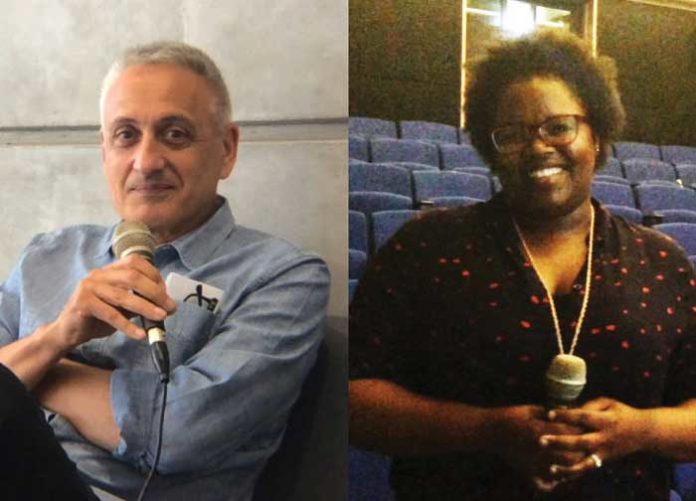
Internationally acclaimed, South African-born cinematographer Dan Mindel was back to his roots for the Silwerskermfees in Cape Town. The renowned director of photography, whose work includes JJ Abrams’ Star Wars and Star Trek films, was invited to the festival as part of an M-Net initiative in association with kykNET to facilitate conversations between South African filmmakers and international experts.
Part of the initiative included a competition where student filmmakers from AFDA, Big Fish and Umuzi Academy were required to submit a short film. More than 75 film entries were received and reviewed. Mindel and a team from the South African Society of Cinematographers (SASC) then selected the winner.
“South Africa will always hold a special place in my heart,” says Mindel. “To return, and be able to step into conversation with South African filmmakers has been a privilege.”
The winner of the competition was Nondumiso Buthelezi, with her documentary film Oswenka. The film looks at the flamboyant tradition started by Zulu migrant workers in the 1950s, which saw them competing for the title of best dressed man.
“Oswenka hit a nerve; it’s interesting, genuine and raw. I was most impressed by its contrasting colour palette and its texture,” explains Mindel, adding that he sees a bright future for this young director. The prize included R30 000, a mini master class with kykNET’s content team, and the opportunity to showcase their work at the 2017 kykNET Silwerskermfees. Beaming after the win, Buthelezi said: “This makes people notice you, this is a great boost for my career.”
She explains that the ‘oswenka’ tradition was invented as a solution to the hard times men were going through. “This film highlights the dignity of these Zulu men who come from respected homes to hostels in Johannesburg, where they are reduced to almost nothing.” So while the film is lighthearted it addresses the underlying pain, she explains. The film has been screened at festivals around world, including the Luxor African Film Festival in Egypt, where it won best artistic director of a student film, and in October it will be viewed at Silicon Valley in California.
“It has travelled in a way I didn’t think was possible,” says Buthelezi. She advises aspiring film makers that “whatever story you want to tell, tell it, no matter how crazy the idea sounds. There is so much red tape, but you will find a way.”
Mindel explains the challenge in the judging process, “As a technician it is hard not to be judgmental on the workmanship and everything about it. So to approach it in an unbiased manner is a hard thing to do but that is the way I try to look at it.” He says that when you look at student films, “they normally take a bigger bite out of whatever it is that they think they are going to do and it ends up being a compromise, because it can’t be done with the money or the skillset that they have.”
Mindel was fascinated by the age group of the people making the films, saying that what they are thinking and expressing through their films tells him what is going on in this country. He notes that the Americanisation of everything is very noticeable and says he was looking for something indigenous in each film. “My friends from the SASC and I sat and worked out a way of separating all the films from each other based on the way they were shot, what was going on story wise and how they felt,” explains Mindel. “I was glad that all of them weren’t violent horror stories from inner Johannesburg or the townships. I would have been devastated if they had all been like that.” He says the winning film had everything he was hoping he would see: “style, humour and sensitive direction.”
Mindel describes the two kinds of films they saw: the ones that had really great equipment and the ones that didn’t. “It is not about what the equipment is or the technical specifications. I think that the methodology is how well the story is told and that is all we can look at. The technology – quite frankly anyone can use it, you don’t need a degree to do that, so I think that even if none of them know how the equipment works, the story is the main thing.”
Advising aspiring filmmakers Mindel says, “Move in a direction of exploration in order to learn what you want to achieve in the end. Without a point to focus on you’ve got nowhere to go, whether you want to be a director, cinematographer, writer or editor, focus on that point and just keep going.”
