


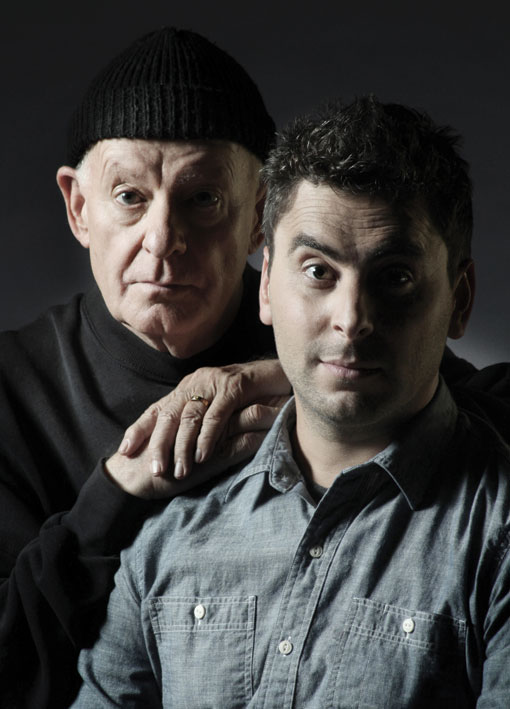
Nobody’s Died Laughing is a theatrical documentary revealing the life and work of performing artist and activist Pieter-Dirk Uys. Uncovering the man behind the prominent persona, a film crew tries to keep up with Uys as he tours SA, the world and on to his home in Darling, Western Cape.
Filmmaker Willem Oelofsen explains his vision for A Journey with Pieter-Dirk Uys: “This film captures a man and a lifetime commitment to a country by using satire to affect change. I believe audiences will be intrigued to experience more about the man who refuses to be silenced while using the arts as his weapon against discrimination and confronting intolerance.”
The film includes interviews with Desmond Tutu, Charlize Theron, FW De Klerk, Janet Suzman, Lizz Meiring, Anna-Mart van der Merwe, Zolani Mahola, Professor David Gere, Sophia Loren, Jonathan Shapiro and many more. It also includes previously unseen archive footage of Tessa Uys and Nelson Mandela.
Oelofsen started researching Uys in 2014 and spent time with him in his personal archives in Darling. “In 2015, we simply picked up a camera and started following him around wherever he went: performing in Berlin or the Cape Flats, and watching him teach a roomful of teenagers about safe sex,” describes Oelofsen. “I found it fascinating that after 50 years in the entertainment industry he was still working at the same pace and with the same vigour as when he started.” Oelofsen got to know Pieter-Dirk Uys while he was working at Theatre on the Bay, where Uys was performing a season of his show Adapt or Fly. When Uys mentioned that he was turning 70 in 2015 the idea was sparked for Oelofsen to make a documentary about his life and work.
Filming took place over the year of 2015, predominantly during April and August where Oelofsen shadowed Uys. “The film follows Pieter-Dirk Uys from theatre productions, book signings and Aids education work to corporate shows and time at home, cut into the chronological story. We tell his life geographically, covering aspects from personal life in locations with significance to that part of his life,” describes Oelofsen.
The film was shot mostly on the Sony FS7 and Canon 5D for gimble and CableCam shots. “When we used multiple cameras we brought in another Sony FS7, the main consideration for using Sony FS7 was mobility, navigating back-stage and following Pieter-Dirk Uys through diverse locations,” explains Oelofsen. He says the DOP Nic van der Westhuizen used a variety of lenses on the Sony to create a rich cinematic look for the film. Due to an intense travel schedule they kept kit to a minimum, even renting while overseas and keeping it simple with two LED key lights and a cosmo lighting set.
For sound during interviews they used a lapel mic on guest speakers and a boom and shotgun mic. “For most of the interviews I also wore a lapel microphone just in case we needed to use the question in the film to establish context, but luckily we only ended up having to use my questions twice in the final cut of the film,” says Oelofsen.
The key team who travelled with them to all the international locations and shot the majority of the material in South Africa were Oelofsen, the co-director and editor Geoffrey Butler and DOP Westhuizen. Butler doubled up as technical director as well, with a keen eye for what he wanted to have in the edit. Final mix and grading was done at Waterfront Film Studios.
“It was very important to me from the very beginning to create a layered and textured film to reflect Pieter-Dirk Uys’ life and composer Josh Wynter was part of the process from very early on,” says Oelofsen. “We also had the luxury which allowed Josh to compose for the picture and make a complete soundtrack for the entire film.” Wynter uses different music styles and sounds to reflect the rich tapestry of Uys’ life, the places they visited and the eras they talk about.
“Rounding off the music for the film is an absolute kick-ass track by Jack Parow written specifically for the film, called ‘A Rebel Till He’s Dead’,” says Oelofsen.
The documentary was filmed around South Africa: in Darling, Cape Town, Johannesburg, Stellenbosch and Grahamstown. “Internationally we did interviews in Los Angeles with Charlize Theron and David Gere, in London we filmed at the Soho Theatre and in Berlin we visited the Jewish Museum with Pieter-Dirk Uys, filmed his performance at the Deutsche Afrika Stiftung and in Geneva we interviewed Sophia Loren,” says Oelofsen.
“I think it speaks a great deal about who Pieter-Dirk Uys is, considering that everybody wanted to be a part of this film, some arrangements were a bit more tricky than others; for Charlize I still had to deal with her PR staff, lawyers and Warner Bros. team who set-up a time for us to interview her,” explains Oelofsen. “I also had to fly Sophia Loren’s agent from Rome to join us for the interview in Geneva and had to sort out the release form with him. But timing and scheduling was probably the trickiest part; you can imagine everybody wants time with Desmond Tutu, so it is a great honour that he made time for us.”
Juggling shoots, interviews, and travel plans, Oelofsen has become a master planner. “As the director I had to be very clear about what I wanted to get out of each shoot,” says Oelofsen. “The biggest challenge during post production was media management and consolidation, especially as we used a huge amount of archive footage from a variety of sources.”
Kyle Stroebel, colourist at Waterfront Film Studios, says the biggest challenge for him was in the multiple formats of the differing archive footage. “Conforming the multitude of material and then creating cohesion while still staying true to each country visited was the biggest test,” says Stroebel. “Pieter’s life is so colourful and simultaneously dramatic and we mimicked that in the grade. The edit and the way it was shot made achieving the vision quite simple, yet still allowed us to be creative in post. The strength of the Baselight system is in its innovation, and being able to quickly alter between looks which allowed us to keep manipulating the finish all the way until the final steps of the online process.”
Uys and Oelofsen attended selected screenings around SA. A film by kykNET films and Vry Films in association with Lion’s Head Productions and Who Projects, it won Best Documentary at the Silwerskermfees, held in August 2016. It is currently in SA cinemas countrywide.
