


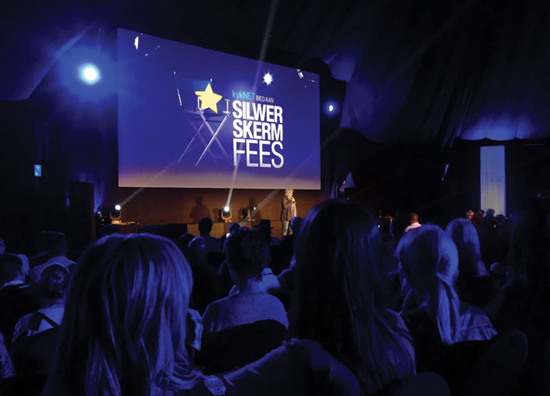
The kykNET Silwerskerm Fees is gearing up for its eighth instalment in 2017, as the successful local festival continues to bring industry personalities together to provide a platform for the next generation of South African filmmakers to showcase their work.
Best news of all, both for long-time fans of the Silwerskerm and for South African television viewers alike, is that the immensely popular short film competition will feature an expanded field of entrants this year, with both 12- and 24-minute films to be screened at the festival (and a selection of which will later be broadcast on kykNET).
The Silwerskerm Festival started in Prince Albert in 2010 before moving to The Bay Hotel the following year. Partly due to this evocative Camps Bay setting, the festival has been nicknamed “the Cannes of South Africa” – but to focus only on its glamour misses the critical role the Silwerskerm Fees plays in the development of the local film and television industries.
According to Karen Meiring, M-Net’s director of Afrikaans channels, the “motivation for starting the festival was to create opportunities for new, established and veteran filmmakers to get together and to be exposed to one another’s work. From the beginning, it was a way to create a platform for the development of new filmmakers” – exhibiting films in several categories such as features, documentaries, experimental films and, of course, the dynamic short film competition.
Some of the country’s brightest – and busiest – young filmmaking talents have emerged from the ranks of the Silwerskerm short film competition, where a selection of scripts are given funding, feedback, guidance and production assistance as bold ideas become transformed into compelling pieces of cinema. Meiring understands the financial restraints on young South African filmmakers, and sees the short film competition as an effective means of “encouraging and engaging people who are passionate and determined to make movies.”
The 2012 entry Buurtwag (Neighbourhood Watch) won two awards – Best Director (Jaco Smith) and Best Screenplay (Beer Adriaanse) – and was subsequently developed into a 13-part television show, written and directed by Adriaanse, which aired on KykNet in 2015. While the writer and director of that year’s winning film, Nantes – René van Rooyen – has been prolific, penning the features Mooirivier, Hollywood In My Huis (with Corne van Rooyen) and the upcoming Vaselinetjie.
In 2013, it was Christiaan Olwagen’s turn to impress, with his short film Toevlug (Refuge) picking up three awards, and landing him a three-film contract from M-Net in the process. His first feature, Johnny Is Nie Dood Nie – about a group of old friends who gather to reminisce about the impact that Johannes Kerkorrel and the Voelvry Movement had on their lives – was released this year to great critical acclaim, confirming Olwagen’s reputation as one of the country’s most promising auteurs. Described by early reviewers as one of the strongest South African films of the year, Johnny Is Nie Dood Nie was awarded seven Silwerskerm Awards in the Feature Film category at last year’s event.
Gambit Films, the production house whose short film No. 37 won at the 2014 event, present an even more resounding success story. As Meiring explains, through the networks created by the competition, “established producers can become involved in mentoring inexperienced producers until they are strong enough to stand on their own feet.” Gambit, who received this kind of support and guidance from Homebrew Films, has flourished, being “involved with numerous projects for kykNET and kykNET & Kie. They were responsible for Ons Stories, a series of 20 television films, and – after a thorough tender process – they were also chosen as the producers of Suidooster,” a Western Cape-based soap opera that has racked up more than 100 episodes and, more importantly, led to the development of Atlantic Studios, “a much-needed new studio complex in Cape Town, which provides almost a hundred permanent job opportunities in the television industry.”
Another prominent entry to the 2014 competition, Vuil Wasgoed (Dirty Laundry), led to its producer Bouwer Bosch starting a production company that has just overseen the development of a feature-length version of the film; while the writer, Bennie Fourie, has also contributed to the popular kykNET series Sterlopers and Hotel, for which he and fellow writer Stian Smith recently won a SAFTA.
Smith, who won Best Script at the 2015 awards for Beurtkrag (Load Shedding), has seen his short film be adapted for the stage by director Jozua Malherbe, another Silwerskerm alumni and the director of the award-winning series Swartwater. The play, which is currently touring on the Afrikaans theatre festival circuit, is yet another example of the “exciting and sometimes unexpected creative opportunities” that the short film competition can provide.
Last year’s competition saw Matthys Boshoff win Best Director for Vlees van My Vlees (Flesh of My Flesh), which also won Best Short Film. Meanwhile, Willem Grobler picked up the Best Script award for the sci-fi-tinged psychological thriller Hum, and the young filmmaker is already building on this momentum with the development of an ambitious “neo noir” feature project called God Is Good.
And, of course, the successes noted above say nothing about the myriad other cast and crew members – from performers to costume and make-up artists, sound engineers, gaffers and DOPs – that have benefited from being involved in the Silwerskerm short film competition over the years. By giving these individuals the opportunity to gain on-set experience – not to mention the exposure that comes from having these films screened at the festival and later broadcast on kykNET – the competition is making a vital contribution to skills development across the board.
Meiring notes that this is one of the most gratifying things about the short film competition, the way she sees production values improving year upon year, and she points out that this has always been part of what the Silwerskerm Fees is about. “We want to keep nurturing a culture of sharing,” she says. “In today’s rapidly changing digital landscape, the opportunities are growing, with options such as television becoming more attractive to filmmakers.”
With 258 entries to the 2017 Silwerskerm Fees (up an incredible 48 per cent from last year’s 174), there is clearly a font of young South African talent yet to be discovered. While the final programme is still to be confirmed, this year’s instalment of the festival will make its selection from a pool of eight documentaries, four films in the Experimental category and 32 short films, which will compete in two streams: ‘kort films’ (24 minutes) and ‘kort-kort films’ (12 minutes).
The 2017 Silwerskerm Fees will take place from the 23 to 26 August at The Bay Hotel in Camps Bay. A limited number of tickets will be available to the public from the 14 August.
By David Cornwell
