Home Authors Posts by Dejero Press

Dejero Press

16 POSTS 0 JOBS
Dejero blends multiple Internet connections to deliver fast and dependable connectivity required for cloud computing, online collaboration, and the secure exchange of video and data.

Dejero announces new capabilities of cloud-based management system

Dejero, an innovator in cloud-managed solutions that provide video transport and Internet connectivity while mobile or in remote locations, has launched a range of new features within its cloud-based management system, Dejero Control. The expanded capabilities of Control further simplify the workflows of broadcasters and content providers enabling expanded device sharing and metadata generation.

Automated and customisable clip metadata

Leveraging the integrated cloud workflow, a new automated and customisable recorded clip metadata feature allows users in the field or back at the control room to edit and add metadata to clips via the Dejero Control interface. Station administrators can create a custom metadata template that is used across all clips to add relevant auto-generated metadata defined by the templates. Users at the station can now quickly search and find relevant content—saving them significant time.

A metadata template is applied to all ingested clips at the station level and users can select from a list of ten pre-set fields, such as geolocation and acquisition date—all auto populated from the transmitter. Customers can also add free-form fields that station operators can define to further organise recorded clips.

“It can be very inefficient and time consuming for broadcasters to find relevant content in their systems. With our new metadata feature, we are providing a means for broadcasters and media organisations to automate the generation and tagging of metadata, saving them valuable time and enabling them to speed up content retrieval and automate metadata driven workflows,” said Todd Schneider, chief technology officer at Dejero.

Expanded device sharing

The system now offers an expanded device sharing capability that allows broadcasters to temporarily route a feed from a field transmitter to a partner station or broadcaster. Building upon this capability, broadcasters can now also share access to receivers. This adds flexibility to how stations integrate with other stations or freelancers in the field. Dejero customers can now send or receive video with the transmitters and receivers set up within the ‘device sharing’ feature in Control.

The simple UI of Dejero Control allows station operators to provide freelancers or other collaborators access to route content, while a cloud-based infrastructure permits device sharing to provide secure, controlled interoperability between stations and freelancers.

Workflow automation

Metadata and expanded device sharing capabilities continue to build on the features of Dejero Control to support broadcasters in transforming their workflows. Existing Control features including real-time analytics, usage reports and notifications, remote controlled settings, and transmitter health monitoring combined with the new features all aim to simplify time-consuming processes allowing broadcasters to focus on the work that matters most and automate their workflows driving improved efficiencies.

“As a leading innovator in embracing and leveraging the cloud for broadcasters, we are continually working to bring our customers more ways to automate and simplify their workflows. Dejero’s flexible and customer-centric approach delivers innovative, effective solutions that we will build on for our future cloud-based offerings,” added Schneider.
Dejero to showcase its latest connectivity solutions at IBC 2018

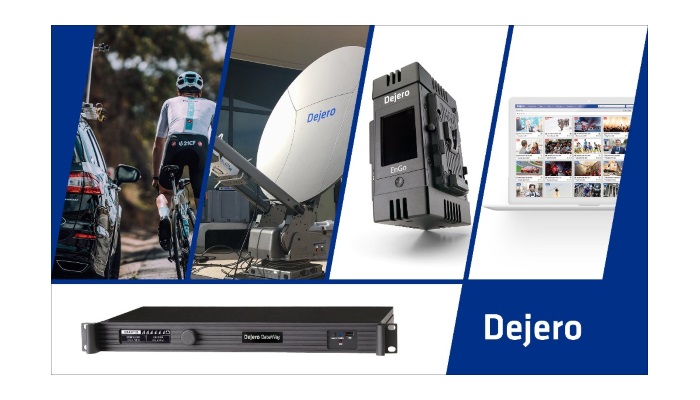
Dejero, an innovator in cloud-managed solutions that provide video transport and internet connectivity while mobile or in remote locations, will showcase its latest blended connectivity solutions for broadcasters and media organisations at IBC 2018. Dejero will feature its award-winning CellSat solution, the new six modem GateWay router, and its latest mobile transmitter.

CellSat connectivity service
Providing enhanced reliability in situations where cellular networks are congested or cellular coverage is limited, Dejero CellSat now includes a new midstream activation feature, simplifying switching between cellular-only and CellSat transmission paths, without having to stop and restart the transmission. CellSat midstream activation puts greater cost control in the hands of broadcasters when contributing high-quality video content from the field.

Dejero CellSat intelligently blends cellular connectivity from multiple mobile network carriers with Intelsat’s Ku-band IP satellite connectivity to provide the necessary bandwidth on demand to deliver exceptional picture quality and greater reliability while on location. Dejero CellSat recently enabled Canada’s Global News and Entertainment Tonight to deliver seven hours of on-location live coverage of the royal wedding.

In addition to video transport up to 20 Mb/s with Dejero HEVC-capable encoders, the CellSat connectivity service also enables data transport for applications such as email and internet access. Visitors to the Dejero stand can experience live demos of the award-winning CellSat solution, which can be deployed in newsgathering and field production vehicles, or with compact flyaway antenna systems.

Enhanced reliability for GateWay mobile connectivity
Dejero is showcasing its new GateWay M6E6 router for high-throughput bidirectional data transport. Six embedded modems allows the use of SIMs from a greater number of mobile network providers, resulting in greater carrier diversity, boosting reliability and throughput. Now featuring six Ethernet ports, the GateWay router provides greater flexibility in connecting networking equipment and additional transmission paths, such as satellite.

The GateWay solution allows crews working on location to access their newsroom or media asset management systems, quickly send and receive large files, access cloud services, communicate with their colleagues via VoIP, and enables any other application requiring internet access. This robust mobile connectivity solution was recently put through its paces by Team Sky during its victories at the Giro d’Italia and Tour de France, where terrain, network congestion and weather has typically presented connectivity challenges.

More processing power in latest mobile transmitter
As the broadcast industry shifts towards the HEVC video compression standard to efficiently transport high quality video from the field, the latest Dejero EnGo is equipped with increased processing power to boost overall performance and deliver enhanced picture quality. Combining Dejero’s industry-leading auto-transport and adaptive bitrate encoding technology with the newest compression standard, Dejero continues to boost video quality in the industry’s most versatile and robust mobile transmitter, mountable on a camera, worn in a backpack, or mounted in a vehicle.

In addition to enhancements to Dejero CellSat, Dejero GateWay and Dejero EnGo, the company will also demonstrate the latest updates and preview upcoming features to Dejero Control, its cloud-based management system.

“Reliable connectivity is critical for content contribution from the field, supporting more efficient remote production workflows, and enabling emerging workflows in the cloud,” said Kevin Fernandes, vice president of Sales at Dejero. “We are looking forward to demonstrating the latest video transport and connectivity solutions to visitors at IBC, and discussing how we can help broadcasters and media organisations save time and reduce costs in their connected workflows.”

Dejero announces major release to Dejero Core software

Dejero, an innovator in cloud-managed solutions that provide video transport and internet connectivity while mobile or in remote locations, has announced a major release to Dejero Core software. Core runs on all Dejero transmitters and receivers and includes the proprietary technology responsible for the intelligent and dynamic blending of IP connections from multiple network providers. The latest update, Core 5.0, will be showcased at NAB Show 2018.

“The drive behind this major release of our Core software is to help broadcasters and media organisations further simplify their workflows while providing even higher levels of performance and video quality,” explains Bogdan Frusina, founder, Dejero.

Continuing its ongoing commitment to broadcasters, Dejero Core 5.0 adds HEVC support to the latest version of Dejero EnGo, a highly versatile mobile transmitter that encodes high-quality video and reliably transmits over multiple IP streams to deliver exceptional quality at low latency.

EnGo now combines Dejero’s industry-leading auto-transport and adaptive bitrate encoding technology – which optimises picture quality when there’s limited bandwidth available – with HEVC, the newest compression standard.

Broadcasters can take advantage of the enhanced efficiency of HEVC compression to provide higher quality video at lower bitrates. The Core 5.0 software update is free for eligible customers, with no additional hardware to be installed or purchased. Core 5.0 also adds support for 1080p at 25/30 fps to Dejero EnGo, GoBox, and VSET transmitters, the Dejero Broadcast Server, and the Cloud Server and MultiPoint cloud services. The recently introduced HEVC-capable PathWay rack-mount encoder/transmitter and WayPoint receiver now support 1080p at 25/30/50/60 fps. The increased frame rates deliver smooth, high-motion video preferred by broadcasters for sports and eSports coverage.

“We see our customers pushing our products to the limit as they aim to provide the best possible experience for their viewers. Now with up to 1080p60 support, our customers can capture high-motion content such as traditional sporting events, emerging eSports, or other high-motion content and provide a level of quality that they never could have before,” adds Kevin Fernandes, vice president of sales at Dejero.

In addition to the HEVC and frame rate enhancements, Dejero Core 5.0 software enables operators in the field to rename clips recorded on the transmitter, making them easier to find and manage at the broadcast facility. An option to record at 12 Mb/s and 15 Mb/s has also been added to provide even higher picture quality when it’s needed. The large storage capacity on Dejero transmitters provides ample space for these high-quality recordings.

Simplifying workflows and saving time, Dejero Core 5.0 software continues to drive video quality performance and improve efficiency for broadcasters. The release will be available in May and will be previewed for the first time at NAB Show 2018.

Dejero and Intelsat partner on new solution to deliver reliable video transmissions solution

Dejero, an innovator in cloud-managed solutions that provide IP video transport and Internet connectivity while mobile or in remote locations, has announced a partnership with Intelsat (NYSE; I), a world leader in providing integrated satellite communications. The collaboration provides broadcasters with a new blended cellular and Ku-band IP solution for live television coverage from remote locations.

Dejero CellSat leverages Dejero’s patented network blending technology to combine cellular connectivity from multiple mobile network carriers with Ku-band IP connectivity provided by Intelsat. This gives CellSat users the required bandwidth and greater confidence to go live from virtually anywhere. If the bandwidth available from cellular connections dips due to network congestion or other factors, CellSat automatically blends in Ku-band IP satellite connectivity to boost bandwidth to the requested level for the live shot.

“We are addressing the dilemma that broadcasters face about which video transport assets to deploy to a news story or live event,’ explained Bogdan Frusina, founder of Dejero. “By taking advantage of cellular and satellite connectivity, CellSat offers high reliability to our customers, with the convenience of procurement, network management, billing, and support from a single vendor. This is a package that is currently unmatched in the marketplace and we are thrilled to be working with Intelsat to make this possible.’

The Dejero CellSat solution communicates with the satellite terminal auto-acquire system to simplify the satellite connection process. There is no need to schedule satellite time, saving crews valuable time and removing the constraint of broadcasting within a certain time window. In addition to managing the fluctuating bandwidth of individual cellular connections, CellSat software dynamically allocates satellite bandwidth for optimal performance.

“Today’s broadcasters are challenged with quickly producing high-quality, reliable television coverage in environments that run the gamut from sparsely populated in extremely remote areas to overcrowded with a congested network,’ said Rob Cerbone, Intelsat’s Vice President and General Manager of Media Services. “Coupling Intelsat’s high performing, ubiquitous Ku-band IP connectivity with Dejero’s blended cellular technology will give broadcasters greater assurance when covering live events. Dejero CellSat was designed with simplicity in mind so crews can focus on setting up quickly and getting the live shot back to the broadcast facility and on the air.’

The Dejero CellSat solution includes pre-certified encoding and receiving equipment, network blending software, connectivity services to the CellSat network, cloud management, and 24/7 technical support. Most satellite vehicles with existing Ka-band or Ku-band satellite equipment can be upgraded for compatibility with Dejero CellSat.

Dejero brings IP to NAB 2017

Dejero is attending NAB 2017, held at the Las Vegas Convention Centre from 24 to 27 April, to showcase its latest developments in the field of IP connectivity for electronic newsgathering (ENG) and remote broadcasting.

“Our LIVE+ platform is designed for critical broadcasting events, such as breaking news and a good example is the recent presidential inauguration, where many of our broadcast clients confidently depended on our reliable transmission capabilities,’ explains Bill Nardi, VP of broadcast integration and global support at Dejero. “The industry is embracing network bonding solutions for transporting video and data from remote locations as it continues to transition towards IP. To address that, Dejero is focused on providing a vast array of solutions that open up new opportunities and provide a stress-free technology experience for production crews working remotely in the field.’

Making its official debut at NAB, the LIVE+ Gateway solution enables news crews to access media assets, research stories, and transfer large files by providing fast, reliable, and secure access to the public Internet and private networks in the field. Leveraging patented network bonding technologies, the solution creates a virtual network of multiple IP connections with the necessary bandwidth and reliability to enable bi-directional data transfers from newsroom and production systems. The complete Gateway solution includes in-vehicle equipment, cellular connectivity services, cloud management, and support.

New capabilities of Dejero’s highly flexible LIVE+ EnGo mobile transmitter will also be showcased at the Dejero booth. EnGo can be camera mounted or carried in a sling bag or new, ergonomic backpack. Key features include a user-accessible SIM module, global roaming packages, and the ability to transmit multichannel audio. EnGo encodes high-quality video and transmits it over multiple IP networks to reliably deliver exceptional picture quality with extremely low latency in the most challenging cellular network environments.

Dejero will also showcase the recent enhancements to its LIVE+ Multipoint cloud service. Broadcasters and media organizations can now share live HD content simultaneously across multiple locations and between different entities anywhere in the world. New capabilities include multichannel audio and closed captioning. Group and single event point-to-multipoint packages are now available in addition to a fully customized, unlimited use package for multipoint-to-multipoint content sharing scenarios.

Visitors to the booth will also see a demonstration of the new capabilities of Dejero’s industry-leading LIVE+ Control cloud-based management system. LIVE+ Control enables the management of transmitters, gateway devices, servers, and content from a web browser. Users can geolocate and remotely control transmitters, configure broadcast and cloud servers, view performance data and detailed analytics, preview low-latency feeds, and route live or recorded content to playout and online delivery workflows.

New release of Dejero app enhances quality of content for mobile journalists

Dejero, an innovator in cloud-managed solutions that simplify the transport of live video and real-time data across remote or mobile IP networks, on 26 April 2016 announced a new update of its LIVE+ Mobile App, its new solution allowing journalists to use iPhones to get stories on air fast.

“We spend a lot of time talking to our customers,’ said Brian Cram, CEO of Dejero. “They outlined what they need to make our LIVE+ Mobile App more useful, and we are using that feedback to add new features and enhancements in each release.’
The new release of LIVE+ Mobile App enables image stabilisation on iPhone 5s and above models, smoothing out vibrations and hand shake, which is inevitable in any situation where a journalist is holding the phone to gather news or cover live events.

Based on user feedback, the audio meter has also been enhanced. Available during shot set-up and while broadcasting live or recording a clip, the on-screen dBFS audio level metering more accurately reflects the sound environment, helping mobile journalists set the appropriate levels for clear commentary. The new release also supports microphones with lightning connector cables such as the iRig Mic HD.

The app now supports real-time analytics in LIVE+ Control, Dejero’s cloud-based management system. Both live and historical stream performance data including network connections and glass-to-glass latency, combined with geolocation information, helps operators in the broadcast facility monitor the performance of a live shot, and review historic shots which helps with planning of future shots.

“Mobile journalism is an increasingly significant trend, with even traditional broadcast journalists recognising the power of getting on air armed with nothing more than their iPhone,’ Cram concluded.

For more information, visit the Dejero website.

- Advertisement -
- Advertisement -
- Advertisement -

Pin It on Pinterest