Home Authors Posts by Cera-Jane Catton

Cera-Jane Catton

316 POSTS 0 JOBS
Cera-Jane Catton is a writer and journalist with years of experience in community newspapers, blogging and freelance journalism. She has worked in a cache of capacities, often finding herself behind or in front of the cameras, intentionally and less so. She has been a stunt double in two Bollywood movies, has worked in various capacities on a number of natural history documentaries, and other international productions shot in South Africa. Cera is a former Screen Africa journalist.

Broadcast-quality live streaming now available on Facebook

With the opening of the Facebook Live API, brands can now live stream video content directly to Facebook using high-quality production equipment. This has been extremely important to broadcasters and video content creators that want to deliver non-stop live video coverage to the Facebook community. LiveU, a pioneer in live streaming technology, has created a new “plug and play’ live streaming bonding solution that connects automatically to Facebook, enabling broadcasters and content creators to deliver rock-solid, highly produced video streams. The Huffington Post, a global source of breaking news, opinion, entertainment and community, and an early adopter of LiveU Solo, is utilising the technology to deliver high-quality live video to a wider audience on Facebook.

“At The Huffington Post, we’re eager to deliver live streaming to our Facebook audience and have already increased production by seven times in the last month,’ said Patrick McMenamin, supervising producer at The Huffington Post. “LiveU Solo has helped us become one of the first outlets to stream high-definition video direct to Facebook. We’ve used LiveU in the field to stream HD video in our primary campaign coverage and high-profile interviews, as well as our popular Game of Thrones after-show chat.’

“Broadcasters and online video content creators are looking to differentiate their content by delivering live quality streams, maintaining reliable connectivity, and sharing it with the world seamlessly. This can be accomplished with LiveU Solo,’ said LiveU co-founder and COO, Avi Cohen. “The Huffington Post has seen tremendous success in live streaming. They understand that live streaming content connects audiences to high-quality video on-the-fly.’

Optimised for online video performance, Solo delivers the rock-solid video streams LiveU is known for by using LiveU Reliable Transport (LRT™) protocol’s integral adaptive bit rate and forward error correction technology. LiveU Solo connects automatically to Facebook Live, Wowza Streaming Cloud™, as well as other popular CDNs, OVPs and YouTube Live, making live video simple. Solo can be managed and controlled remotely via a web interface or smartphone.

To learn more visit the LiveU Solo website.

A+E Networks appoints Yusuf Nabee as general manager Africa

A+E Networks recently announced that it has appointed Yusuf Nabee to the newly-created role of general manager, Africa. Nabee will take up his post on 1 June 2016. The announcement was made by Nicolas Eglau, chief operating officer at A+E Networks UK, and general manager Nordics, the Benelux and CEEMEA, to whom Nabee will report.

In his new role, Nabee will be responsible for building on the global media company’s success across the African continent, one of its most important growth markets. His remit will be securing new distribution for A+E Networks’ portfolio of channels and driving commercial opportunities.

Additionally, Nabee will head up A+E Networks’ office in Johannesburg, and will be responsible for building a full local team to drive the performance of A+E Networks’ channel portfolio across the continent.

Nabee currently serves as CEO of ReelAfrican, a content aggregator which specialises in making African content available to audiences around the world. Nabee has previously worked in various roles at SABC, including planning for the launch of new DTT networks, as well as a principal consultant at KPMG.

Announcing the appointment, Nicolas Eglau said, “Yusuf is a great addition to A+E Networks’ senior team. We are confident that his proven track record of launching new channels, commissioning content and increasing audience share in the competitive African TV landscape will enable A+E Networks to gain further scale in this exciting and important market.’

A+E Networks already has a strong presence in Africa, with three premium channel brands – HISTORY®, Crime + Investigation® and Lifetime® – all available on the DStv platform. In 2015 the company opened its first African office, in Johannesburg. In the past two years, A+E has also invested in two hit local commissions, Pawn Stars South Africa and Four Weddings South Africa, both local adaptations of global franchises.

Yusuf Nabee added, “I am very pleased to be joining the A+E Networks’ family. I am particularly excited at the opportunity to build on the base that A+E has already established in Africa, by expanding the company’s presence across the continent and bringing more local flavour to its existing brands and content.’

A+E Networks UK currently broadcasts 19 channels in 90 countries across EMEA.

Demand escalates in an expanding industry

Video-on-demand (VOD) technology is developing at an indeterminate speed with new players entering the market regularly. The convergence of technologies is blurring the distinction between mobile units and television sets. Despite South Africa’s low internet penetration, currently at less than 50 per cent, it has not deterred the rising usage of VOD platforms in the country.

According to a new Nielsen VOD survey, 63 per cent of South Africans watch some kind of VOD programming on an online device. The Nielsen survey polled more than 30 000 online respondents in 61 countries including SA, and found that rather than replacing paid traditional TV services, South Africans are supplementing traditional viewing habits with online service subscriptions.

The delivery of video content is shifting towards subscription-based VOD and consumer habits are changing, a development that provides hope for revenue stream diversification for all players involved.

Kgositsile Poonyane, head of marketing at SA VOD industry player ONTAPtv.com, says that VOD is a relatively new way of seeing films and TV series and that the cost of data is an issue. “Against this, there are huge advantages. People have choice, they have thousands of films and episodes to choose from and watch when it is convenient to them. And VOD is mobile, you can choose to watch a movie, a TV series or a documentary on your smart phone or tablet. In short VOD is the future for most people,” says Poonyane.

At the start of 2016 Netflix entered 130 new countries. This move introduced the VOD service to 4.51 million new subscribers in territories outside its native United States market pushing it up to 70 million customers in more than 190 countries worldwide. This didn’t deter ONTAP. “With our local content offering, blockbuster rentals and download (to view later offline) capability we have our unique positioning,” says Poonyane.

Nigerian VOD operator iROKOtv is one of YouTube’s largest channel partners in Africa, with a total of 396 movie and music channels generating 65 million views every single month.

“Netflix arriving in Africa certainly raised the overall profile of the huge potential market that is VOD in Africa,” said iROKO CEO Jason Njoku. “iROKO continues on its quest to bring Nollywood to millions on the continent, so from that perspective, our vision stays the same. iROKO is built for Africa – mobile-first, Android-first, download-only and we are also priced for this market. So our offering, in terms of content, our product and our prices are totally built around an African audience.”

Internet TV, VOD or SVOD platforms are seeing double digit growth figures across Africa, as the continent’s growing population expects to access their favourite content 24/7 online. OTT and internet TV will, this decade, become a serious player in Africa’s content consumption market, going head-to-head with the continent’s more established linear FTA and pay TV networks.

ONTAP notes that customers prefer the opportunity to “binge watch their favourite TV series,” says Poonyane. The biggest challenge they face is broadband limitation which is why they have enabled download as well as streaming packages. “We are however encouraged by the growth in cost effective broadband in South Africa.”

iROKO too has continued to face challenges regarding streaming long-format content because of issues with broadband connectivity. This is why in 2015, we essentially decided to switch off the streaming part of the platform and build iROKOtv app,” said Njoku.

South Africans have increasing choice, gone are those days when pay and free-to-air TV were the only options. “VOD will go from strength to strength, and ONTAP will continue to be innovative with regards to our service and also the options of content we provide for our target audience,” confirms Poonyane.

“The future is probably best focussed on mobile and internet TV, VOD and the live streaming of long format content in Africa is going to remain hugely challenging as long as the continent’s broadband infrastructure remains patchy (at best) and expensive,” says Njoku. “However, watching content on the go, via mobile, will without a doubt be the future for content consumption on the continent.”

According to statistics portal Statista, faster internet speeds globally are expected to increase VOD subscribers to 200 million by 2020, from around 83 million last year. SA can already enjoy local offerings from Vidi, BoxOffice, Altech Node, ShowMax, MTN VU, FutureTV among international players as the industry continues to expand.

Peter Russell shares his secrets

Peter Russell recently presented his seminar Secret Patterns of Writing for Different Genres in Durban, Johannesburg and Cape Town, between 12 and 22 May 2016, through the Writers Guild of South Africa. Hollywood’s renowned story doctor’s clients include Imagine Films, HBO, Participant, Viacom, CBS, to name a few.

Russell started out as a script reader in LA nearly 20 years ago. “My notes got passed around, and people started offering to pay me to give them development notes on their scripts,” said Russell. A recent tally of all the commercially submitted scripts he’s read topped 7 000. “Even an idiot – and I certainly can fit that description – can start to see patterns in what works and what doesn’t.”

Since Russell was a child he wanted to be a writer. “I think writing is the most astonishing craft in the world. I think it’s as challenging as nuclear physics, and I always admired writers above everyone else. I still do. I have deep honour and respect for writers.”

Russell loves helping create a story and making it better. “I get to work with the smartest people in the world. Then I get to teach this stuff to beginners and to people at UCLA and Pepperdine University who are just starting out.  That is a blissful thing, I get such a high from teaching that I get nowhere else.”

At his South African seminar, he covered the deep hidden patterns in action movies like Dark Knight Rises, Iron Man, 300, and the reason The Fast & Furious and Bond franchises work so well. How movie mystery thrillers like Inception work. He looked at the Sci-Fi patterns in Star Trek, Star Wars: The Force Awakens, Avatar and Interstellar. At TV drama like The Good Wife, True Detective and Mr Robot.

He broke down TV structures claiming that TV plots are much more intricate than film. Using Breaking Bad to illustrate this. At romantic comedy and love stories and comedies like Bridesmaids. “I see a lot and I analyse a lot for my clients in LA, and frankly, I’m going to see what the SA folk want. I love to tailor it to what the audience wants.”

So, what are the Secret Patterns of Writing for Different Genres? “At the heart of almost all great movies is one simple thing:  a wounded hero given a chance to heal,” said Russell. “It’s different in TV, but in the Hollywood movie story, by the end of two hours this wounded hero has either healed (happy ending) or they’ve bled out (tragedy). In TV, the hero is offered a chance to heal, but they generally don’t take it for 100 episodes, or ever. That’s one important gist of almost all great film and TV shows.”

Russell explained that this same pattern works in slightly different ways in shorts and webisodes. “It’s critical to understand where the industry is right now, in 2016. It’s in a helluva different place than it was just five years ago.” He said that back then in 2011, 80 per cent of his doctoring was for movies. Now, in 2016, 80 per cent is for TV. “Luckily, almost all the hidden patterns I’ve found in films also apply (in each genre) to TV.”

Russell explained that almost all hit movies use the following tools: ‘Weed and Speed’, ‘Core Wounds’, ‘Five Suspense Techniques’, ‘Healers and Wounders’, ‘Theme’, ‘BMOC’, ‘Hero’s Journey’, ‘The 3 Act Structure’ and the ‘20 Beats of the Story’. “There are 20 big beats in almost all hit movies. Even though the movies can be about wildly different subjects, these beats usually are the same. They tend to happen in the same order, and at the same time,” he added. “Just like pop songs, no matter how original, they always have choruses, verses, bridges, et cetera.”

Talking about why certain genres seem to be more popular than others Russell explained: “It’s all about the audience and who will pay to watch what. Some groups of people (Hollywood thinks) won’t go see anything, by the way, Hollywood can be wrong. People over 60 are one of the newest, growing markets for movies and TV shows, which surprised the hell out of Hollywood.”

So on his first trip to SA Russell advised script writers to write about Africa. “I can tell you that Americans are fascinated with Africa. It’s such a huge, astonishing place and we know so little about it.”

Russell has a series of books on genre coming out next year where each genre has its own book. The best piece of advice he has ever been given is also what he believes is most needed to succeed as a screen writer: Don’t quit.

“It also helps to be a narcissist who is completely certain that what you have to say is incredibly valuable, so when your work gets criticised you just shrug it off,” Russell added. “And you must get along with people. This, too, is horrible news to a lot of writers, who have become writers because they loathe working with other people. Screenwriting is all about collaboration.”

Russell continues to get to know stories better and to share what he’s learned. While doing just that in SA he planned to explore thoroughly what he called “your fabulously renowned, gorgeous country.”

FILM DIRECTOR SPEAK: Francois Verster

Emmy award-winning documentary filmmaker François Verster has won local and international awards and been broadcast around the world. His films have been used to teach and illustrate the fusion of creative documentary and social activism.

WHAT IS YOUR BACKGROUND AND HOW HAS THIS SHAPED YOU AS A DIRECTOR?

I have a background in music, photography and literature studies – all of these have helped in some ways with directing documentary films.  The amazing thing about documentary is that you can bring any knowledge, discipline, or content into it, come from any background, and it all still makes sense within the form.

DESCRIBE THE MOMENT WHEN YOU DECIDED YOU WANTED TO BECOME A DIRECTOR?

I was 19 when I first saw Werner Herzog’s Aguirre, The Wrath of God and The Enigma of Kasper Hauser and I thought wow, I never knew this is what one could do with film. I also never thought I would be a director until I started working on student and independent films in New York, first as a PA and then as a clapper-loader, and realised that the only way I am going to enjoy filmmaking is by calling the shots myself.

HOW WOULD YOU DESCRIBE YOURSELF AS A DIRECTOR?

A bit of a lone operator, mostly out of financial necessity. I would say my strengths lie in conceptualising films and integrating varied material within them, in forming intimate observational relationships with people on camera, and in being open to how situations develop and change. Weaknesses would be resistance to definite planning, and willingness to keep working endlessly for no pay.

WHERE DO YOU FIND INSPIRATION?

Usually by watching films – particularly if they move one’s sense of what is possible formally, emotionally or perhaps even morally – and from people who become the subjects of my films.

DO YOU HAVE ANY MENTORS?

The two people I learnt most about filmmaking from: Saskia Baron – a BBC director whom I worked with intensively on a film she made in South Africa, and Peter Neal – the master filmmaker who edited by first film Pavement Aristocrats and many of the subsequent ones such as A Lion’s Trail, The Mothers’ House and more.

WHAT ARE YOUR PERSONAL CAREER MILESTONES?

Completing my first film, winning an Emmy for A Lion’s Trail, starting to teach, premiering Sea Point Days at the Toronto IFF, and finishing The Dream of Shahrazad.

WHICH PROJECTS ARE YOU CURRENTLY INVOLVED IN?

Some short TV pieces (the day job), a documentary feature on JM Coetzee, and I am also working with my wife Shameela Seedat on a film she is directing on Thuli Madonsela. Cape Town filmmaker Simon Wood and I are embarking on another project that will be made public in the next while.

WHAT ARE YOUR LEAST FAVOURITE PARTS OF THE JOB?

The initial stages of editing, where all is just slog, fundraising, time and financial stress.

WHAT HAS BEEN YOUR FUNNIEST MOMENT ON SET?

While shooting A Lion’s Trail when Rian Malan’s boxer dog kept attacking the sound recordist’s mic fluffy. And while shooting Sea Point Days, when a young boy started competing with an old man sitting singing on the pavement and insisting he was better.

WHAT ARE YOUR ALL-TIME THREE FAVOURITE FILMS AND WHY?

This is an impossible call. Films have impact because of where and at what time of one’s life one saw them… There are so many films that were so important at different times, offhand I would say Aguirre, The Wrath of God: the film even today transports me to places I cannot quite articulate, there are moments of complete filmic magic, and somehow the power of the film lies partly in its being a flawed work. Stalker: simply one of the great masterpieces of all time, one that locates the biggest metaphysical questions within the close-up textures of gritty reality. Belovy: this is a film that I can watch again and again, unpretentious, funny, tragic, with some of the most amazing observational scenes ever, astounding and at times mysterious camerawork, wonderful characters and perfect structure.

WHICH FIVE FILM CHARACTERS WOULD YOU INVITE TO A DINNER PARTY?

Thomas Fowler from The Quiet American;  Billy from Easy Rider; the driver played by Mania Akbari in Kiarostami’s Ten; Mory from Mambety’s Touki Bouki;  David Locke from Antonioni’s The Passenger.

WHAT DOES THE FUTURE OF FILM IN AFRICA LOOK LIKE TO YOU?

Hugely positive… Africa’s film industry is steadily ‘internationalising’ – and so-called star African directors are no longer based in Western Europe or North America.  Some examples of exciting things happening are the amazing Docubox East African documentary, based in Nairobi, the extensive rise of local industries in regions like Egypt, Nigeria, South Arica, Kenya, Burkina Faso, the local appearance of major TV and news channels, the explosion of more author-oriented film in Egypt after the 2011 uprisings, and so on.

IF YOU COULD SHOOT A FILM ANYWHERE IN THE WORLD, WHERE WOULD IT BE?

I would love to make a film in Egypt again.

WHAT DO YOU DO WHEN YOU AREN’T MAKING MOVIES?

Obsessing about what I am not doing to get them made. Otherwise socialising, swimming, hanging with my wife and son, reading, surfing, watching low-brow TV series.

WHAT HAS BEEN YOUR PROUDEST MOMENT AS A DIRECTOR?

Being told by a number of Egyptian activists that my film The Dream of Shahrazad came closest to capturing their own experience of events from 2011 to 2013 from all films they saw on the so-called Arab Spring.

WHAT IS YOUR FAVOURITE ONE-LINER FROM A FILM?

“Shit… Trees on the road” from Walerian Borowczyk’s The Beast – I guess you have to hear it in context.

WHAT SONGS MAKE UP YOUR MOST RECENT MUSIC PLAYLIST?

I don’t really do playlists… but lately have been listening to Zim Ngqawana’s Vadzimu, to George Kazazian’s Monaga, and to Beethoven’s Missa Solemnis (possibly a future film).

IF YOU COULD PRODUCE AN AFRICAN VERSION OF A HOLLYWOOD CLASSIC, WHAT WOULD IT BE?

The Sound of Music… or perhaps a revisionist version of Apocalypse Now.

Harmony hits Jozi

Johannesburg provides the setting for the music video of RubyGold’s latest single ‘In the City’. The video opens with dancers jiving on a busy city street to the opening line, “What do you see?”

This bitter sweet song is about life in the dog-eat-dog world of the city where, the lyrics suggest, there is nothing wrong in the money-hungry city. All you need is to know where you heart beats.

“The song is about the life in the city and it was befitting for the music video to be shot in the location that captures all the elements of the song, and that was in the city of Johannesburg,” said director Sam Leburu.

The music video was filmed in Maboneng and Ghandi Square, over two days on the weekend of 27 and 28 June 2015. Since its release in February 2016 the video has been airing on MTV Base and Soweto TV.

The song is a fusion of jazz, hip hop and dance. RubyGold’s record label, Strange Medley Music Group, describes her style as ‘A sound unique to her multi-faceted repertoire known as trance-jazz. The sound derives from the gradual downbeat of spiritual trance and is within pivotal breaks nuanced with the sensuality of jazz.’

Filmed and produced by Krugersdorp based LeburuGraphy Pictures the video was filmed using a Sony FS700 camera which Leburu says he chose for its slow motion precision. He says they used a 16-35mm, 50mm prime and a 24-70mm Canon lens and a Glidecam Steady Shot Rig and Manfrotto shoulder rig.

“Although the city does not necessarily give the impression of a carefree world,” said Leburu. “People are heading to work, some just milling around and there are street-vendors everywhere, but we get to see the artist show her true self, free and happy.”

He said the music video gives the feeling of freedom in an unsafe place. “There is dance and some scenes are shot in slow motion. The atmosphere looks cold but the different characters captured bring in the warmth,” said Leburu.

RubyGold is preparing for the release of Box Unlimited, her first album with the independent label, which is licensed to Gallo Records.

Saving the earth by banking glass

Comparing recycling to banking, and animated by glass bottles that, once recycled, build a better country.

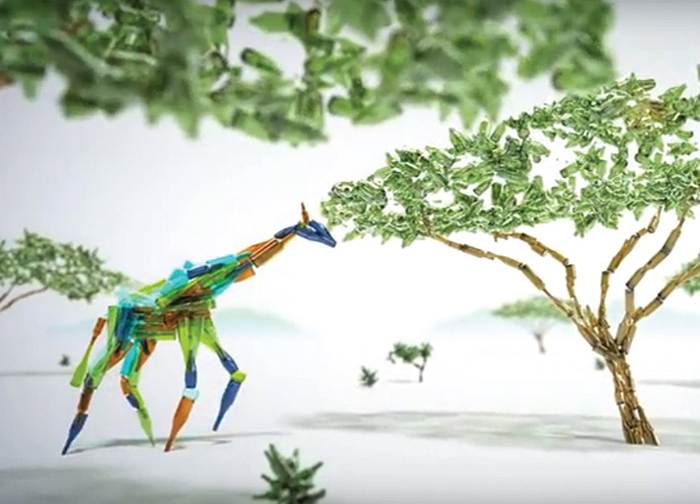
This is the premise of The Glass Recycling Company of South Africa’s (TGRC) latest ad campaign. It is a simulation of an idyllic Africa brought to life by glass bottles, revealing what is saved by what is recycled.

“When you put something in, you get something out,” is the theme behind the ad. TGRC CEO Shabeer Jhetam was inspired while conducting national research. “We found that consumers placed great importance on looking after our environment.” Therefore the advertisement needed to link and communicate the direct benefits of glass recycling.

The TVC was conceptualised with the South African advertising agency Tribe Sauce (TS), whose CEO Ant Hanly says: “We were faced with the challenge of creating a commercial that would break through the boredom of standard environmental communication.”

The ad was produced in Johannesburg by Stephen Hanly who said the task came with much difficulty. “In order to fully visualise the glass-banking metaphor, animation software programmes such as After Effects and Avid were used over a six-week period using 16 computers to render different parts of the commercial.” This was an enormous task as each bottle had to be rendered separately and then placed in position.

Animated in Ireland by Street Monkey (SM) who produced a trial animal (The Giraffe) so that they could test looks, environments and ways of rendering. “We worked for a week or more to narrow down a look. This Giraffe set the tone for the remainder of the job and allowed us to calculate timeframes for all aspects going forward,” says Dermot Faloon, director at SM.

“Once everyone was happy with the test concept the commercial was boarded out on paper by the agency, then roughly modelled using basic 3D shapes in our software Cinema4D. This gave us timings to work to and allowed the client to see a very rough version of the commercial.”

At the same time designers worked on the lighting and environment for the glass bottle animals to come alive. “The animals were all created as basic bone skeletons. In the 3D environment these invisible bones were used to attach the 3D bottles. This was a very tricky part. In conventional 3D character animation, we can bend and deform shapes to make arms and legs work, but this time we had to work with what essentially was a 3D jigsaw,” says Faloon.

“Rendering on this job was time consuming. It’s an unusual request as we had so many transparent, reflective, refractive objects at once. This pushed our render farm hard as we needed feedback every morning to make visual tweaks and amends. Visuals were being calculated 24 hours a day. Some of the more complex frames in this job took 40 to 50 minutes per frame to work out all the glass. Frames and scenes were internally swapped to suit skillsets across four employees,” says Faloon. He confirmed that client feedback was easy using Skype and email as they worked from their location in Belfast.

Faced with continuous challenges Ant Hanly explains: “Bringing the world together at the end was incredibly difficult as the shots cut from a close-up featuring both mother and baby elephant to a long shot of the Earth. This resulted in rendering millions of minute bottles from above so that one could visualise that glass recycling helps the Earth to become more environmentally stable.”

Jhetam from TGRC concludes: “The visualisation of glass recycling and its positive link to creating a sustainable world was done in so much detail, so that one can see that action is needed in order to bring about change.”

Kiss and create a stir in Kenya

In January Coca-Cola launched its largest global campaign in almost a decade.

The campaign in South Africa was launched early in March and is known by the tagline ‘Enjoy the Feeling’. While the global creative campaign has the tagline ‘Taste the Feeling,’ which replaces the seven-year-old ‘Open Happiness’ tag they have been using.

With the new campaign came the sugared surge of new commercials. However, Kenya was not too pleased with the ad selected for its TV stations. The Kenya Film Classification Board (KFCB), after receiving complaints in April, contacted the advertiser to remove what it deemed an offensive scene.

The scene in question was a three-second shot of two strangers who have a passionate embrace in a library. The film board warned the advertisers to consider whether children would be watching at the time the advert is aired.

The KFCB and the management of Coca Cola in Central, East & West Africa held a discussion about the campaign and agreed that the advert would be edited.

Head of communications at Coca-Cola Southern Africa, Zipporah Maubane confirmed that the advert referred to is not currently being aired in South Africa, as they chose to use a different version to the one being aired in other countries.

“Prior to broadcast in Kenya we received guidance from the KFCB and rating approval in line with their established classifications and our own responsible marketing guidelines and processes,” says Maubane. “However, following the request received from the KFCB, we have made a minor revision to one of the TV advertisements and a new version is currently being aired on the local electronic media channels.”

According to Eva Mbun, corporate communications at KFCB, the commercial was edited immediately. “It has been two weeks since the edited version aired on broadcast stations as required,” claims Mbun. The commercial remains the same, except it is now without the kissing scene. “The new version is without the offensive kissing scenes that violated family values,” she says.

“We’re committed to marketing in line with local guidelines and consumer values,” adds Maubane.

Considering that Coca-Cola can select from the campaign which commercials are run in which country, specifically by its local head office, it is interesting that they chose to delete the scene as opposed to running another ad. The SA version does not include any of the kissing scenes. While Coca-Cola confirmed it had not received any complaint from any other country, they could not confirm where the commercial with the kissing scene is being aired.

The fact that Coca-Cola Southern Africa chose to air a version without such passion and rather focus on the brotherly love bonding contained in the ad speaks for our broadcasters, or does it? Would SA have needed a similar amendment?15

The future of 4K at MultiChoice

The question around the globe is whether to move to Ultra High Definition 4K now or wait until industry standards have been finalised, which might only happen in 2017 or later. Where does that leave Africa?

After reports that 4K was not on the cards for MultiChoice, Screen Africa spoke to their broadcast technology division that confirmed that they have not made a definite decision whether or not to broadcast in 4K. “We are simply not offering it at present,” says Nyiko Shiburi, group general manager. “4K is still very new on the market and there is still much development that needs to be done before it can become a broadcasting standard.”

Shiburi confirmed that MultiChoice will keep an eye on international developments as standards for 4K broadcasting begin to emerge. In July 2015 broadcaster FujiTV became the first commercial broadcaster to start streaming 4K in Japan, with a commitment of 19 channels on air by 2018. There are eight channels available in Europe in 4K, India is testing in 4K and Sky Europe will start transmitting in 4K at the end of 2016 with assurances in the US that 4K broadcasting will commence this year.

“4K is still a developing technology internationally. 4K content is just emerging so true 4K content is currently rare. 4K is not just about higher resolution but also a high dynamic range and better colour. The standards for 4K broadcasting have not been fully developed yet and relatively few TVs offer HDR and better colour,” says Shiburi.

Ultra-High Definition 4K is very much the next step for broadcasters worldwide but when that step will be taken is still up in the air. In South Africa the scope of 4K television is still limited, so for now MultiChoice is focusing on expanding their HD offering. “We believe HD offers good quality viewing to our customers. Many South Africans, and DStv customers, still don’t have HD viewing in their homes. This is why we now offer HD on all our packages and have a single view HD decoder on the market, which is manufactured here in South Africa,” adds Shiburi.

As with all new technology, it is about setting clear standards and also getting the right equipment into customers’ homes. “Even though some international operators offer 3D broadcast, not many customers have got equipment capable of receiving 3D broadcasts, which is why this has not taken off to the extent it was originally predicted,” says Shiburi.

MultiChoice continues to follow new technologies and advancements and says for now HD is quite enough for South Africa. The question remains: do consumers want 4K and will they pay more for it?

New independent film puts Limpopo in the limelight

Shot over five days in Limpopo, Madimabe: The Phalaborwa Story is an unorthodox feature film produced using no script, and novice actors. Screen Africa caught up with fresh filmmaker and director Mofenyi Malepe to talk about the improvised Madimabe: The Phalaborwa Story and how it was shaped.

According to Malepe the film was shot on nearly no budget. “I took my last R4 000 and headed to Phalaborwa to meet up with the natural talent in the region. I explained to them that we do not even have budget for food, that’s how dedicated we were to make it happen.”

Shooting on Malepe’s Canon 5D Mark II, the crew used Rode NTG 2 microphone and Zoom 6 recorder for sound, which ended up being the biggest challenge they faced. “There was sound coming from every household, as we were shooting during the festive season and everyone was playing their home theatres up to planet Mars, but we managed to minimise the disturbance,” says Malepe.

It was shot between 29 December 2015 and 3 January 2016 in and around the Phalaborwa township called Namakgale, which Malepe says is Limpopo’s oldest township.

Why would a director choose to make a film with no script? Malepe explained, “Scripts tend to limit the thespians and talent. I already had my arcs in my head, so, it came to me that if explained better to the cast, then we had a better chance of executing the moral of the story effortlessly. I must say they came to the party, we can only grow from there.”

Malepe noticed a uniformity in the cast’s love of the story and said: “It probably invigorated their relatability. The direction I gave them was that they must not act but portray the characters at hand. For talented people, that became an easily digestible task.”

Malepe wanted to begin the journey of unearthing untapped talent in his hometown. “I spent a decade in front of the camera as the only actor from my town and it felt lonely hoisting the flag alone, it is time my people get their shine and we are going to do that as a clique.”

Inspired by a lack of dialogue among traditional and religious leaders, Malepe said “We are all shareholders of this thing we call life, so we must cohabit harmoniously and meet each other halfway. Dialogue is very crucial, if we fail to talk, we will perish because of lack of knowledge. Every individual can teach others.”

Moving back to Limpopo Malepe said: “I see myself bidding my goodbyes to ‘Johustleburg’ because we want

- Advertisement -
- Advertisement -
- Advertisement -

Pin It on Pinterest