


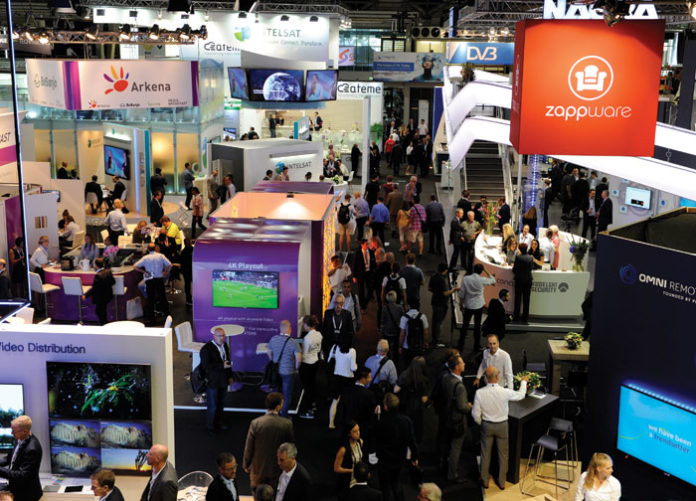
SCREEN AFRICA EXCLUSIVE: Michael Crimp, CEO of IBC, on the importance of trade shows; current industry trends and hot topics; and what visitors to IBC Show 2018 can look forward to…
WHY ARE TRADE SHOWS IMPORTANT, AND IN PARTICULAR WHY ARE TRADE SHOWS IMPORTANT IN OUR INDUSTRY? ARE WE SEEING A DROP IN INTEREST?
I still believe people have a real need to meet, to talk face to face. In our industry we are dealing in extremely complex systems that use technology to drive creativity and commerce. It is not the sort of industry where a quick Google search will find an off-the-shelf product, so getting together with multiple potential partners, in the right environment to do business, is really valuable.
If you look at the structure of the media and entertainment business, we have a tiny handful of really big suppliers, a few middle-sized vendors, and a long, long tail of small, specialised and extremely valuable companies. This structure has been around for as long as I have been in the industry, and it works.
One of the reasons that it works is that it depends upon collaboration which naturally feeds innovation. IBC is a great place for those collaborations to be incubated.
WHAT’S NEW AT IBC 2018?
Before I answer that, it is important to say what is the same: We still have 15 exhibition halls full of all the players in this rapidly changing industry. That includes some new and exciting businesses, like the Alibaba Group, based in China, and the sixth largest internet company in the world.
Also the same since the first IBC, 51 years ago, is the recognition that our visitors are seeking knowledge. They rely on IBC to provide the forum for information exchange, on the show floor, in the conference, and in the value added experiences and networking opportunities we create.
In turn, we are seeing exhibitors evolve in the way they present themselves. When IBC started, exhibitors were selling big devices: it was obvious what they did, and the captions alongside the big boxes talked in terms of technical specifications.
Today, large numbers of the products at IBC are software packages of some sort, whether running on dedicated hardware, standard computers or in the cloud. Exhibitors have to innovate to showcase their products and their unique selling points.
Smart exhibitors are finding new ways of telling their stories. We see many more putting theatres on their stands so they can present the philosophies behind their solutions, perhaps introducing users who have successfully adopted the technologies. It is all part of telling the story.
In the conference, too, we are finding new ways to tell the story. Our Global Gamechangers day, for instance, brings together people and roles as diverse as Mohamed Abuagla, CTO of Al Jazeera, and Peter Salmon, chief creative officer of Endemol Shine, the production company behind programmes as varied as Black Mirror and MasterChef.
The IBC Conference was founded on technical papers, and they remain absolutely central to the programme. This year, though, they are being woven more closely into broader sessions, so that the underlying technology is handled alongside the operational and business implications, putting all sides of the story in the same place.
WHAT ARE YOU MOST EXCITED ABOUT FOR IBC 2018?
Honestly, it is the opening (finally!) of the new North-South metro line. Now visitors will be able to get from central Amsterdam to the heart of the RAI in just a few minutes. It will be a great relief for those who dread the crowds on the number 4 tram, and it will slash journey times.
When you get off the new train, then you will see that we have transformed the conference programme. To create new impetus, we have a new conference steering group, chaired by Keith Underwood, COO of Channel 4 in the UK.
They have guided our team to create six new conference tracks focusing on the most pressing challenges. They have also added new formats into the conference, like breakfast briefings and lounge talks.
I have already mentioned the Global Gamechangers stage which kicks off the conference. There are also keynote presentations from the likes of Kelly Day of Viacom, Neal Mohan of YouTube, JB Perrette of Discovery, and former model and entrepreneur Lily Cole of Impossible.com.
WHAT ARE THE TECHNOLOGICAL TRENDS YOU ARE MOST EXCITED ABOUT?
It may be an odd thing to say, in a technological industry, but it is not the technologies themselves that are exciting. Certainly there are big things happening. I think we will see big advances in areas like artificial intelligence, 5G and blockchain.
But the real excitement comes when these raw technologies are put into action. IBC puts these ideas in front of people who can imagine the possibilities and create the applications that transform our creativity and our business models.
One of the IBC events I enjoy most is the awards ceremony on Sunday evening, and within that the IBC Innovation Awards. These mark the most successful completed projects of the year. Time after time the winners say that their projects started with conversations at IBC, when they saw the potential of new technologies and could see how to solve their own very specific challenges. That is worth getting excited about.
WHAT ARE SOME OF THE HOT TOPICS THAT WILL BE ADDRESSED DURING THE CONFERENCE?
We have six tracks through the conference this year:
- New platforms: innovators and disruptors
- Audiences: engage; influence; grow
- Smart connectivity and multi-play devices
- Advertising: the new attention economy
- Cutting edge tech innovators
- Nextgen: interactive and immersive experiences.
Within each of these streams we have some big names who have pioneered new approaches and guided their businesses to successful achievements.
Alongside these are some special events, including our popular Leaders’ Forum and CTO-level days on cyber-security and the convergence of media and telecoms, plus the Gamechangers Stage and popular regulars like What Caught My Eye and the IBC Big Screen events.
The whole conference programme has been very carefully designed to tell a story, to guide the visitor through the whole IBC experience. In turn, I see that the industry is no longer bound by its technology, but by the desire to find new and engaging ways to tell stories, and to monetise those efforts fairly and equitably. Those, I think, will be the key messages debated at IBC this year.
WHAT ARE THE HOTTEST TRENDS IN THE INDUSTRY AT THE MOMENT?
I think the top trends are well established and you do not need me to talk about the shift to IP connectivity and software-defined topologies; about the convergence of broadcast, IT and telecoms; and about the search for new formats, whether that is Ultra HD or virtual reality.
What is exciting is the way that the business that uses these technologies is changing. How will broadcasters, telcos and streaming companies co-exist? Will OTT providers be the new broadcasters, or will producers sell direct to consumers? These are the sorts of questions that are debated at IBC.
Advertising still seems a reliable and lucrative way to fund content production and delivery. Will programmatic advertising planning and dynamic ad insertion transform the cost/revenue model? Or will new monetisation methods – maybe blockchain-managed micropayments from consumer to producer – transform the creative industry?
These issues may not be solved at IBC 2018, but they will be much talked about.
HOW ARE THE ATTENDEES AND COMPANIES PARTICIPATING IN IBC CHANGING?
The last stage of development in IBC was a move away from an engineering-based event to one which attracts debate from the creative, operational and commercial sides of media businesses. Today that sweeping approach to all the issues makes IBC the natural forum for those in adjacent industries which are adopting our skills and technologies.
So we have specialist days in the conference which attract those from the telecoms industry, for example, or those charged with managing cyber-security. Where appropriate, IBC creates a hosted programme to bring leaders from adjacent industries into the event and into the community.
HOW DO YOU ENSURE THE CONTENT AT IBC STAYS FRESH YEAR ON YEAR?
By listening. We do not say it as often as we used to, but IBC is organised by the industry for the industry. Through bodies like our content steering group and the IBC Council we get input from those, around the world, who are leading the industry today.
These create a halo effect. Keith Underwood, this year’s guest chair for the content steering group, brought in some of his own contacts, and talked to others. Having access to high level address books in this way brings us a huge amount of insight.
At the same time, we drive the agenda from within, looking to influence the industry on a wider basis. This year, for example, we are concentrating hard on diversity, in age, gender and race. It is important to the whole team that we lead in showing the world we are an inclusive industry.
WHAT ARE THE HIGHLIGHTS OF THE IBC INNOVATION AWARDS?
The IBC Innovation Awards are a perfect encapsulation of everything we think is good about IBC. They reward not pure technology, but the way that end users and technology partners work together to achieve a practical and satisfying solution to a real world challenge.
This year’s shortlist sees 10 projects up for the three awards – and those 10 finalists come from at least 10 countries (there are a couple of multi-national projects in there). They come from five continents: Africa, America, Asia, Australasia and Europe.
I know that they include sport and news, multi-lingual production and multi-national delivery, new ways of engaging audiences and new business models to maximise revenues. As a sports fan, I am personally delighted that half of them are from the world of sport – rallying to skiing.
HOW IMPORTANT ARE NON-EUROPEAN VISITORS TO IBC?
They are vital to the success: why wouldn’t they be? IBC happens to be held in Europe but it is a global event. Each year we welcome visitors from around more than 170 countries.
