


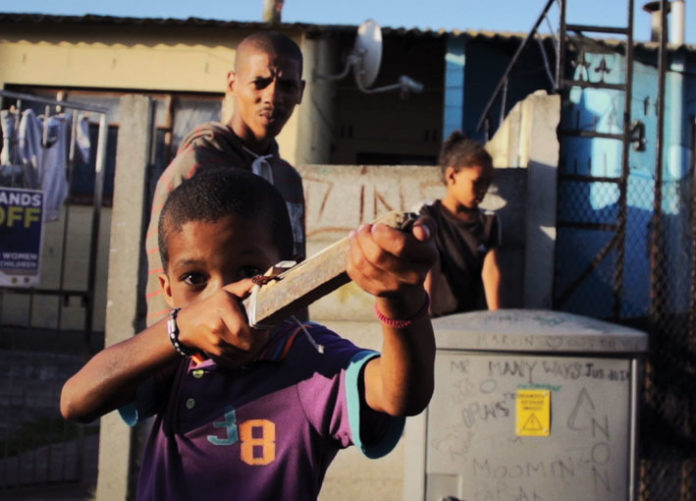
Finding Freedom follows two parolees from Cape Town, as they redefine life after prison. Filmmakers captured the experience of protagonist Franklin Esau shooting his first music video. This was a fulfilment of a dream of his and was shot in his hometown of Elsies River, which has become notorious gang territory.
In addition to Franklin, they were also filming the community, an approach that allowed them to film this shot of the boy with a toy gun. This scene had an unforeseen wrap when an actual gun played a real role in the film.
Roxanne Dalton on directing
The film is an exploration of rehabilitation and a meditation on freedom. It oscillates between interviews and hand held observational scenes where we allowed events to happen as naturally as they could with us being there. We followed Franklin Esau and Malcolm Booysen for more than a year. This scene takes place just over half way through the film. Esau is deeply loved and respected in the community, especially as he is now focused on giving back and uplifting younger musicians. This meant we felt quite safe when filming with him in Elsies.
We had a larger crew than normal on this particular day, since I arranged that we would help film the music video itself, while the DOP would be capturing the process as it unfolded. We only filmed in the day and avoided filming when it got dark. Elsies River and Ocean View are two communities that we focus on in the film, and they both become an extension of the two protagonists. When filming our focus was not only the two protagonists in their environment, but also the environments themselves, and we were always on the lookout for moments that spoke to the experience of living there. One of the biggest challenges with this scene was crowd control. We tackled that by incorporating some of the community to help.
Roxanne Dalton on production design
The decision to incorporate slow-motion filming speaks to the feeling of a suspension of time that is often described in moments of extreme danger or complete freedom and ecstasy. The slow motion footage is a technique to physically slow time. This creates an interesting effect within the reality being presented through the documentary form. It is as if the world is holding its breath; there is a pause created where one can observe more closely. The shot of the boy with the toy gun is one such moment captured in slow motion. We see him in the montage following the gunshots that were fired while we were filming the music video.
We were always on guard in Elsies, and stuck together. What was great about filming there was the vibrancy both in colour and in the people. It was clear that Franklin was loved and admired, which meant we were able to capture many poignant moments in the community. This was Franklin’s moment. None of us foresaw it ending in an actual shootout.
Roxanne Dalton on editing
At the end of the shooting process of the entire film, we had about four TB of footage to go through, which made the edit process incredibly difficult. The film was very much made in the edit, and it became clear early on that this scene would become the climax of the film. Since the shoot ended so abruptly, we ended up filming the music video again at a much later date. In the edit I decided to combine both music video shoots as one, and intercut them with Malcolm experiencing his ultimate passion of spinning cars in a spin pitch in Strandfontein.
The nature of a music video is multiple outfit changes and location changes, so continuity when editing this scene, wasn’t a problem. Our DOP had been rolling when the gunshots occurred and captured Franklin telling us we had to leave. These shots served as a natural end to the sequence. Grading was done by Regard Voges using Davinci Resolve. And he tried as much as possible to match the grade as I had roughly done during the edit in FCP 7.
Michael Everard on cinematography
We used the Canon 5D Mark III, with the Sony FS700 for slow motion. The 5D is a great, light, and fairly inconspicuous as cameras go. It also captures a great image and can handle various lighting situations. This scene was shot entirely using natural light. We wanted to go for realism as well as practicality when shooting in Elsies.
The environment and atmosphere of Elsies both make this scene what it is and presented the biggest challenge in terms of shooting. I think the big trick was just to allow the environment to mould the filming rather than trying to force it to present what we were hoping to capture. There is very little control when shooting in these conditions, but in many ways this is when the best content presents itself.
Going back was definitely a different feeling, a heightened awareness and alertness that I didn’t have before. I guess knowing first hand that gang shootouts really can happen anywhere and any time does change your sense of security. That said my camera provides a sense of security and an ability to focus on the task at hand without worrying excessively about what is going on around me.
While violence is a reality and a serious social issue, there is also a considerable amount of hope and life in these communities which I would never have experienced had we not shot this scene.
Wayne C. Simpson on sound
The scene immediately felt like a point of reflection for me as the composer and I wanted the viewer to know that. Themes of hope run through much of the film, but this scene injects some reality. Slow motion scenes suspend time and give us a chance to reflect and this was my starting point with the score.
The piano I used, along with the strings sound broken and worn somehow. There was a strong parallel between what I was trying to communicate and my own process of writing. The cue is written in Dorian mode and avoids a feeling of rest anywhere. The whole cue feels like its suspended, like a chunk of time that was cut out.
Limited resources definitely were a challenge. Creativity is just problem solving and having too many possibilities could stifle workflow. My process felt like a parallel to Franklin and Malcom’s life after prison. You just make it work.
Franklin Esau and Malcolm Booysen on Elsies
Franklin Esau: Although I was excited about filming my music video, I was feeling protective for I know in the neighbourhood I grew up in, violence erupts at any moment. I had my eyes on the crew the whole time so that they didn’t get robbed. Luckily music is in my blood so it did not affect my performance on camera. When the shots went off, then got louder and closer, I was looking for each one of the crew. Rounding them up, explaining we needed to get going.
As you see in this image of the young boy holding a toy gun, he has no choice but to accept gun violence as a normal event of the day. This violence has an impact on your moral compass. To have held a real gun as a child adds to the destruction of the community, it is too easy to fall victim to gangsterism and drugs. I think we must educate our youth and steer them towards building positive pillars in the community.
Malcolm Booysen: When the shooting took place it was good and bad for me. Good, because that shows how dangerous our communities are even during daylight. People who see the film also feel what it’s like living in these difficult circumstances. Bad, because our kids are at risk of the dangers that reside there.
