


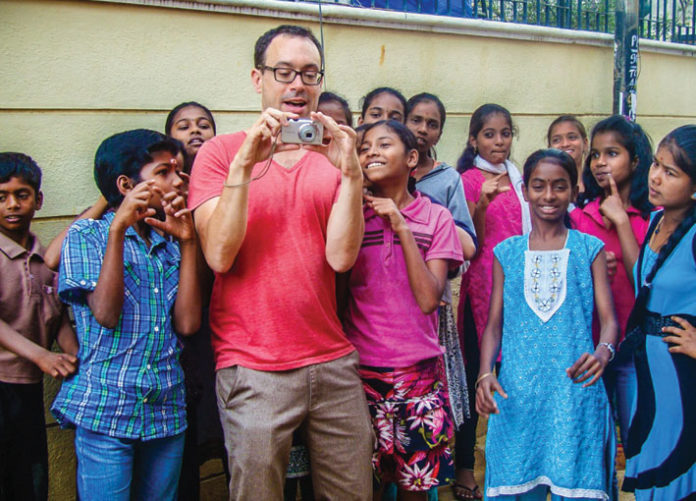
Through the sharing of native narratives, the universal medium of storytelling allows people to better understand one another and greater appreciate diversities. Ensuring that limitations and lack of equipment are not a deterrent, filmmaker Steve Clack takes workshops around the world, to show how one can use what they have to tell their story to the world.
New York based Bent Marble offered a free documentary filmmaking workshop to Zanzibar International Film Festival (ZIFF) groups. Founder Clack says his company offers courses that foster multicultural understanding through empowering people to create their own digital stories with the resources they already possess. Bent Marble focus on locations and communities that don’t normally have access to training in filmmaking and the digital arts.
“The workshops at ZIFF were a great success,” says Clack. His workshop focuses on training in how to make a documentary, including all stages of pre-production, production, and post-production. “I was extremely impressed with the initiative participants showed, the depth and breadth of the topics they chose, and the extent to which they helped each other through this challenging process,” he adds.
Clack says a unique challenge at the ZIFF workshops was that there were many participants who did not speak English. “To date I have always taught workshops in languages in which I am fluent (English, Spanish, and Indonesian), and this marked the first time that we needed to enlist the help of a translator, who was only available for the first two days. With the translator’s assistance we got through day one, which was a big day of film idea development and production skills training. And on subsequent days, specific students who were fluent in English and Swahili helped their fellows and their instructor, by providing on-the-spot translation when needed. It was truly a beautiful thing how much we helped each other and how well it worked.”
Clack says the final films produced in the workshops were impressive, “and definitely among the best that have been produced by any workshop group I’ve facilitated to date,” and these new works were shown on the big screen at ZIFF on the final night.
Facing mostly fiscal challenges Clack funds the workshops himself and collaborates with initiatives within the country they seek to serve, namely Livity Africa in Johannesburg SA and Art for Social Change in Kampala, Uganda. “To date I have taught around 14 complete workshop series, as well as several topic specific master classes in editing, sound recording, and documentary camera work in different countries including Russia, Indonesia, the Philippines, India, Uganda, Tanzania, South Africa, and Colombia. And I plan on taking our workshops to West Africa over the coming months,” says Clack.
Besides using the technological resources workshop participants already possess, Clack strives to take advantage of the vast experience and know-how that already exists in each workshop. “Our group at ZIFF had folks who were highly skilled in areas such as sound recording and design, and video editing. And these participants were extremely generous in sharing what they knew to help their fellow filmmakers in the workshops,” says Clack.
Hollywood based veteran cinematographer Barry Braverman led a camera and visual storytelling workshop at ZIFF. “The hunger for knowledge in this part of the world never ceases to amaze me as my students demonstrate an eagerness to learn and practise the fundamental lessons of good visual storytelling and effective camera operation,” he says. Besides offering cinematography courses at ZIFF for four years, he has done them in 29 countries around the world.
“You can’t just bring your skills in and apply them, because they don’t have resources and so you have to adjust your methods to accommodate the conditions,” Braverman explains. “The thing about Zanzibar is that there is a lot of light out there but little indoors, and so one of the things is to use very simple solutions to complex problems.” The use of mirrors and passive lighting was his solution. “When you go on the streets its very bright and it’s also very dark in the same scene and they are using SLR cameras to do video, which are not video cameras and they do not have the ability to capture a lot of detail both in the highlights and in the shadows at the same time, so that’s why I taught them to shoot late in the day when the sun is off the buildings and out of the alleys, then it looks great,” he says. Without a sophisticated camera Braverman says it is best to adjust and shoot early morning or late in the day. “The biggest problem is not technical. As you saw from the festival, audiences will accept all kinds of problems technically if they are engaged in the story. So story always takes priority. That’s why even in the camera class, it is all about story,” confirms Braverman.
Clack hopes to return and turn his former students into workshop facilitators themselves. He also hopes to improve fundraising so he can continue offering free workshops around the world, “as well as eventually have not one, but preferably three or four workshop facilitators travelling the globe, helping people make and share their stories in the modern form of the ancient art of storytelling that is filmmaking,” says Clack.
