


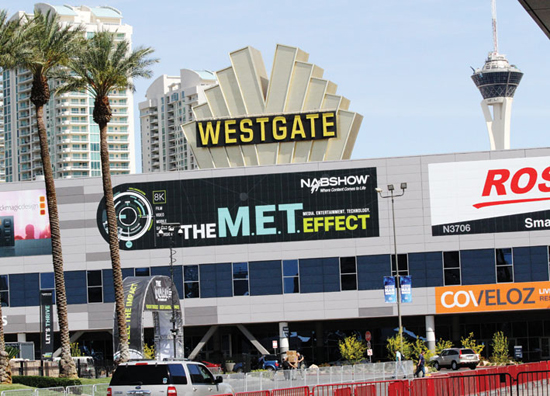
In Elvis Presley’s ode to Las Vegas he chanted: “Bright light city gonna set my soul on fire, got a whole lot of money that’s ready to burn, so get those stakes up higher.” The stakes were indeed high at NAB 2017 and 103 433 visitors packed the 1 million square metre exhibition space, which has become familiar territory for those attending the world’s largest event focused on the intersection of technology, media and entertainment.
The overall theme of NAB 2017 was The M.E.T. Effect – the result of three once distinct fields of media, entertainment and technology, converging and becoming something far greater than the sum of their parts. The Exhibits and Education Programme at the 2017 NAB Show was specifically tailored to showcase all aspects of The M.E.T. Effect and its impact on the Media and Entertainment industries with great success. This year’s conference sessions revealed no real surprises, but the content always generates some excitement especially in the ‘Super Sessions’.
In the first-ever live 4K video stream from space during the Super Session: Reaching for the Stars: Connecting to the Future with NASA and Hollywood, NASA astronaut and International Space Station (ISS) commander Dr. Peggy Whitson and NASA astronaut Jack Fischer conversed live from the ISS. The event utilised a RED Epic Dragon camera and a UHD-capable video encoder opening up a whole new chapter in live broadcasting from the space station, providing a powerful new tool to support science and research.
In the past few years at NAB, Ultra HD was the featured video technology. At this year’s show, high dynamic range (HDR) moved to centre stage. From production, to streaming, to the television, the industry is working to fill the holes in the value chain of delivery. Though there are many HDR standards, the conversation at NAB seemed to focus on just two: HDR10 and Dolby Vision. There couldn’t have been a better example of the future of HDR with Sony’s display of their new hi-tech display monitor – the Canvas.
The impressive 8K by 2K, 9m x 3m Canvas uses surface-mounted light sources that Sony is calling Ultrafine LEDs, to drive large the high-contrast and HDR-ready display. The picture quality was amazing and this kind of technology could well replace the digital projector in cinemas sooner than we think.
The over-the-top video (OTT) trend has been gaining momentum for years, as Netflix, Amazon, Hulu and other companies demonstrate the demand for streaming video. But the trend took on a new dimension this year as internet giants like Google and Facebook used the show to highlight their own work in the broadcasting industry. The growth of social video has had content creators, media brands, and marketers rethinking production and distribution. Facebook has emerged as one of the most impactful players in this space – and the platform continues to evolve as publishers learn how to better leverage it.
The 2017 NAB Facebook Boot Camp featured presentations from Facebook staff, as well as creators who have found success on the platform. There were hundreds of practical tips, insightful data and best practices discussed to help publishers make the most out of this new and exciting global broadcast platform. Google hosted a number of sessions at NAB to discuss its virtual reality video efforts as well as its web video production and advertising technologies. Is this the future of television unfolding before us?
2017 is shaping up to be a real turning point for media-over-IP standards and practices, with the SMPTE ST 2100 standard inching closer to completion and a growing number of media facilities building real-time IP production into their infrastructures. A number of major North American and European broadcast companies have indicated that they will commence real-time IP production infrastructure projects this year.
With over 1 800 companies exhibiting their wares in the vast halls and corridors of the Las Vegas Convention Centre, it was a tough task getting to see everything over four days. There is a lot of new innovation out there, far too much to mention in a single sitting so I have chosen but a few of the items that caught my eye this year.
CAMERAS
This is a little beauty. Sony’s new UMC-S3C 4K camera offers an astonishing 0.004lx, expandable to ISO 50-409600 range on its full-frame 35mm Exmor sensor. The camera is compatible with E-mount lenses and can capture smooth 4K/29.97P/25P colour video in almost pitch-black conditions, from night-time starlight to poorly lit rooms. It’s extremely compact size and on-board recording capability make the camera ideal for remote PoV (Point of View), documentaries, wildlife and live action shooting, plus challenging environments where cabling or space are limited.
HDR
A great addition to the monitor market from Australian innovators Atmos. They have continued their push into HDR monitoring with the super-sized 19-inch Sumo monitor-recorder, rated as a 1200-nit 10+ stop panel on a box offering 4K 12-bit raw or 10-bit ProRes or DNxHR recording. And because of its size, the Sumo is being promoted as a solution for on-set workflow as well as an HDR grading monitor.
360/VIRTUAL REALITY
Everyone’s favourite action camera company GoPro were showing off Fusion, a 5.2K 30 fps spherical camera. Aimed for virtual reality environments, the Fusion features a new OverCapture creative solution that gives content creators the flexibility to produce conventional non-VR video and photos in HD quality.
360° video has been on the rise of late, with more and more 360° camera rigs from established companies entering the space. Vimeo’s new 360° service launched at NAB does not simply introduce new features for videos on the site, but it also now supports the new content type. With 360° file sizes commonly four times larger than “flat” video, Vimeo’s support of uploads up to 8K and is the no-brainer destination for 360° creators.
LIGHTING
There weren’t too many products that stopped me in my tracks at NAB, but this one from a burgeoning start-up company got me intrigued: Illuminati’s wireless, smartphone-connected light and colour ambient and strobe meter. The meter takes an ambient reading of your location and sends stats straight to your phone. Unlike traditional light meters, however, it’s not just taking exposure readings; it also measures the colour temperature and even chromaticity of your ambient so you can correct magenta/green shifts. Pretty cool!
DRONES
Content creators are always looking for fresh perspectives and new angles to propel their projects to new heights. The NAB Aerial Robotics and Drone Pavilion always delivers. Whist GoPro was pushing the reborn Karma in a desperate attempt to save face following its earlier model that kept crashing, it was DJI who stole the show with their drone innovation and their first 100-megapixel integrated drone imaging platform. The DJI M600 Pro drone, the ultra-smooth Ronin-MX gimbal and the Hasselblad H6D-100c camera was demoed as an unprecedented tool for precise, detailed and accurate aerial imaging. You will need to win the lotto to get this one but is just goes to show how the drone industry is changing and there are already murmurs of US news channels replacing their live ‘news copters’ for drones.
DJI is improving that smooth silky look for ground images too. The latest from DJI, the Ronin 2, is a 3-axis camera stabiliser based on the company’s transformative gimbal technology, providing more power and torque to carry larger cameras. With an enlarged camera cage and 50mm extendable arms, its versatility can support everything from DSLRs to full cinematic camera and lenses up to 30 lbs.
AUDIO
Sennheiser released its MKE 2 microphone for GoPro. The microphone is completely waterproof up to 1-metre and the included windjammer has been tested at speeds up to 100 kph to help reduce any unwanted ambient noise. It’s quick to install and perfect for HERO4 cameras, a version for the HERO5 is in the making, great for those surfing videos.
Tiny package, big punch! If you’re a sound recordist, you already know what radio frequency (RF) interference can do to a production track. The ZAXCOM ZFR400 is a standalone device that records professional Broadcast Wave Format (BWF) or MP3 files directly to an internal micro-SD card. Measuring just 55.8mm x 40.6mm x 14mm and weighing 62g with the battery, it’s ideal for wiring talent when wireless transmission is unfavourable or when distance is an issue. The included rechargeable battery provides up to ten hours of runtime. This is a truly innovative device that you need in your sound kit.
Whenever I walked past, there were queues of enthusiasts at the Sound Devices stand eyeing out their new MixPre-3 and MixPre-6 multi-function audio devices. The MixPre series give you a mixer, a recorder, and a computer audio interface, all in one rugged box that will fit under your camera at a really reasonable price point and quality that is just unmatched. I’ve never seen a product generate such interest, everybody wanted one!
STUDIO
Blackmagic wowed the crowds with its first of a kind ATEM Television Studio Pro HD. It’s a hardware control panel with the controls on it, and the inputs on the back of the unit so it’s more of a traditional, table top-type design. It has eight 1920x1080p60 HD-SDI inputs, and four of them can be switched to HDMI. Also, if you’re using Blackmagic cameras, you have controls for secondary colour correction. It also has tally and talkback. Well done Blackmagic Design for another innovative product.
POST-PRODUCTION
On the software front, there were three industry role players who had big announcements at NAB this year.
Blackmagic’s mission has been to make DaVinci Resolve a one-stop-shop for colour grading, editing and audio – what, did I hear you correctly…audio! Oh yes indeed, DaVinci Resolve 14 now features a powerful post-production audio tool for film and broadcast. Basic features include sound editing, mixing and routing, professional bussing and multi-format mastering to 3D audio formats like 5.1, 7.1 Dolby and 22.2. Not only that—Blackmagic is dropping the price of the software from $999 to a $299 license and doing away with dongles. I have to make mention too of Blackmagic’s DaVinci Resolve Micro Panel – a high quality, portable low profile panel that features three high resolution trackballs and 12 precision machined control knobs for accessing all essential primary colour correction tools, perfect for independent editors and colourists that need a truly portable solution.
Avid announced the release of Avid Media Composer®. First, a free version of the industry-standard video editing system. It’s powered by the Avid MediaCentral® Platform, so “First” users can also easily connect and collaborate with other aspiring creative and media professionals through the Avid Artist Community. The free version is limited however with four video tracks, eight audio tracks, and a host of built-in visual effects, transitions, colour correction presets and titling templates.
Not to be upstaged Adobe Systems released a major update for video in Adobe Creative Cloud delivering new features for graphics and titling, animation, polishing audio and sharing assets; support for the latest video formats, such as HDR, VR and 4K; new integrations with Adobe Stock; and advanced artificial intelligence capabilities powered by Adobe Sensei. From what I have seen this huge upgrade puts Adobe (who are also celebrating their 25th anniversary) into a league of their own.
UNTIL NEXT TIME
The NAB organisers wrapped it up perfectly, “Technology is evolving faster than humankind itself and we’re living in a world of our own invention. Behaviour and business have merged to redefine content, workflows and revenue streams, fuelled by hybrid solutions and boundless connectivity that’s changing the very nature of how we live, work and play.” NAB is an exciting platform that offers an insight to the ways our industry is growing, adapting and transforming in an ever-changing world. In the words of the King himself’ “Viva Las Vegas!”
